The minimum loft insulation thickness in UK homes is 270 mm
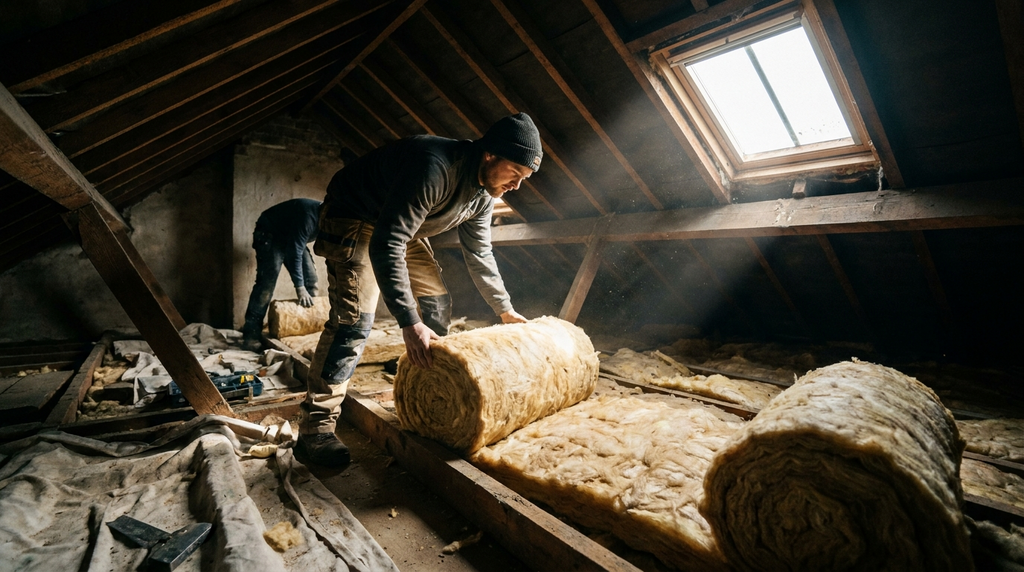
The Energy Saving Trust recommends 270 mm of mineral wool loft insulation as the minimum for most UK homes. This figure comes from the Building Regulations Approved Document L (2021 edition, updated for 2026), which sets the target U-value for loft insulation at 0.16 W/m²K (GOV.UK, 2026). For homes with existing insulation, topping up to reach this thickness is often more cost-effective than a full replacement.
The minimum loft insulation thickness in UK homes is 270 mm for mineral wool, based on the Building Regulations target U-value of 0.16 W/m²K. Higher-performance materials like PIR boards need less thickness to achieve the same result. Check your current insulation and top up if needed.
- Minimum loft insulation thickness is 270 mm for mineral wool.
- Building Regulations target a U-value of 0.16 W/m²K for lofts.
- PIR foam boards achieve same U-value with 150–180 mm thickness.
- Topping up existing insulation is often more cost-effective than replacing.
- Use the Energy Saving Trust calculator to estimate your savings.
- The minimum loft insulation thickness in UK homes is 270 mm
- How U-values and thickness relate to your loft insulation decision
- Quick numbers thickness, cost, and savings for loft insulation
- How much loft insulation thickness you need for your specific home
- When loft insulation thickness is not enough, other factors to check
- How to verify your loft insulation installer is certified and eligible for grants
Different insulation materials have different thermal conductivities, so thickness alone is not the only factor, the U-value target is the key metric. Mineral wool typically has a conductivity around 0.044 W/m²K, while higher-performance materials like PIR foam boards can achieve the same U-value with less thickness (Energy Saving Trust, 2026).
How U-values and thickness relate to your loft insulation decision
U-value (measured in W/m²K) is the rate of heat loss through a material, lower is better. A target of 0.16 W/m²K for lofts is set by the Department for Energy Security and Net Zero (DESNZ) via the Building Regulations (GOV.UK, 2026). For mineral wool with a conductivity of about 0.044 W/m²K, achieving 0.16 W/m²K requires roughly 270 mm thickness. For higher-performance materials like PIR foam boards (conductivity around 0.022 W/m²K), the same U-value may be reached with only 150–180 mm thickness, this affects headroom in confined lofts (BRE, 2026).
The Energy Saving Trust calculator tool lets homeowners input their current insulation thickness and property type to estimate savings, this is the most accurate way to determine needed thickness for your home (Energy Saving Trust, 2026).
Quick numbers thickness, cost, and savings for loft insulation
| Property type | Recommended thickness (mineral wool) | Typical cost (DIY, 2026) | Typical annual saving on energy bills (EST) | Payback period |
|---|---|---|---|---|
| Detached house | 270 mm | £300–£400 | Up to £500 | Under 2 years |
| Semi-detached house | 270 mm | £200–£300 | Up to £300 | Under 2 years |
| Mid-terrace house | 270 mm | £150–£250 | Up to £200 | Under 2 years |
| Flat (top floor) | 270 mm | £100–£200 | Up to £150 | Under 2 years |
Source for savings: Energy Saving Trust loft insulation calculator data, 2026 (Energy Saving Trust, 2026). Source for costs: EST guide to loft insulation costs, updated 2026 (Energy Saving Trust, 2026). Source for payback estimates: Derived from EST savings and typical costs; assumes current energy price cap (Ofgem, Q1 2026) (Ofgem, 2026).
How much loft insulation thickness you need for your specific home
The direct answer: for most UK homes, the recommended thickness is 270 mm of mineral wool or equivalent U-value (0.16 W/m²K). If your loft already has insulation, measure its depth, if it is less than 100 mm, topping up to 270 mm is highly cost-effective. If it is 150–200 mm, topping up may still be worthwhile but with a longer payback (Energy Saving Trust, 2026).
For homes with limited headroom (e.g., converted lofts with low rafters), consider high-performance rigid boards (PIR) which need less thickness to achieve the same U-value. If you have a cold roof (insulation at ceiling level) versus a warm roof (insulation at rafter level), the thickness requirement changes, cold roofs typically need 270 mm at ceiling level; warm roofs need insulation between rafters and above, often 150–200 mm total thickness (BRE, 2026). guide to cold roof vs warm roof insulation
When loft insulation thickness is not enough, other factors to check
Air gaps and compression can reduce insulation effectiveness by up to 50% (Energy Saving Trust, 2026). Ensure insulation is laid evenly, not compressed by stored items or wiring. Ventilation is critical: a 270 mm layer of mineral wool can block soffit vents, leading to condensation and mould. The National House-Building Council (NHBC) recommends maintaining a 50 mm air gap between insulation and roof felt (NHBC, 2026).
If your loft has a water tank or pipes, they must be insulated separately (lagging) to prevent freezing, this is not covered by loft insulation thickness. For homes with a flat roof, insulation thickness requirements differ (typically 150–200 mm of PIR), as they are insulated at the roof deck level, not at ceiling level (Energy Saving Trust, 2026). how to insulate flat roofs properly
How to verify your loft insulation installer is certified and eligible for grants
For loft insulation installation, the installer must be registered with TrustMark (for government schemes like ECO4) and hold a relevant certification. For mineral wool, this is often under the National Insulation Association (NIA) or the Cavity Insulation Guarantee Agency (CIGA) for related work (TrustMark, 2026). If you are using rigid boards (PIR), the installer should be registered with BBA (British Board of Agrément) or similar for product compliance (BBA, 2026).
For grants under the Energy Company Obligation (ECO4) scheme, installation must be done by a TrustMark-registered installer. For standalone loft insulation, MCS certification is not required, TrustMark and NIA registration are the key checks (GOV.UK, 2026). To verify, use the TrustMark website’s “Find a Tradesperson” tool or the NIA’s “Find an Installer” directory. Always ask for proof of certification before work begins.
Frequently Asked Questions
The minimum loft insulation thickness for UK homes is 270 mm for mineral wool, as recommended by the Energy Saving Trust to meet Building Regulations target U-value of 0.16 W/m²K (GOV.UK, 2026).
DIY loft insulation costs between £300 and £400 for a detached house in 2026, according to the Energy Saving Trust. Professional installation adds labour costs.
Yes, topping up existing loft insulation to reach 270 mm thickness is often more cost-effective than full replacement, per the Energy Saving Trust. Ensure the existing layer is in good condition first.
The target U-value for loft insulation is 0.16 W/m²K, set by the Department for Energy Security and Net Zero via Building Regulations (GOV.UK, 2026). Lower U-values mean better thermal performance.
Loft insulation can save up to £300 per year on energy bills for a detached house, according to the Energy Saving Trust. Savings depend on your current insulation thickness and property type.