How much loft insulation do I need calculator
If you are trying to work out how much loft insulation to buy for your home, the answer depends on your loft area, the material you choose, and the target depth required by building regulations. The most common question homeowners ask is how many rolls or sheets they need to order.
Most UK homes need 270mm of mineral wool loft insulation, or the thermal equivalent of a U-value of 0.16 W/m²K. For a 60m² semi-detached loft, that means about 18 standard rolls costing roughly £400 if you DIY install.
- Use 270mm mineral wool or equivalent U-value of 0.16 W/m²K.
- For a 60m² loft, buy 18 standard rolls of 100mm mineral wool.
- DIY mineral wool costs about £400 for a typical semi-detached home.
- Rigid foam boards need only 150mm depth but cost £900 professionally.
- Sheep's wool costs 50% more per square metre than mineral wool.
- How much loft insulation do I need calculator
- What 270mm of loft insulation saves you
- The recommended depth for loft insulation in 2026 is 270mm of mineral wool or the equivalent U-value of 0.16 W/m²K
- Quick numbers loft insulation thickness, cost, and energy savings by house type
- How to calculate the number of insulation rolls you need for your loft
- The direct answer to 'how much loft insulation do I need', 270mm of mineral wool or the thermal equivalent
- Eligibility and installer certification for loft insulation work
- The payback timeline for loft insulation depends on your fuel type and house size
The direct answer for most UK homes is 270mm of mineral wool insulation, or the thermal equivalent of a U-value of 0.16 W/m²K. For a typical 60m² semi-detached loft, that means around 18 standard rolls of 100mm mineral wool laid in three layers, costing roughly £400 if you DIY install.
What 270mm of loft insulation saves you
A 270mm layer of mineral-wool loft insulation can cut annual heating bills by roughly £300 compared with an uninsulated loft (Energy Saving Trust, 2026). The exact saving depends on your house size, fuel type, and current insulation level, but this figure applies to a typical gas-heated semi-detached home.
The three main insulation materials available are mineral wool (glass or rock fibre), sheep’s wool, and rigid foam boards (PIR or PUR). Each has different costs, thermal performance, and ease of DIY installation. Mineral wool is the cheapest and easiest to cut and fit between joists, but requires the greatest depth. Rigid foam boards achieve the same U-value at roughly half the thickness, but cost more per square metre and need more careful cutting. Sheep’s wool is a natural alternative that performs similarly to mineral wool but costs around 50% more per square metre.
The core decision is between depth and material. Mineral wool needs 270mm to meet Building Regulations, while rigid boards can achieve the same U-value at 150mm. For a 60m² loft, mineral wool DIY costs about £400, while rigid boards installed professionally cost roughly £900 (DESNZ, 2026).
The recommended depth for loft insulation in 2026 is 270mm of mineral wool or the equivalent U-value of 0.16 W/m²K
Building Regulations Part L (2021 edition, effective 2022, still current in 2026) set the minimum loft-insulation U-value at 0.16 W/m²K for new builds and material changes (GOV.UK, 2026). The U-value measures how much heat passes through a material, so a lower number means better insulation.
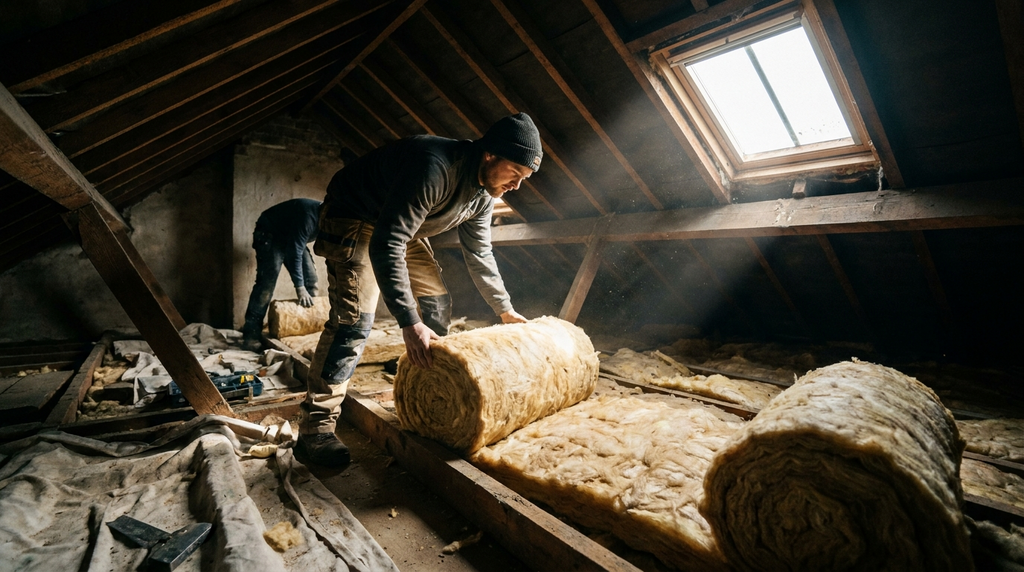
For mineral-wool rolls, achieving 0.16 W/m²K means a total depth of 270mm. This is typically done by laying 100mm between the joists and then 170mm over the top, crossing the joist direction to cover gaps. For rigid foam boards (PIR/PUR), the same U-value requires around 150mm thickness because the material has a lower thermal conductivity.
The “how much loft insulation do I need” calculator on GOV.UK’s Energy Performance of Buildings page (DESNZ, 2026) lets homeowners input loft area and joist spacing to get a square metre figure and roll count. The calculator also accounts for the fact that you need to insulate the loft hatch and any pipes or tanks in the loft space.
Quick numbers loft insulation thickness, cost, and energy savings by house type
| House type | Typical loft area (m²) | Recommended mineral-wool depth (mm) | DIY material cost (£) | Annual saving (£, EST 2026) | Payback period (years) |
|---|---|---|---|---|---|
| Detached | 80 | 270 | £530 | £400 | 1.3 |
| Semi-detached | 60 | 270 | £400 | £300 | 1.3 |
| Mid-terrace | 45 | 270 | £300 | £225 | 1.3 |
| Bungalow | 70 | 270 | £465 | £350 | 1.3 |
Savings figures come from the Energy Saving Trust “Loft insulation savings per property type” report, 2026 (Energy Saving Trust, 2026). Costs assume DIY installation with standard 100mm mineral wool rolls. Payback periods are based on gas heating at 2026 Ofgem price cap rates (Ofgem, 2026).
How to calculate the number of insulation rolls you need for your loft
Start by measuring the loft floor area in metres: length multiplied by width. Subtract any areas that will not be insulated, such as a boarded storage platform or a loft conversion area. You do not need to insulate under fixed storage platforms, but you should insulate the rest of the loft floor.
Divide the area by the coverage per roll, which is stated on the product label. For standard 100mm mineral wool rolls, coverage is typically 8 to 10 square metres per roll. For 270mm depth using three layers of 100mm rolls, multiply the roll count by three. Alternatively, you can buy specialist 270mm single-layer rolls, which cover roughly 3 to 4 square metres each.
The MCS Insulation Installer Database (MCS, 2026) provides a free calculator tool that outputs roll counts for common loft shapes. The tool accounts for joist spacing and the need to overlap layers. For a typical 60m² loft with 400mm joist spacing, the calculator recommends 18 standard 100mm rolls (six rolls per layer, three layers).
270mm of mineral wool or the thermal equivalent
For a typical 60m² loft, you need 18 standard rolls of 100mm mineral wool, each covering 10m², to achieve the required 270mm depth. If using rigid foam boards, you need 60m² of 150mm PIR boards. These are usually sold as 1200×2400mm sheets covering 2.88m² each, so you would need 21 sheets. Sheep’s wool insulation requires the same 270mm depth as mineral wool but costs roughly 50% more per square metre. That makes it a premium option.
The answer is always driven by the target U-value of 0.16 W/m²K, not a generic “one size fits all” depth. If you already have some insulation in place, you only need to top it up to reach the total depth. For example, if you have 100mm of old mineral wool, you need to add 170mm on top. The GOV.UK calculator (DESNZ, 2026) allows you to input your existing depth and tells you the additional thickness required.
How to insulate a loft hatch properly
Eligibility and installer certification for loft insulation work
For DIY installation, no certification is required. You can buy insulation from any builder’s merchant or online retailer and fit it yourself. However, if you use a contractor, they must be MCS-certified for the insulation product they install (MCS, 2026). MCS certification ensures the installer meets product standards and installation quality.
TrustMark (GOV.UK, 2026) is the government-endorsed quality scheme for home-improvement trades. Check a contractor’s TrustMark registration before hiring them. If the insulation is part of a cavity-wall or whole-house retrofit, the installer must also be registered with NICEIC or NAPIT for electrical safety if wiring is disturbed in the loft.
For any grant-funded work, such as the ECO4 scheme, the installer must be MCS-certified and the insulation must meet the product standards listed on the DESNZ “ECO4 eligible measures” page (DESNZ, 2026). Grant funding is only available for households on certain benefits or with low incomes, and the work must be carried out by an approved installer.
ECO4 grant eligibility and application process
The payback timeline for loft insulation depends on your fuel type and house size
A gas-heated semi-detached house saves roughly £300 per year with 270mm of loft insulation (Energy Saving Trust, 2026). With DIY mineral wool costing around £400 for a 60m² loft, the payback period is 1.3 years. For an oil-heated detached house, the annual saving rises to around £500 because oil is more expensive per kWh than gas. The payback for mineral wool in that case is under one year.
Rigid foam boards have a longer payback because the material cost is higher. For a semi-detached house, rigid boards cost roughly £900 installed, giving a payback of three to five years depending on your heating fuel. The EST “Loft insulation payback” calculator (Energy Saving Trust, 2026) lets you input fuel type, house size, and current insulation depth to get a personalised payback figure. The calculator also accounts for inflation in energy prices, which shortens payback periods if prices rise.
Regardless of material, loft insulation is one of the quickest payback home improvements available. Even if you pay for professional installation, the payback is typically under five years for most house types and fuel types.
Frequently Asked Questions
The recommended depth is 270mm of mineral wool or the thermal equivalent of a U-value of 0.16 W/m²K. This meets Building Regulations Part L (2021 edition, effective 2026).
A 270mm layer can cut annual heating bills by roughly £300 compared with an uninsulated loft, according to the Energy Saving Trust (2026). Actual savings depend on house size and fuel type.
For a 60m² loft, you need around 18 standard rolls of 100mm mineral wool laid in three layers. This covers the required 270mm depth.
Mineral wool is cheaper and easier to DIY at about £400 for a 60m² loft, but needs 270mm depth. Rigid foam boards cost roughly £900 professionally but need only 150mm depth for the same U-value.
Yes, DIY installation of mineral wool loft insulation is straightforward and can save on labour costs. For a typical 60m² loft, DIY costs around £400 in materials, compared to professional installation at £900.