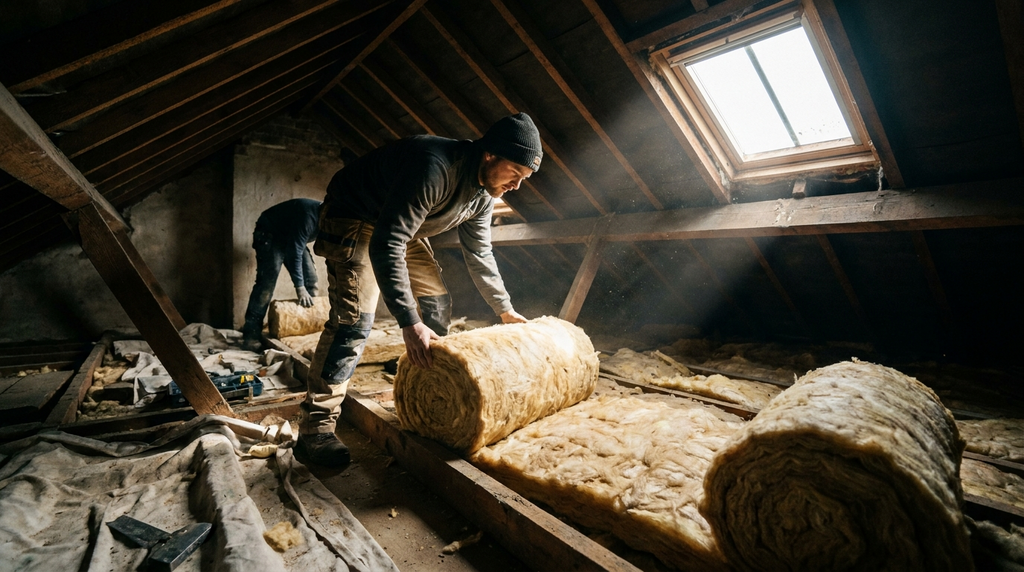
The cost of insulating your loft is typically recovered within two years through energy savings, yet fewer than half of UK homes have the recommended 270mm depth.
If you are asking “how much loft insulation UK“, the answer is not a single number but a target depth and a cost range. The minimum standard for loft insulation in the UK is 270mm of mineral-wool blanket or an equivalent thickness of another material. Energy Saving Trust data shows a typical semi-detached house can save between £200 and £300 per year on heating bills after topping up from 100mm to 270mm (Energy Saving Trust, 2026). With installation costs for a top-up typically between £300 and £500, the payback period is often under two years.
Loft insulation costs £300-£500 to top up to the 270mm UK standard, saving £200-£300 yearly on heating bills. Payback is under two years, and grants are available for eligible households.
- Cost £300-£500 for a top-up to 270mm depth.
- Saves £200-£300 per year on heating bills.
- Payback period under two years for most homes.
- ECO4 and GBIS grants require 270mm minimum.
- Check eligibility via GOV.UK if on benefits.
- The cost of insulating your loft is typically recovered within two years through energy savings, yet fewer than half of UK homes have the recommended 270mm depth.
- The minimum depth for government-funded loft insulation is 270mm
- Who qualifies for a free or subsidised loft insulation grant
- Quick numbers
- How to confirm your loft insulation depth and eligibility in five minutes
- The installer must be MCS-certified for any grant-funded loft insulation
- The direct answer how much loft insulation you need depends on your home’s current depth and your eligibility
The minimum depth for government-funded loft insulation is 270mm
The Great British Insulation Scheme closed on 31 March 2026. It funded insulation measures only and never covered windows or glazing. This requirement is set out in the Ofgem ECO4 Ordering and Delivery Guidance and the GBIS Scheme Rules, both updated for 2026 (Ofgem ECO4 Guidance, 2026; GOV.UK GBIS Rules, 2026). If your existing insulation is below 270mm, you may qualify for a subsidised top-up to this level. For uninsulated lofts, a full 270mm installation is the standard.
Who qualifies for a free or subsidised loft insulation grant
Eligibility for free or subsidised loft insulation under ECO4 is restricted to households receiving specific means-tested benefits. These include Pension Credit, Universal Credit, Income Support, and several others listed on the GOV.UK eligibility checker (GOV.UK ECO, 2026). Under GBIS, owner-occupiers and private tenants (with landlord permission) in properties with an Energy Performance Certificate (EPC) rating of D, E, F, or G can receive a subsidised top-up. The Great British Insulation Scheme closed on 31 March 2026. It funded insulation measures only and never covered windows or glazing.
Quick numbers
| Material | Cost per m² (installed) | U-value at 270mm (W/m²K) | Annual saving (typical semi) | Payback (years) |
|---|---|---|---|---|
| Mineral-wool blanket | £15–£25 | 0.16 | £200–£300 | 1.5–2.5 |
| Blown fibre | £20–£35 | 0.15 | £200–£300 | 2–3 |
| Rigid board (PIR) | £30–£50 | 0.12 | £220–£320 | 2–4 |
Costs and savings are based on a typical three-bedroom semi-detached house with a loft area of approximately 50m². Annual savings assume topping up from 100mm to 270mm and gas central heating. Source: Energy Saving Trust home insulation cost data (Energy Saving Trust, 2026).
How to confirm your loft insulation depth and eligibility in five minutes
You can check your current loft insulation depth by inserting a tape measure through the loft hatch. If the depth is below 270mm, you may be eligible for a top-up grant. Next, locate your EPC rating (available on the GOV.UK EPC register) and check your household benefit status against the criteria in the previous section. Finally, enter your postcode on the Energy Saving Trust Home Energy Check tool or the Ofgem consumer checker website to see which schemes are active in your region (Energy Saving Trust Home Energy Check, 2026; Ofgem ECO Consumer Website, 2026).
Check your EPC rating and understand its impact on grant eligibility
The installer must be MCS-certified for any grant-funded loft insulation
The Great British Insulation Scheme closed on 31 March 2026. It funded insulation measures only and never covered windows or glazing. The MCS certificate number must be provided before installation begins, and you can verify the installer on the MCS Installer Database (MCS Installer Database, 2026). For non-grant work, TrustMark registration is a recommended minimum for consumer protection (TrustMark, 2026).
How to verify an MCS-certified installer for your home insulation project
The direct answer how much loft insulation you need depends on your home’s current depth and your eligibility
If your existing insulation is less than 270mm, you need a top-up to 270mm to meet current building regulations and qualify for government support. If your home is uninsulated, you need a full installation of 270mm of mineral-wool blanket or an equivalent thickness of another material. If you are not eligible for a grant, the typical cost for a 270mm top-up in a three-bedroom semi-detached house is £300–£500, with an annual saving of approximately £200–£300 (Energy Saving Trust, 2026). Building Regulations Approved Document L (2025 edition, in force 2026) also sets a minimum U-value of 0.16 W/m²K for loft insulation, which 270mm of mineral wool achieves (GOV.UK Approved Document L, 2026).
Compare loft insulation costs with other home insulation types
Frequently Asked Questions
A top-up to the recommended 270mm depth costs £300-£500 for a typical semi-detached house, according to the Energy Saving Trust (2026). Full installation for an uninsulated loft may cost £500-£800.
The minimum standard is 270mm of mineral-wool insulation, as set by Ofgem for ECO4 and the Great British Insulation Scheme (GOV.UK, 2026). Existing insulation below this depth qualifies for a subsidised top-up.
Yes, if you receive means-tested benefits like Pension Credit or Universal Credit, you may qualify for free loft insulation under ECO4. Check eligibility on GOV.UK (2026) or contact your energy supplier.
Topping up from 100mm to 270mm saves £200-£300 annually on heating bills, based on Energy Saving Trust data for a semi-detached house (2026). Savings vary by property size and current insulation.
Local Authority Flexible Eligibility also covers households under £31,000 income in England.