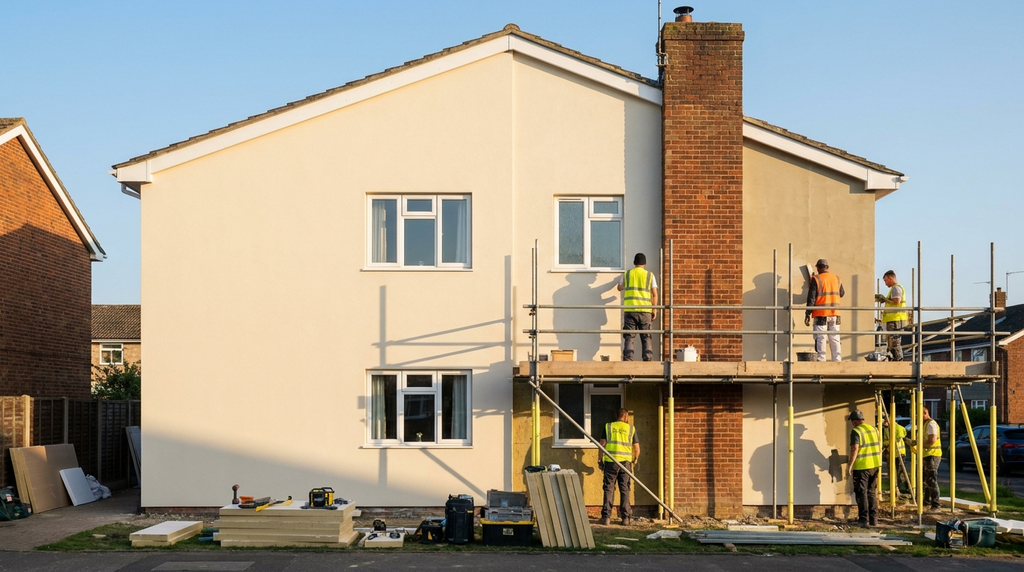
Loft insulation can reduce summer heat gain by up to 30% according to the Energy Saving Trust
Many homeowners assume loft insulation is only useful for keeping heat in during winter. In fact, insulation works year-round by slowing the movement of heat in both directions. The Energy Saving Trust states that a properly insulated loft can reduce summer heat gain by up to 30% (Energy Saving Trust, 2026). This can keep indoor temperatures 2–3°C lower than an uninsulated home on hot days.
This contradicts the common belief that insulation only matters in cold weather. The effect depends on the type and thickness of insulation installed. A 270mm layer of mineral wool is the current minimum standard for new builds under UK building regulations (Building Regulations Approved Document L, 2026).
How loft insulation blocks summer heat from entering living spaces
Heat from the sun radiates through the roof into the loft space, then into the rooms below. Insulation creates a thermal barrier that slows this downward heat transfer. Mineral wool and foam insulation have low thermal conductivity, typically 0.032–0.044 W/mK, which resists heat flow (BRE, 2026).
The loft space itself stays cooler as a result, reducing the radiant heat effect on ceilings downstairs. Without insulation, the ceiling surface can become noticeably warm to the touch on summer afternoons. With insulation, that heat transfer is significantly delayed and reduced.
The difference between winter U-values and summer thermal performance
Winter U-value standards measure how well a material prevents heat loss from inside to outside. For new builds, the target is 0.16 W/m²K for loft insulation (Building Regulations Approved Document L, 2026). Summer performance relies on the same insulation slowing heat gain from outside to inside. A 270mm layer of mineral wool provides equivalent summer protection to its winter performance.
The physics is the same in both seasons. Insulation resists heat flow regardless of direction. The only difference is the direction of the temperature gradient. In winter, heat moves from warm living spaces to cold loft. In summer, heat moves from hot roof to cooler rooms below.
Quick numbers, cost, energy savings, and temperature reduction
| Item | Value |
|---|---|
| Typical installation cost (DIY, 270mm mineral wool, 50m² loft) | £300–£600 |
| Typical installation cost (professional, same spec) | £600–£1,200 |
| Annual energy bill saving (EST estimate, gas-heated home) | £180–£315 |
| Summer temperature reduction (EST data) | 2–3°C lower indoor temp |
| Payback period | 2–4 years |
| Loft insulation lifespan | 40+ years |
Source for costs and savings: Energy Saving Trust loft insulation calculator, 2026. Source for temperature reduction: EST “Keeping cool in summer” guidance, 2026.
Loft insulation alone cannot air-condition your home, what it actually does in summer
Insulation slows heat entry but does not actively cool the house. It works best combined with ventilation, such as eaves vents or roof vents, to remove trapped hot air from the loft space. Without ventilation, the loft can still heat up significantly, and some of that heat will eventually reach living areas (DESNZ “Domestic heating and cooling” research report, 2026).
Reflective foil insulation, also called multifoil, adds a radiant barrier effect. It can reflect up to 95% of radiant heat back toward the roof surface. This is most effective in homes with dark roofs that absorb more solar radiation. The cooling effect is most noticeable on upper floors and in rooms directly below the loft.
How to verify your loft insulation is installed correctly for summer performance
Check for MCS certification if combining insulation with renewable technologies such as solar panels or heat pumps (MCS register, 2026). For DIY installation, ensure insulation does not block eaves vents. Blocked vents trap heat and can cause condensation, which reduces insulation effectiveness and can lead to damp problems.
Use a thermal imaging camera, or hire a surveyor, to identify gaps in coverage. Cold spots in winter or hot spots in summer indicate missing or compressed insulation. Installers should hold TrustMark registration for government-backed schemes such as the Great British Insulation Scheme (TrustMark website, 2026).
The direct answer, yes, loft insulation makes your house cooler in summer by slowing heat entry
Loft insulation reduces the rate at which external heat reaches living spaces. The effect is measurable: 2–3°C cooler on hot days according to Energy Saving Trust data. It is not a substitute for mechanical cooling, but it reduces reliance on fans or air conditioning.
Combined with ventilation and reflective barriers, loft insulation forms an effective passive cooling strategy. The same insulation that saves you money on heating bills in winter also keeps your home more comfortable in summer. For most UK homes, installing or upgrading loft insulation is one of the most cost-effective improvements you can make for year-round comfort.