Most households with loft insulation installed before 2006 are sitting on material that has never been inspected since it went in. Yet the Energy Saving Trust estimates that a quarter of all heat loss in an uninsulated home escapes through the roof, which means degraded insulation, performing at a fraction of its original capacity, could be doing precious little more than bare rafters. That is a significant amount of money disappearing into the sky every winter.
Loft insulation typically lasts 20 to 40 years depending on the material, with mineral wool lasting longest under good conditions. If your insulation is over 25 years old or measures below 270mm in depth, a top-up or replacement is worth considering. Eligible households can get this done free through ECO4 or the Great British Insulation Scheme.
- Mineral wool loft insulation can last 40 or more years in ideal conditions but commonly degrades meaningfully after 20 to 25 years in real UK homes, check yours if it was installed before 2006.
- Loose-fill cellulose has a shorter effective lifespan of 20 to 30 years and is more vulnerable to moisture, compaction, and pest disturbance than mineral wool.
- Age alone is rarely the main cause of failure, moisture ingress, roof leaks, pest activity, and compression are the primary reasons insulation loses performance ahead of schedule.
- Open your loft hatch and visually inspect the insulation at least every five years, looking for flattened or thinning material, damp patches, discolouration, or visible gaps around eaves.
- The current recommended depth for mineral wool loft insulation is 270mm, if yours measures significantly below this, a top-up is likely worth doing before considering full replacement.
- If spray foam insulation is present in your loft, get a specialist assessment before attempting to sell your home, as many mortgage lenders currently refuse to lend on properties with spray foam installed.
- Check eligibility for the Great British Insulation Scheme or ECO4 funding before paying for replacement out of pocket, qualifying households can receive loft insulation at significantly reduced cost or free.
- The "Fit and Forget" Myth That Is Costing UK Homeowners Money
- What Loft Insulation Actually Does and Why It Degrades Over Time
- How Long Does Loft Insulation Last, A Realistic Answer by Material Type
- The Warning Signs You Can Actually See From Your Loft Hatch
- Top Up or Replace, How to Make the Right Call
- What Professionals Actually Find in UK Lofts
- What It Costs to Top Up or Replace Loft Insulation in 2026
- Grants and Funding Available in 2026
So how long does loft insulation last? The honest answer is that lifespan varies considerably by material, with mineral wool lasting 40 or more years under ideal conditions but often declining meaningfully after 20 to 25 years in real UK homes. Loose-fill cellulose typically performs for 20 to 30 years, while spray foam and rigid foam boards each carry their own complications beyond simple age. The more important point is that age alone is rarely the main culprit, it is what happens to insulation over time that destroys its performance.
This article walks you through how insulation degrades, how to spot the warning signs from your own loft hatch, and how to decide whether a top-up or full replacement is the right call for your home.
The “Fit and Forget” Myth That Is Costing UK Homeowners Money
The most common thing I encounter when visiting homes for energy assessments is that the owner has no idea what type of insulation is in their loft, let alone when it was installed or what condition it is in. It was put in at some point, it was ticked off the list, and it has not been thought about since. This is understandable, insulation is invisible, inaccessible, and nobody talks about it at dinner parties.
The problem is that the 1980s and 1990s saw a significant push to install loft and cavity wall insulation across UK housing stock, often through government-backed grant schemes. That means a substantial proportion of homes currently have insulation that is between 30 and 40 years old. Some of it is still performing adequately. Much of it is not.
The “fit and forget” assumption is one of the most persistent and costly misconceptions in domestic energy efficiency. Insulation is a physical material subject to the same forces that degrade everything else in a building, moisture, mechanical disturbance, temperature cycling, biological activity. The idea that a roll of glass wool laid in 1989 is still performing at specification in 2026 needs challenging directly.
What most articles on this subject miss is the distinction between age-related degradation and event-driven degradation. A 35-year-old mineral wool installation that has never been walked on, never been wet, and sits in a well-ventilated loft may genuinely still be doing a reasonable job. Conversely, a 10-year-old installation that has been repeatedly walked on by tradespeople, sits above a bathroom with poor ventilation, and has had boxes stacked on it for eight years is performing far below specification. Age is a useful indicator, but it is not the whole story.
guide to loft insulation types and materials
What Loft Insulation Actually Does and Why It Degrades Over Time
Loft insulation works by trapping millions of tiny pockets of still air within a matrix of fibres or foam. Still air is an excellent thermal insulator, it is the movement of air, and the transfer of heat through solid conduction, that drives heat loss. The insulation material itself is largely irrelevant; what matters is the still air it holds in place.
Once those air pockets are disrupted, whether by compression, saturation with water, or physical damage, the insulation’s ability to resist heat flow collapses. In technical terms, this is measured as thermal resistance, expressed in UK assessments as m²K/W (metres squared kelvin per watt). The higher the value, the better the insulation. A new 270mm mineral wool installation might achieve a thermal resistance of around 7.0 m²K/W. The same material compressed to 150mm through years of foot traffic might achieve less than half that.
Mineral wool (both glass wool and rock wool) relies on a fibrous structure that is quite resilient when left undisturbed but compresses permanently when loaded. Once the fibres are crushed, they do not spring back. Loose-fill cellulose, recycled paper fibre treated with fire retardants, is more vulnerable to moisture absorption and natural settling; it can compact to significantly less than its installed depth over time. Spray foam creates a rigid or semi-rigid matrix depending on whether it is open-cell or closed-cell, and its thermal properties are more stable over time, but it creates structural and mortgage complications that are discussed separately below. Rigid foam boards (PIR and PUR boards, often used in warm roof or conversion contexts) maintain their properties well but are highly sensitive to installation quality and subsequent disturbance.
The UK climate creates specific degradation pressures. Damp winters drive moisture-laden air upward through ceilings into loft spaces. Freeze-thaw cycles stress materials. Poorly ventilated roof spaces trap condensation directly against insulation for months at a time. A loft in a terraced house in Manchester faces meaningfully different conditions than one in a well-ventilated detached home on the south coast, and both will age differently from how a manufacturer’s laboratory test would predict.
How Long Does Loft Insulation Last, A Realistic Answer by Material Type
This table gives you a practical reference point for each common insulation type. These figures reflect real-world UK conditions, not ideal laboratory assumptions.
| Insulation Type | Stated Lifespan (Industry Guidance) | Realistic Performance Window | Primary Degradation Risk |
|---|---|---|---|
| Mineral wool (glass wool / rock wool) | 40+ years | 20–25 years in typical UK homes | Compression, moisture ingress, disturbance by trades |
| Loose-fill cellulose | 20–30 years | 15–25 years | Compaction, moisture absorption, air movement |
| Loose-fill mineral wool | 30–40 years | 20–30 years | Settlement, moisture, eaves coverage gaps |
| Spray foam (closed-cell) | 30+ years structurally | Lifespan less relevant than mortgage/survey implications | Structural bonding to rafters, mortgage complications |
| Spray foam (open-cell) | 20–30 years | Often problematic within 10–15 years in damp conditions | Moisture retention, structural concerns |
| Rigid foam boards (PIR/PUR) | 25–40 years | 25–35 years if installation is undisturbed | Poor installation joints, subsequent disturbance |
The critical caveat that most guides overlook is this. A 30-year-old undisturbed mineral wool installation in a dry, well-ventilated loft may genuinely still outperform a 10-year-old installation that has been walked on repeatedly, wetted by a minor roof leak, or compressed under stored furniture. Age is a starting point for investigation, it is not a verdict on its own.
In a typical 3-bed semi with a cold loft (where the insulation sits on the loft floor rather than at rafter level), the most common scenario I see is 100mm of original mineral wool from the late 1980s or 1990s that has settled to somewhere between 60mm and 80mm of effective depth. That is well below the current recommended 270mm and is performing at perhaps 25 to 30 percent of what it should be.
recommended loft insulation depth guide for UK homes
The Warning Signs You Can Actually See From Your Loft Hatch
You do not need a professional to conduct an initial inspection. A torch, a ruler, and 15 minutes are enough to identify the major warning signs. Here is what to look for.
Depth
The Energy Saving Trust recommends a minimum of 270mm for mineral wool insulation laid between and over joists in a cold loft. Anything below 100mm is performing very poorly. Anything between 100mm and 200mm should be topped up. Take measurements at multiple points across the loft, depth is often uneven, with good coverage in the centre and very little at the eaves where it matters for preventing cold bridging.
Visible Compression and Matting
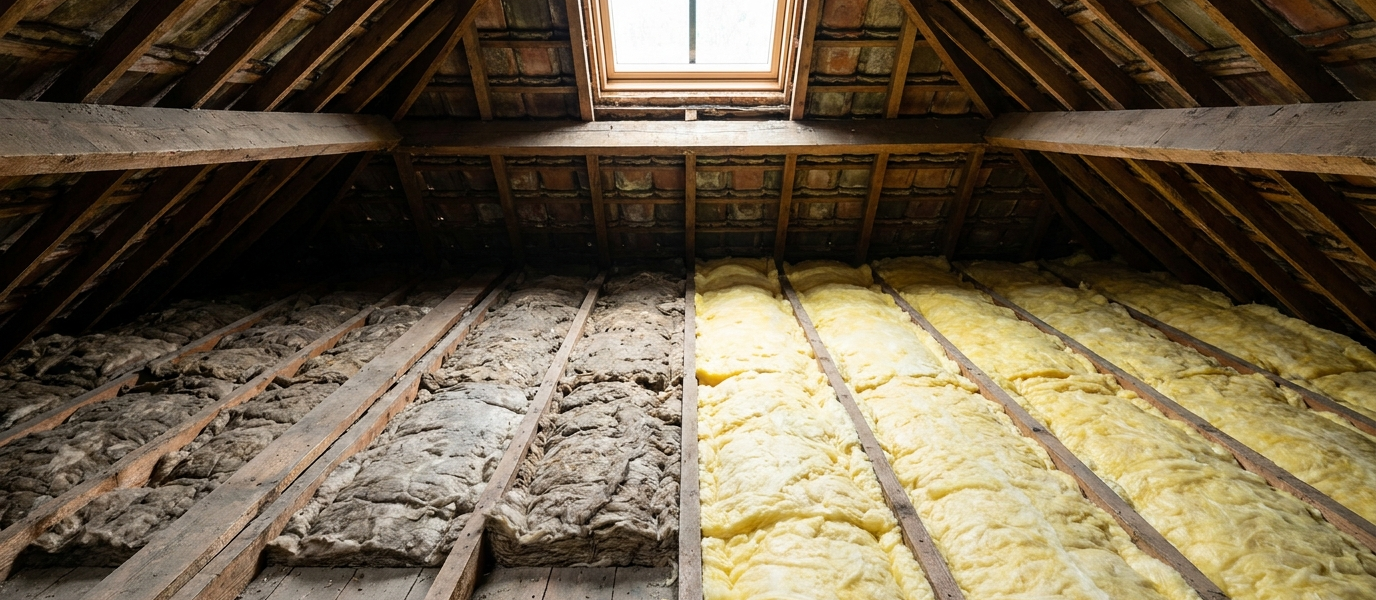
Mineral wool that looks flat, matted, or has obvious indentations has lost a significant proportion of its thermal resistance. The fibres that trap still air have been permanently crushed. This cannot be reversed by fluffing or rearranging, the material needs replacing or supplementing with fresh rolls laid over the top, provided the existing layer is dry.
Discolouration and Damp Patches
Yellow-brown staining, dark patches, or any area of insulation that feels heavier than the surrounding material indicates moisture ingress. This is a serious problem. Wet insulation conducts heat rather than resisting it, and the damp conditions accelerate mould growth in the roof structure above. Any area of confirmed moisture damage needs removing, not topping up over.
Gaps Around Joists, Lights, and the Loft Hatch
The loft hatch itself is one of the most consistently underinsulated elements in UK homes. Cold air flows freely around the hatch frame if it is not properly draughtproofed and insulated on the top face. Similarly, gaps around recessed downlighters (which typically cannot be covered with standard mineral wool for fire safety reasons) and poorly fitted insulation around joists create thermal bypasses, points where heat flows through largely unimpeded. These gaps are disproportionately damaging relative to their area.
Pest Activity
Rodent runs through insulation, nesting material mixed into mineral wool, and droppings throughout the loft are more common than most homeowners expect, particularly in older terraced properties and in homes backing onto green space. Contaminated insulation is not simply a thermal problem; it is a health issue. Any loft with confirmed rodent activity needs professional clearance before any insulation work is considered.
The Check Most Articles Do Not Mention
While you are up there, look at the underside of your roof felt or sarking boards directly above the insulation. Black mould growth or heavy condensation staining on those surfaces is a reliable indicator that loft ventilation has failed. It means your insulation has been sitting in persistently damp air, potentially for years, regardless of how it looks from the top. This is particularly common in homes where the original breathable roofing felt has been replaced with a non-breathable alternative, or where eaves vents have been blocked during re-rendering or re-pointing work. If you see this, the ventilation problem needs addressing before any insulation work begins, otherwise you are recreating the same damp conditions for new material.
Top Up or Replace, How to Make the Right Call
Getting this decision right saves you money and avoids the expensive mistake of laying new insulation over a problem that continues to worsen beneath it.
Topping up is appropriate when the existing insulation is confirmed dry, shows no contamination, is structurally intact, and simply falls short of the recommended 270mm depth. This is the most common scenario in pre-2000 homes where 100mm was the standard installation depth at the time. In these cases, a simple top-up with new mineral wool rolls is cost-effective and straightforward.
Full replacement is necessary when moisture damage is confirmed across a significant area, pest contamination is present, or the insulation has deteriorated to the point where topping up would be counterproductive. If you top up over wet insulation, you trap the moisture and accelerate the decay. It is the equivalent of painting over rising damp.
Spray foam is a category of its own. If your loft contains spray foam insulation, do not proceed with any other work until you have taken specialist advice. Spray foam removal is complex, and the presence of spray foam in a loft can affect your ability to remortgage or sell the property. The Residential Landlords Association and major lenders have taken an increasingly cautious position on spray foam in recent years, and this has not softened in 2026.
The hybrid approach, spot replacement in problem areas combined with a top-up across the main loft floor, is often the most cost-effective solution. A typical scenario might involve removing and replacing insulation around a previously leaking felt valley or near an old cold-water tank, while simply topping up the dry, intact material across the main span.
Here is a step-by-step decision process you can follow before committing to any expenditure.
- Measure current depth at a minimum of five points across the loft, including at the eaves. Record the lowest reading, not just the average.
- Check for moisture by pressing gently on the insulation at several points. Wet or heavy material needs to come out. Also check the roof felt above as described in the previous section.
- Look for pest activity, runs, nests, and droppings. If present, address the pest problem before any insulation decision.
- Inspect ventilation, check that eaves vents are clear, that any ridge or tile vents are present and unobstructed, and that breathable membrane condition looks reasonable where visible.
- Get two independent assessments from installers before committing to full replacement. One assessment from a company that earns more from a full replacement job than a top-up is not sufficient basis for a decision.
- Cross-reference your EPC rating. If your Energy Performance Certificate shows loft insulation as adequate but your heating bills suggest otherwise, request a new assessment through an accredited Domestic Energy Assessor registered with an approved scheme such as Elmhurst or Stroma.
how to read your Energy Performance Certificate
What Professionals Actually Find in UK Lofts
After visiting hundreds of homes over 15 years, the patterns that emerge are fairly consistent, and they differ from what homeowners assume.
The single most common surprise for installers is the number of lofts where previous insulation has been disturbed by plumbers, electricians, or roofers and never correctly reinstated. A plumber fitting a new cylinder will move six rolls of mineral wool to access pipework and push them back loosely. An electrician running cables will lift and replace insulation without particular care for depth or continuity. A roofer replacing felt will disturb the eaves sections entirely. None of this gets logged anywhere. The owner assumes the insulation is as it was. It is not, and the uninsulated voids left behind are often the worst-performing areas of the entire loft.
What surprises homeowners most is discovering that their loft insulation, which they had confidently listed as “present” in their minds, consists of 50mm of compacted glass wool from the late 1980s. In some Victorian terraces, the eaves sections contain no insulation at all. The main span might have something, but the corners and edges, the areas where cold air infiltration is most active, are entirely bare.
A mistake homeowners frequently make before calling a professional is laying new rolls directly on top of heavily compressed existing insulation without first checking for damp. The logic seems reasonable, top it up, save money, job done. But if the lower layer is moisture-affected, sealing new material over the top traps that moisture and creates the ideal conditions for mould growth in the structure above. In a Victorian terrace with timber joists, that is a meaningful structural risk over time.
On spray foam, the consensus among reputable installers in 2026 is clear. The material itself may still be performing thermally, but the complications it creates are significant enough that specialist advice should always be sought before undertaking any loft work where spray foam is present. Some firms specialise in spray foam assessment and removal, always verify their credentials and check for membership of the British Board of Agrément or registration with TrustMark.
Finally, the storage issue is worth addressing directly. A loft used for boxes, luggage, old furniture, and seasonal items is, over time, a loft with progressively worse insulation. Loft boards laid directly on mineral wool compress it permanently. If you need loft storage, the solution is raised boarding systems that sit on stilts above insulation level, maintaining the full depth of the material beneath. These are widely available and straightforward to install.
What It Costs to Top Up or Replace Loft Insulation in 2026
Costs vary by region, property type, access difficulty, and whether the existing insulation needs removing first. The figures below reflect professional installation across Great Britain in 2026 and should be used as a guide rather than a quote.
| Job Type | Typical Property | Estimated Cost Range | Notes |
|---|---|---|---|
| Mineral wool top-up (professional) | 3-bed semi-detached (approx. 50m²) | £300–£500 | Assuming existing insulation is dry and intact |
| Mineral wool top-up (professional) | 4-bed detached (approx. 75–90m²) | £600–£900 | Costs rise with access difficulty and awkward geometry |
| Full replacement (removal plus new installation) | 3-bed semi-detached | £450–£900 | Includes removal and disposal at £150–£400 on top of top-up cost |
| Spray foam removal | Varies significantly | £1,000–£3,000+ | Specialist job; always seek independent specialist assessment first |
| DIY top-up (mineral wool rolls only) | 3-bed semi-detached | £250–£480 materials only | Appropriate only when existing insulation is confirmed completely dry |
Mineral wool rolls from builders’ merchants currently cost approximately £5 to £8 per square metre of material. A typical 3-bed semi requires roughly 50 to 60m² to bring depth up to the recommended 270mm from a low baseline. The DIY route is legitimate for a healthy, dry loft where the homeowner is confident in the assessment and comfortable working at height in a loft space, but it is not appropriate where any moisture concern exists.
The cost of doing nothing is real and quantifiable. Based on Energy Saving Trust indicative figures, a poorly insulated loft performing at below 100mm depth can cost an estimated £150 to £250 more per year in heating bills compared to a properly insulated equivalent. A professional top-up costing £400 therefore has a simple payback period of roughly two to three years, after which the saving is recurring. Over a decade, the financial case is not remotely close.
Grants and Funding Available in 2026
The good news for homeowners considering loft insulation work in 2026 is that several funding routes remain available, though eligibility criteria vary and the landscape does shift. Always verify current availability directly with the relevant body before making financial assumptions.
ECO4 (Energy Company Obligation, Phase 4)
ECO4 is a government-mandated scheme under which large energy suppliers fund energy efficiency improvements in low-income and fuel-poor households. Loft insulation is one of the qualifying measures. Eligibility is linked to means-tested benefits including Universal Credit, Pension Credit, and certain legacy benefits, as well as low Energy Performance Certificate ratings. If you are eligible, the work may be fully funded. Check eligibility via the Energy Saving Trust’s ECO4 checker or directly through your energy supplier. ECO4 runs until March 2026 in its current form, with successor arrangements expected to be confirmed by DESNZ (the Department for Energy Security and Net Zero), check the government’s website for the latest position as this article is published.
Great British Insulation Scheme (GBIS)
The Great British Insulation Scheme has a broader eligibility reach than ECO4, covering households with an EPC rating of D or below, regardless of income in some cases (through a council tax band route), and low-income households across bands A to G. Loft insulation is a primary qualifying measure. Funding levels vary depending on your supplier and property type, but partial or full funding is available for qualifying homes. Check eligibility through the Ofgem consumer pages or the Energy Saving Trust.
Home Upgrade Grant (HUG2)
HUG2 (Home Upgrade Grant Phase 2) targets off-gas-grid homes with low incomes and poor energy ratings. If your home is not connected to the gas network and your EPC is E, F, or G, loft insulation as part of a broader energy upgrade package may be funded. This scheme is administered through local authorities, contact your local council to establish whether your area has remaining funding available.
Scotland, Wales, and Northern Ireland
Homeowners in Scotland may be eligible for support through Home Energy Scotland, which is funded by the Scottish Government and administered by the Energy Saving Trust. Wales operates the Warm Homes Programme through Welsh Government funding. Northern Ireland has separate arrangements through the Energy Saving Trust Northern Ireland and the Affordable Warmth scheme. Each has its own eligibility criteria and funding levels, the headline figures differ from England, so check the relevant national programme directly.
Installer Accreditation, What to Look For
Any installer carrying out grant-funded loft insulation work must be registered with TrustMark and work to the relevant PAS (Publicly Available Specification) standards, specifically PAS 2035 for funded works. For non-funded work, TrustMark registration is still a reliable indicator of a vetted installer. You can verify registration on the TrustMark official register at trustmark.org.uk. MCS accreditation applies primarily to renewable energy installations rather than insulation directly, but where an installer is working across measures, MCS registration is a positive indicator of broader quality standards. Always ask for evidence of registration and verify it yourself rather than accepting a leaflet or verbal assurance.
how to find a TrustMark registered insulation installer
One point worth making clearly. The availability of grant funding does not mean the job will be done to a high standard. Publicly-funded schemes have historically produced variable installation quality, and the guidance under PAS 2035 was specifically introduced to address this. Make sure your installer carries out a proper pre-installation survey including ventilation assessment, and that you receive a completion certificate detailing what was installed, to what depth, and the assessed thermal resistance achieved. That document matters both for your records and for any future EPC assessment or property sale.
understanding PAS 2035 for home insulation works
Loft insulation is not a one-time decision. It is a physical material in a working building environment, and it ages. Knowing what type you have, how old it is, and what condition it is in takes less than 20 minutes and could save you hundreds of pounds a year. The homes that perform worst energetically are almost always the ones where the owner assumed everything was fine.
If you take one thing from this article, make it this. Before next winter, get your head into your loft with a torch and a ruler. Measure the depth, look for discolouration, check the felt above. If something looks wrong, it probably is, and the cost of putting it right is almost always far lower than the cost of years of inadequate insulation doing less than you paid for.
Frequently Asked Questions
Mineral wool typically lasts 40 or more years under ideal conditions but often performs noticeably worse after 20 to 25 years in typical UK homes. Loose-fill cellulose generally has an effective lifespan of 20 to 30 years. Real-world factors like moisture, pests, and compression can shorten either material's useful life considerably.
Look for insulation that has compressed to well below the recommended 270mm depth, damp or discoloured patches, visible gaps near the eaves, or signs of pest activity. If your heating bills have risen noticeably without another explanation and your insulation is over 25 years old, a professional inspection is worth arranging.
Full replacement of loft insulation in an average semi-detached home typically costs between £300 and £600 for mineral wool, including installation. Costs vary by property size, access difficulty, and whether old material needs removing first. Households on certain benefits may qualify for free installation through ECO4 or the Great British Insulation Scheme.
In most cases yes, provided the existing insulation is dry, free from pest damage, and covers the whole loft floor without significant gaps. A top-up to bring the total depth to 270mm is usually cheaper than full replacement and can restore much of the thermal performance lost through compression over time.
Yes, spray foam in the loft can make a property difficult to mortgage because many UK lenders class it as a risk to the roof structure and treat it as a valuation concern. Removal typically costs between £1,000 and £4,000 depending on property size. Always get a specialist assessment before buying or selling a home where spray foam is present.