The recommended loft insulation depth is 270 mm, and that is the figure you will see most often
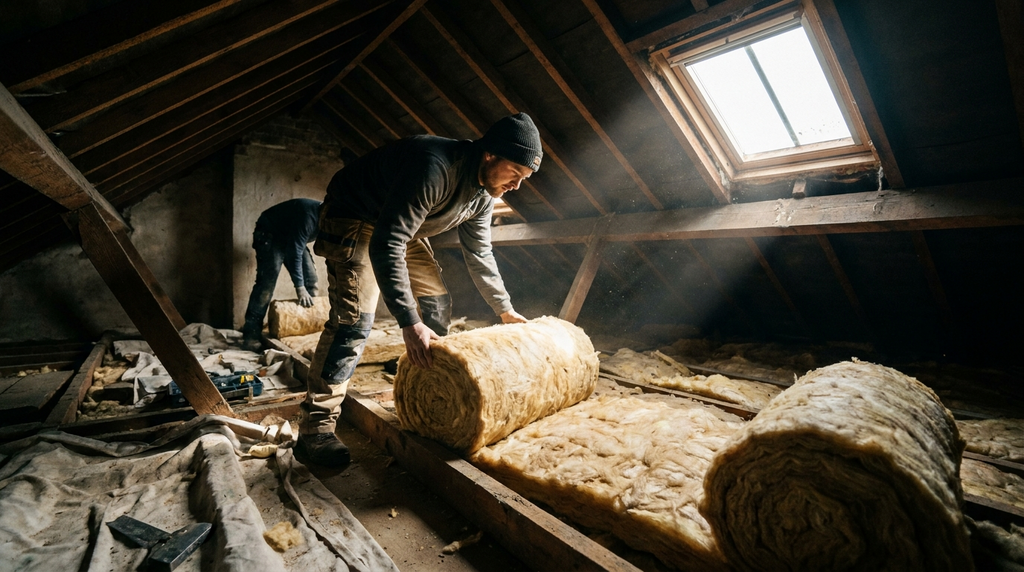
If you search online for how much loft insulation you need, 270 mm is the number that appears most frequently. The Energy Saving Trust (EST) and the UK Government’s Department for Energy Security and Net Zero (DESNZ) both state 270 mm of mineral wool or fibre insulation as the target depth for most homes (Energy Saving Trust, 2026). This depth applies to insulation laid between and over the joists in a typical loft with no room-in-roof conversion.
The recommended loft insulation depth is 270 mm for mineral wool, achieving a U-value of 0.16 W/m²K. This figure is standard per the Energy Saving Trust and Building Regulations. Other materials like rigid foam may need less depth to meet the same target.
- Aim for 270 mm mineral wool insulation between and over joists.
- Target a U-value of 0.16 W/m²K per Building Regulations 2021.
- Rigid foam boards need only 120–150 mm to achieve the same U-value.
- Top-up depth depends on existing insulation condition and material.
- Use the Energy Saving Trust calculator to estimate exact top-up depth.
- The recommended loft insulation depth is 270 mm, and that is the figure you will see most often
- The U-value you are aiming for is 0.16 W/m²K, not just a fixed depth
- Quick numbers, what 270 mm costs, saves, and pays back
- How to check if your current insulation is enough, the ruler test
- The two main types of loft insulation and their different depth requirements
- The Great British Insulation Scheme closed on 31 March 2026. It funded insulation measures only and never covered windows or glazing.
- How to verify your installer, MCS, TrustMark, and the Gas Safe Register
- The cost of not insulating, what you lose per year
If you are using a different material, such as rigid foam boards or sheep’s wool, the depth may differ because the thermal performance is measured in U-value, not just thickness. The 270 mm figure is a practical standard for mineral wool, which is the most common and cost-effective insulation material. Always check the manufacturer’s guidance for the specific product you plan to use.
The U-value you are aiming for is 0.16 W/m²K, not just a fixed depth
The Building Regulations (Approved Document L, 2021 edition, applicable in 2026) require a U-value of 0.16 W/m²K for loft insulation in new builds and most retrofit work (HM Government, 2026). A U-value measures how quickly heat passes through a material. The lower the number, the better the insulation.
270 mm of mineral wool achieves roughly this U-value. Other materials need different thicknesses to hit the same target. For example, rigid foam boards may need only 120–150 mm, while natural fibre insulation like sheep’s wool requires 250–270 mm. If your loft already has some insulation, the top-up depth needed depends on the existing material’s condition and thickness. Use the EST insulation calculator to work out the exact top-up depth for your home (Energy Saving Trust, 2026).
Quick numbers, what 270 mm costs, saves, and pays back
| Cost category | Typical figure | Source |
|---|---|---|
| Minimum cost (DIY, 270 mm mineral wool rolls for a 50 m² loft) | £250–£400 | Energy Saving Trust, 2026 |
| Professional installation cost (average UK quote) | £500–£800 | Energy Saving Trust, 2026 |
| Annual energy bill saving (gas-heated mid-terrace house) | £300–£400 | DESNZ, 2026 |
| Annual CO₂ saving | 600–800 kg | Energy Saving Trust, 2026 |
| Simple payback period (years) | 2–3 years (DIY) or 4–5 years (professional) | Energy Saving Trust, 2026 |
How to check if your current insulation is enough, the ruler test
The direct answer to how much loft insulation you should have is simple. You measure the depth of existing insulation at several points using a ruler or tape measure. If it is less than 270 mm, you need more. Take measurements in different areas of the loft, as depth can vary due to settling or damage.
If the existing insulation is damaged, damp, or compressed, replace it entirely rather than topping up. Damp insulation loses most of its thermal performance and can cause mould problems. If you have less than 100 mm, the EST estimates you could save £300–£400 per year on heating bills (2026 figures) by topping up to 270 mm (Energy Saving Trust, 2026). Use the EST online tool to check your specific situation.
The two main types of loft insulation and their different depth requirements
Mineral wool (glass or rock fibre) is the most common option. It comes in standard rolls, and the target is 270 mm laid between and over joists. Cost is around £5–£8 per m² for DIY (Energy Saving Trust, 2026). This is the cheapest and easiest option for most homes.
Rigid foam boards (PIR or phenolic) are thinner for the same U-value. You typically need 120–150 mm to achieve 0.16 W/m²K. Cost is higher, around £12–£20 per m². These boards are better for lofts used for storage, as they can support a lightweight floor deck above them.
Sheep’s wool or natural fibre insulation requires a similar depth to mineral wool, around 250–270 mm. It costs more, typically £10–£15 per m², but offers better moisture management and is a renewable material (MCS, 2026). Choose based on your budget, storage needs, and environmental priorities.
The Great British Insulation Scheme closed on 31 March 2026. It funded insulation measures only and never covered windows or glazing.
The Great British Insulation Scheme closed on 31 March 2026. It funded insulation measures only and never covered windows or glazing. You must be in a low-income or vulnerable household, or live in a property with an EPC rating of D or below (GOV.UK, 2026). The scheme covers top-up to 270 mm, and the installer must be certified under PAS 2030:2023 and registered with TrustMark.
The Great British Insulation Scheme closed on 31 March 2026. It funded insulation measures only and never covered windows or glazing. Check your eligibility on the GOV.UK page or contact your energy supplier. Grants are limited and subject to assessment by the installer.
How to verify your installer, MCS, TrustMark, and the Gas Safe Register
For loft insulation, the key certification is TrustMark, the government-endorsed quality scheme. The installer must also be registered with PAS 2030/2035 certification (TrustMark, 2026). If the insulation is part of a grant scheme (GBIS or ECO4), the installer must be on the MCS (Microgeneration Certification Scheme) or equivalent for insulation (MCS, 2026).
Gas Safe Register is not relevant for loft insulation, as it covers gas appliances only. NICEIC or NAPIT registration may apply if electrical work is involved, such as rewiring after insulation. Always check the installer’s credentials before work begins. You can search for verified installers via the TrustMark website.
The cost of not insulating, what you lose per year
A typical uninsulated loft loses 25–30% of a home’s heat through the roof, according to EST modelling (Energy Saving Trust, 2026). For an average gas-heated semi-detached house in 2026, that equates to £350–£500 in wasted heating costs annually, based on the Ofgem price cap of 24.5p/kWh for gas (Ofgem, 2026).
Adding 270 mm insulation cuts that loss to near zero, saving the full amount. Over a typical 10-year period, that is £3,500–£5,000 saved. The cost of insulating is recovered within a few years, and the savings continue for the lifetime of the insulation, which is at least 25 years. loft insulation cost and savings guide
Frequently Asked Questions
The recommended depth is 270 mm for mineral wool insulation. The Energy Saving Trust and UK government state this as the target for most homes.
Yes, overfilling can reduce ventilation and cause moisture issues. The Energy Saving Trust advises sticking to the recommended depth of 270 mm for mineral wool.
Building Regulations require a U-value of 0.16 W/m²K for loft insulation. This is achievable with 270 mm of mineral wool according to HM Government.
DIY cost for 270 mm mineral wool covering a 50 m² loft is typically £250 to £400. Professional installation may add labour costs.
Use the Energy Saving Trust insulation calculator to find the top-up depth needed. It depends on existing material thickness and condition.