The average UK home needs 270 mm of mineral-wool loft insulation to meet the 2026 building-regulation minimum
If you are searching for “how much loft insulation do I need”, the answer depends on your home and current insulation. But for most UK homes, there is a single standard figure that applies.
You need 270mm of mineral-wool loft insulation to meet the 2026 building-regulation minimum. This depth can save a typical gas-heated three-bed semi up to £300 per year on heating bills, per Energy Saving Trust figures.
- 270mm of mineral wool meets the 2026 building-regulation U-value of 0.16 W/m²K
- Two 100mm layers plus a 70mm top-up achieve the required depth
- Rigid foam boards need only 150–200mm for the same U-value
- Sheep’s wool requires 250–280mm to match the 0.16 W/m²K target
- Top-up insulation if current depth is under 100mm to save over £100 yearly
- The average UK home needs 270 mm of mineral-wool loft insulation to meet the 2026 building-regulation minimum
- The U-value target for loft insulation in 2026 is 0.16 W/m²K, per UK building regulations
- Quick numbers Loft insulation depth, cost, and savings by material
- How to check your current loft insulation depth and measure what you need
- The direct answer You need 270 mm of mineral-wool loft insulation for a standard UK home
- The Great British Insulation Scheme closed on 31 March 2026. It funded insulation measures only and never covered windows or glazing.
- How to verify a loft insulation installer MCS certification and TrustMark
You need 270 mm of mineral-wool loft insulation to meet the 2026 building-regulation minimum. This depth can cut annual heating bills by up to £200–£300 for a typical gas-heated three-bedroom semi-detached home (Energy Saving Trust, 2026).
The 2026 Part L1A building regulations, published by the Department for Energy Security and Net Zero (DESNZ), specify a U-value of 0.16 W/m²K for loft insulation in new builds and most retrofit projects (DESNZ, 2026). A U-value measures how quickly heat passes through a material; lower numbers mean better insulation. For mineral-wool rolls, achieving this U-value typically requires a total depth of 270 mm, laid as two 100 mm layers plus a 70 mm top-up. If your current insulation is less than 100 mm, you are likely losing more than £100 per year in heat loss through your loft (Energy Saving Trust, 2026).
The U-value target for loft insulation in 2026 is 0.16 W/m²K, per UK building regulations
The 2026 Part L1B (existing dwellings) and Part L1A (new dwellings) both set a maximum U-value of 0.16 W/m²K for loft insulation (DESNZ, 2026). This U-value corresponds to a thermal resistance, or R-value, of approximately 6.25 m²K/W. The R-value is the opposite of the U-value; higher numbers mean better insulation.
Achieving this U-value requires different depths depending on the material. Mineral wool needs 270 mm. Rigid foam boards, which are more thermally efficient per millimetre, require 150–200 mm. Sheep’s wool, a natural alternative, needs 250–280 mm (MCS Register product data, 2026). The U-value target is the same for both pitched roofs with a loft space and flat roofs, though the material thicknesses will vary depending on the specific product and its declared thermal conductivity.
Quick numbers Loft insulation depth, cost, and savings by material
| Material | Depth (mm) | Cost per m² (£) | Annual saving (£) | Payback (years) |
|---|---|---|---|---|
| Mineral-wool rolls | 270 | £6–£10 | £200–£300 | 2–4 |
| Rigid foam boards | 150 | £15–£25 | £200–£300 | 4–7 |
| Sheep’s wool | 250 | £20–£35 | £200–£300 | 6–10 |
All savings figures assume a gas-heated, three-bedroom semi-detached home, based on data from the Energy Saving Trust (Energy Saving Trust, 2026). Costs are for materials only and do not include labour or installation. Payback periods are approximate and will vary depending on your energy tariff and house size.
How to check your current loft insulation depth and measure what you need
Use a tape measure or ruler at several points across the loft floor, avoiding areas near the hatch or eaves where depth may vary (Energy Saving Trust guide, 2026). If insulation is below 100 mm, a full top-up to 270 mm is recommended. If it is between 100 mm and 200 mm, a single top-up layer of 170 mm may suffice.
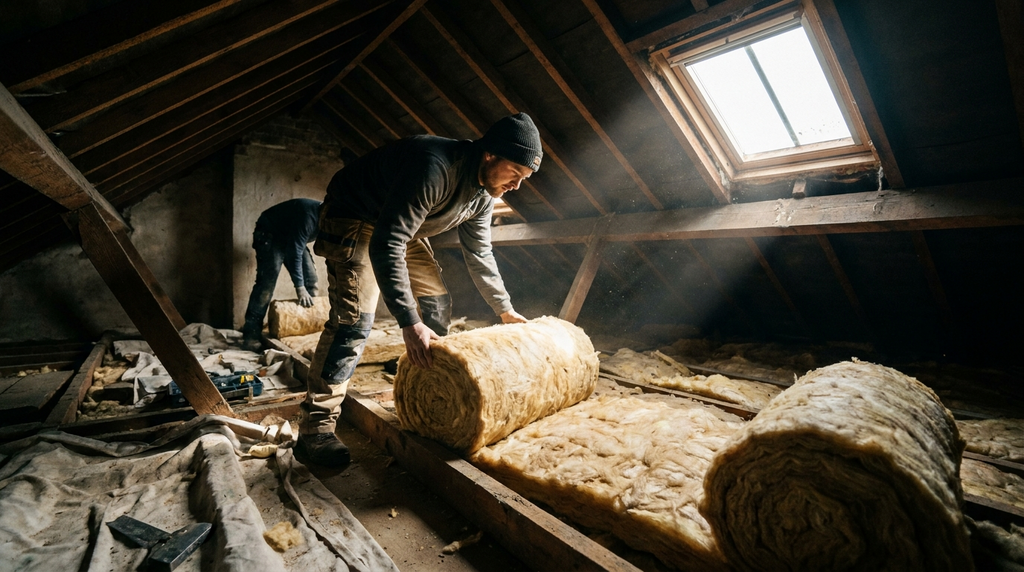
Measure the loft floor area by multiplying the length by the width to calculate the total square metres you need to cover. For mineral-wool rolls, buy rolls labelled “270 mm total depth” or two 100 mm rolls plus one 70 mm roll for a single installation. If you have existing insulation, do not compress it. Adding a new layer on top is fine, but make sure the total depth does not block ventilation at the eaves.
how to measure your loft for insulation
The direct answer You need 270 mm of mineral-wool loft insulation for a standard UK home
This is the plain-English answer to the keyword query “how much loft insulation do I need”. For a typical UK home with a pitched roof and accessible loft, 270 mm of mineral wool is the standard. For homes with limited loft access, such as trussed roofs with tight spaces, rigid foam boards or sheep’s wool may be easier to install at 150–200 mm depth.
If you have existing insulation, measure it. If it is 100 mm or less, add 170 mm to reach 270 mm total (Energy Saving Trust, 2026). This depth applies to both DIY installations and professional work. Professionals will use the same U-value target of 0.16 W/m²K, regardless of the material chosen.
The Great British Insulation Scheme closed on 31 March 2026. It funded insulation measures only and never covered windows or glazing.
The Great British Insulation Scheme closed on 31 March 2026. It funded insulation measures only and never covered windows or glazing. ECO4, the Energy Company Obligation, covers loft insulation for homes with an EPC rating of D, E, F, or G, with installation to the 0.16 U-value standard (Ofgem, 2026).
The Great British Insulation Scheme closed on 31 March 2026. It funded insulation measures only and never covered windows or glazing. Grants typically cover 100% of the cost for eligible households. For others, the cost of a professional installation for a typical loft is £200–£400 (Energy Saving Trust, 2026).
loft insulation grants and eligibility in 2026
How to verify a loft insulation installer MCS certification and TrustMark
For any professional loft insulation job funded by a grant, the installer must be MCS-certified under the Microgeneration Certification Scheme (MCS Register, 2026). TrustMark registration is also required for all government-backed schemes such as GBIS and ECO4 to ensure quality and consumer protection (TrustMark, 2026).
Check the installer’s MCS certificate number on the MCS Register website or ask for a copy before work begins. For DIY work, no certification is needed, but you must follow building regulations and use materials with a declared U-value of 0.16 W/m²K (DESNZ, 2026). If you are not using a grant, you can choose any reputable installer, but it is still good practice to check for TrustMark registration and public liability insurance.
Frequently Asked Questions
A typical 3-bed semi needs 270mm of mineral-wool loft insulation to meet the 2026 building-regulation U-value of 0.16 W/m²K. The Energy Saving Trust estimates this can cut heating bills by £200–£300 per year for a gas-heated home.
The 2026 Part L1A and L1B building regulations set a minimum U-value of 0.16 W/m²K for loft insulation. For mineral wool, this requires a depth of 270mm; for rigid foam boards, 150–200mm is sufficient, according to DESNZ (2026).
Use a tape measure or ruler at several points across the loft floor to check the depth. If it is less than 100mm, the Energy Saving Trust recommends topping up to at least 270mm to meet the 2026 standard and reduce heat loss.
The 2026 building regulations require a U-value of 0.16 W/m²K for loft insulation. This is specified in Part L1A for new builds and Part L1B for existing homes, as published by DESNZ (2026).
Yes, sheep’s wool is a natural alternative. To achieve the same 0.16 W/m²K U-value, you need a depth of 250–280mm, according to MCS Register product data (2026). It is slightly thicker than mineral wool but offers comparable thermal performance.