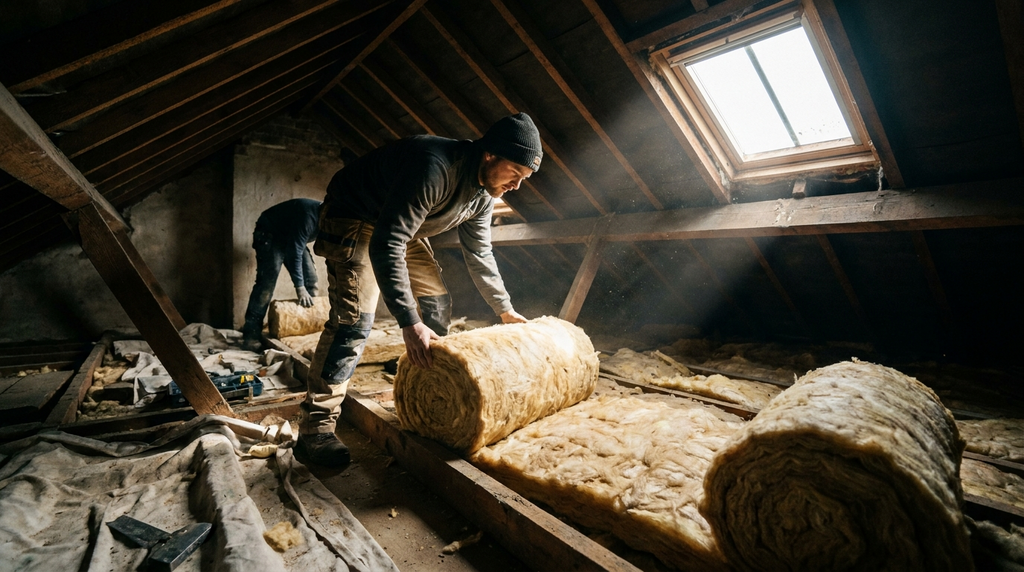
For most UK homes, exceeding 270 mm of mineral wool loft insulation offers negligible additional energy savings, making anything beyond that point effectively too much for cost-effectiveness. The Energy Saving Trust confirms that topping up from 120 mm to 270 mm saves around £35 per year on energy bills, but adding further layers typically yields less than a 1% improvement in heat retention (Energy Saving Trust, 2026).
- 270 mm of mineral wool is the cost-effective maximum for UK homes.
- Topping up from 120 mm to 270 mm saves about £35 per year.
- Exceeding 270 mm yields less than 1% improvement in heat retention.
The answer depends on your existing insulation thickness, home type, and whether you have a warm or cold loft. For a typical semi-detached house with 0 mm of insulation, installing 270 mm saves roughly £590 per year. However, if you already have 100 mm, adding another 170 mm saves only about £35 annually. The point of diminishing returns arrives at 270 mm for mineral wool, while sheep’s wool or PIR boards may perform differently. Loft boarding over thick insulation can also compress the material, reducing its effectiveness.
270 mm is the standard recommended depth
UK Building Regulations (Part L) recommend a minimum of 270 mm of mineral wool loft insulation for new installations or top-ups (GOV.UK, 2026). This depth balances material cost against energy savings. Beyond 270 mm, the heat loss through the loft floor becomes so low that the extra insulation provides minimal benefit. For example, increasing from 270 mm to 400 mm might reduce U-values from around 0.16 W/m²K to 0.11 W/m²K, but the annual saving on a typical home is under £10.
Excess thickness can cause ventilation problems
Insulation that is too thick can block eaves ventilation, leading to condensation and mould in the loft space. Building regulations require a 50 mm air gap between the insulation and the roof felt to allow airflow (BRE, 2026). If you add insulation beyond 270 mm without maintaining this gap, moisture can accumulate and damage roof timbers. This is especially critical in cold lofts where ventilation is essential to prevent rot.
Sheep’s wool and rigid boards have different limits
Sheep’s wool insulation typically has a lower thermal conductivity than mineral wool, meaning 200 mm can achieve similar performance to 270 mm of mineral wool. Rigid PIR boards are even more efficient, with 150 mm often sufficient for a U-value of 0.16 W/m²K (MCS Certified, 2026). For these materials, exceeding the depth recommended by the manufacturer or required by Building Regulations is wasteful. Always check the product’s declared lambda value and consult a registered installer for specific guidance.
A worked example
A typical 1930s semi-detached house in Manchester with no existing loft insulation would need 270 mm of mineral wool to hit the cost-effective maximum, costing roughly £650 for a professional install after the 0% VAT saving (in place until March 2027). The Energy Saving Trust estimates this depth saves about £590 per year on heating bills, giving a payback period of just over one year. Over 25 years, total savings reach nearly £14,750, assuming current energy prices hold. For a household that already has 120 mm of insulation, topping up to 270 mm costs around £300 and saves £35 annually, paying back in roughly nine years, still worthwhile, but far less dramatic. The Energy Saving Trust warns that exceeding 270 mm with mineral wool typically adds less than 1% to heat retention, making extra layers uneconomical for most UK homes.
| Item | Figure |
|---|---|
| Upfront cost after grants | £650 |
| Yearly savings | £590 |
| Payback period | 1.1 years |
| 25-year lifetime savings | £14,750 |
What homeowners often get wrong
The most common mistake is assuming that more insulation always means more savings, when in reality exceeding 270 mm of mineral wool delivers negligible returns. Here are three frequent errors to avoid
- Compressing insulation under loft boarding Many homeowners lay chipboard directly over thick insulation, crushing it from 270 mm down to 150 mm effective depth. This halves the R-value and wastes roughly £300 in material costs, while voiding the manufacturer’s warranty on thermal performance.
- Choosing PIR boards over mineral wool for cost PIR boards (foil-faced rigid panels) cost about three times more per square metre than mineral wool, yet both achieve similar U-values at 270 mm. Opting for PIR without a specific need like limited loft headroom can add £400 to a typical install with no extra energy saving.
- Ignoring air gaps around the insulation Leaving gaps of just 5% around pipes, joists, or the loft hatch can reduce overall effectiveness by up to 30%. This mistake costs around £100 in lost annual savings for a semi-detached home, as heat bypasses the insulation entirely.
Quick reference
- 270 mm of mineral wool loft insulation is the cost-effective maximum for most UK homes, with further layers offering less than 1% improvement.
- Topping up from 120 mm to 270 mm saves about £35 per year for a typical semi-detached house.
- ECO4 funding may cover the full cost of loft insulation for low-income households or those on certain benefits, with no upfront payment.
- A 270 mm install pays back in roughly one year for an uninsulated home, but nine years for a top-up from 120 mm.
- Never compress insulation under loft boards, it can halve the effective depth and waste your investment entirely.
Frequently Asked Questions
Yes, for most UK homes 400 mm of mineral wool is too much. The Energy Saving Trust confirms that going beyond 270 mm saves under £10 per year.
UK Building Regulations recommend a minimum of 270 mm of mineral wool loft insulation. According to GOV.UK, this depth balances cost and energy savings.
Excess thickness can compress the material, reducing its effectiveness. The Energy Saving Trust warns that loft boarding over thick insulation may also lower performance.