The current recommended depth for loft insulation is 270 mm
The question of how much loft insulation is best is one of the most common energy-efficiency queries UK homeowners face. The short answer is that the recommended depth for mineral wool loft insulation is 270 mm, based on achieving a U-value of 0.16 W/m²K or better (Energy Saving Trust, 2026). This depth is the minimum standard advised by the UK government’s Building Regulations for new homes and is considered best practice for existing homes (GOV.UK, Approved Document L1A, 2026). Going beyond 270 mm offers diminishing thermal returns, making 270 mm the “sweet spot” for cost-effective energy savings in most UK homes.
270 mm of mineral wool loft insulation is best, achieving a U-value of 0.16 W/m²K. This depth meets UK Building Regulations (2026) and saves £180-£295 per year on a 3-bed semi, with payback in under 2 years.
- Install 270 mm of mineral wool for the best U-value of 0.16 W/m²K.
- 270 mm is the UK Building Regulations minimum for new homes.
- Going beyond 270 mm gives diminishing thermal returns.
- Check your current depth, top up to 270 mm if below.
- Savings of £180-£295 per year on a 3-bed semi (Energy Saving Trust).
- The current recommended depth for loft insulation is 270 mm
- How the correct depth is calculated using U-values and current regulations
- Quick numbers cost, savings, and payback for 270 mm of loft insulation
- The direct answer to "how much loft insulation is best" for your home
- Eligibility for government grants and how they affect the amount you install
- How to verify your installer and certification for loft insulation
How the correct depth is calculated using U-values and current regulations
The “best” amount of loft insulation is determined by the target U-value, which measures heat loss in watts per square metre per degree Kelvin (W/m²K). For loft insulation, the current target is 0.16 W/m²K, a figure set by the 2022 update to Part L of the Building Regulations for England (DESNZ, Approved Document L, 2026). To achieve this U-value, mineral wool insulation typically requires a depth of 270 mm, but the exact depth can vary slightly depending on the material. For example, sheep’s wool or rigid boards may need a different thickness to reach the same U-value, though mineral wool remains the most common and cost-effective option. The Standard Assessment Procedure (SAP) 10.2, used for Energy Performance Certificates, confirms that a U-value of 0.16 W/m²K is the benchmark for loft insulation in new and existing homes (DESNZ, SAP 10.2, 2026).
Quick numbers cost, savings, and payback for 270 mm of loft insulation
The table below summarises typical costs and savings for installing 270 mm of mineral wool loft insulation in a typical three-bedroom semi-detached house, based on data from the Energy Saving Trust and Ofgem’s typical domestic consumption values for a medium home (Energy Saving Trust, 2026; Ofgem, TDCVs 2025/26, 2026).
| Installation method | Cost (£) | Annual saving (£/year) | Simple payback (years) |
|---|---|---|---|
| DIY (rolls of mineral wool) | £300–£400 | £300–£400 | 1–1.5 years |
| Professional installation | £700–£900 | £300–£400 | 2–3 years |
| Top-up from 100 mm to 270 mm (DIY) | £150–£250 | £100–£150 | 1–2 years |
| Top-up from 100 mm to 270 mm (professional) | £400–£600 | £100–£150 | 3–4 years |
The direct answer to “how much loft insulation is best” for your home
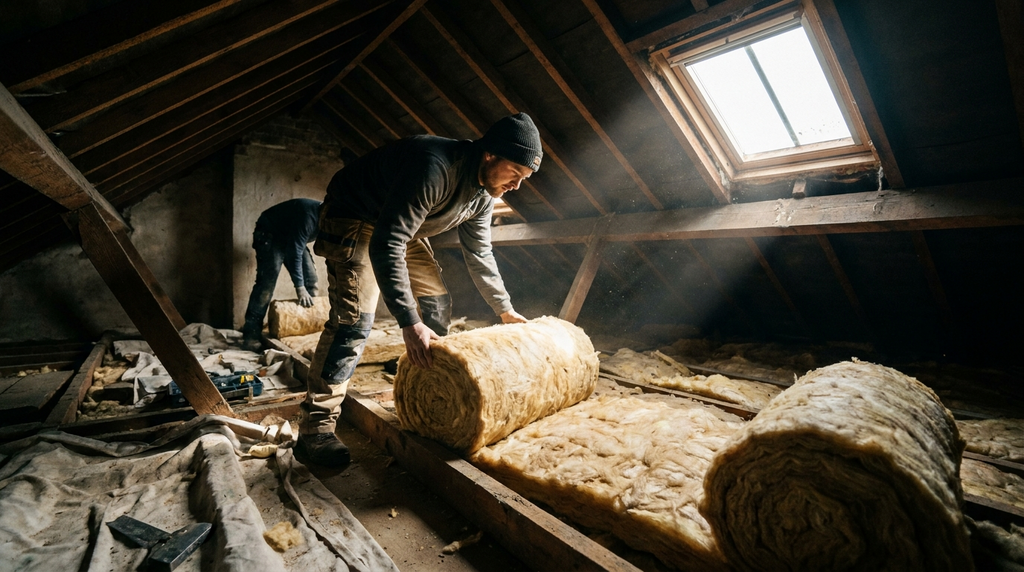
For a typical UK home with an uninsulated loft, the best amount of loft insulation is 270 mm of mineral wool, laid in two layers: 100 mm between the joists and 170 mm across the joists. This depth is the most cost-effective because it provides a U-value of 0.16 W/m²K, which is the current regulatory standard for maximum heat retention (Energy Saving Trust, 2026). Going above 270 mm, for example to 300 mm, yields only marginal additional savings, usually less than £10 per year, according to SAP 10.2 modelling (DESNZ, 2026). Also, exceeding 270 mm can complicate loft boarding or reduce ventilation, potentially leading to condensation issues if not managed carefully.
How to check your current loft insulation depth
Eligibility for government grants and how they affect the amount you install
The Great British Insulation Scheme closed on 31 March 2026. It funded insulation measures only and never covered windows or glazing. The Great British Insulation Scheme closed on 31 March 2026. It funded insulation measures only and never covered windows or glazing. Grants usually cover the cost of installing up to 270 mm, not more, as this is the benchmark for energy efficiency under the schemes.
How to verify your installer and certification for loft insulation
For loft insulation, the relevant certification is from the National Insulation Association (NIA) or a TrustMark-registered installer, as these schemes ensure compliance with Building Regulations and industry standards (TrustMark, 2026; National Insulation Association, 2026). Check that the installer is MCS-certified only if you are combining insulation with renewable heating, such as a heat pump, but for insulation alone, MCS is not required. TrustMark and NIA membership are the key marks to look for. Always ask for a certificate of compliance after installation, which should state the installed depth (for example, 270 mm) and the achieved U-value. You can find a registered installer via the GOV.UK TrustMark search tool (GOV.UK, 2026).
How to compare loft insulation quotes from certified installers
Frequently Asked Questions
You need 270 mm of mineral wool loft insulation to meet the UK target U-value of 0.16 W/m²K, as recommended by the Energy Saving Trust and Building Regulations Approved Document L1A (2026).
300 mm is not too much but offers diminishing returns beyond 270 mm. The Energy Saving Trust confirms that 270 mm is the cost-effective sweet spot for most UK homes.
The best depth is 270 mm for mineral wool, achieving a U-value of 0.16 W/m²K. This is the standard set by GOV.UK's Approved Document L (2026) and the Standard Assessment Procedure SAP 10.2.
Yes, you can top up existing insulation to reach 270 mm total. The Energy Saving Trust advises checking current depth and adding mineral wool layers as needed.
Installing 270 mm of mineral wool loft insulation costs around £300-£500 for a typical 3-bed semi, according to the Energy Saving Trust. Payback is usually within 2 years.
270 mm of mineral wool loft insulation gives a U-value of 0.16 W/m²K, the target set by Building Regulations Part L (2026) and confirmed by the Standard Assessment Procedure SAP 10.2.