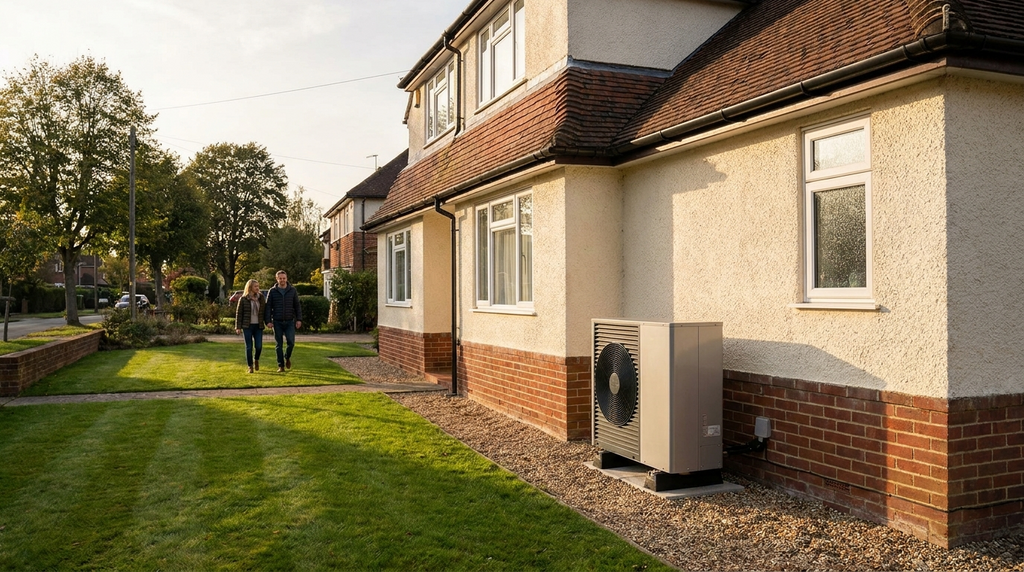
The Boiler Upgrade Scheme 2026 offers up to £7,500 off a heat pump, compared to a typical new gas boiler costing around £2,500 installed
The Boiler Upgrade Scheme (BUS) is a government grant built to help homeowners in England and Wales replace fossil fuel heating with a heat pump. It provides a fixed upfront payment of up to £7,500, deducted directly from your installer’s invoice, so you never handle the money yourself.
To put that in perspective, a typical gas boiler replacement in 2026 costs between £1,800 and £3,500 installed (Energy Saving Trust, 2026). After the BUS grant, an air source heat pump can cost between £1,500 and £6,000, meaning the upfront price can be comparable to or even lower than a new gas boiler. The scheme runs until 2028 and is administered by Ofgem on behalf of the Department for Energy Security and Net Zero (DESNZ).
The Boiler Upgrade Scheme pays a fixed £7,500 grant for air source heat pumps and £7,500 for ground source heat pumps
The grant amount is a flat £7,500 for both air source heat pumps (ASHPs) and ground source heat pumps (GSHPs). There is no variation by property size, location, or the specific model of heat pump you choose (GOV.UK, 2026).
The grant is deducted from the installer’s invoice before you pay, so you never handle the money yourself. The installer claims the £7,500 from Ofgem after the installation is complete and verified. For a ground source heat pump, which typically costs between £15,000 and £25,000 installed, the £7,500 grant is a significant but partial contribution. For an air source heat pump, which typically costs between £7,000 and £13,000 installed, the grant covers a much larger share of the cost.
You must meet four eligibility conditions to claim the 2026 grant
To qualify for the Boiler Upgrade Scheme 2026, your property must meet four conditions:
- Valid Energy Performance Certificate (EPC): Your EPC must have no outstanding recommendations for loft or cavity wall insulation. If your EPC recommends topping up loft insulation or filling cavity walls, you must complete those measures before applying (GOV.UK, 2026).
- MCS-certified installer: The heat pump must be installed by a company certified under the Microgeneration Certification Scheme (MCS) and registered with the BUS scheme. You can check the MCS register online.
- Location: The grant is available for properties in England and Wales only. Scotland operates a separate scheme through Home Energy Scotland, which offers different grant and loan options.
- No previous BUS grant: You cannot have received a BUS grant for the same property before. One grant per property is permitted.
If you live in a listed building or a conservation area, additional planning permission rules may apply, but the BUS grant itself does not require planning consent.
Quick numbers cost comparison, grant amount, and running costs
The table below compares typical installed costs, annual running costs, and the net cost to you after the BUS grant. Running cost estimates are based on the October 2026 price cap (24.5p/kWh for electricity, 6.0p/kWh for gas) and a heat pump Seasonal Coefficient of Performance (SCOP) of 3.5, meaning it produces 3.5 kWh of heat for every 1 kWh of electricity consumed (Ofgem, 2026; Energy Saving Trust, 2026).
| Item | Typical installed cost (GBP) | Annual running cost estimate (GBP) | Grant amount (GBP) | Net cost to homeowner (GBP) |
|---|---|---|---|---|
| New gas boiler | £2,500 | £900 | £0 | £2,500 |
| Air source heat pump (no BUS) | £10,000 | £650 | £0 | £10,000 |
| Air source heat pump (with BUS) | £10,000 | £650 | £7,500 | £2,500 |
| Ground source heat pump (no BUS) | £20,000 | £550 | £0 | £20,000 |
| Ground source heat pump (with BUS) | £20,000 | £550 | £7,500 | £12,500 |
These figures are typical estimates. Your actual costs will depend on your property size, existing heating system, and the complexity of the installation. The running cost savings assume the heat pump is correctly sized and installed.
The step-by-step application process runs through your installer
You do not apply to the Boiler Upgrade Scheme yourself. The entire process is handled by your chosen MCS-certified installer. Here is how it works:
- Find an MCS-certified installer: Use the MCS register or TrustMark website to find installers in your area. Check they are also registered with the BUS scheme.
- Get a quote with the grant deducted: The installer checks your EPC and property suitability, then provides a quote showing the total cost minus the £7,500 BUS grant.
- Installer submits the application: The installer submits the BUS application to Ofgem on your behalf. You will need to provide your EPC number and confirm you agree to the application.
- Ofgem approves the grant: Ofgem reviews the application and usually approves it within 5 working days (GOV.UK, 2026).
- Installation and payment: Once approved, the installer proceeds with the installation. After completion, the installer claims the grant from Ofgem, and you pay only the balance shown on your original quote.
The entire process typically takes 2 to 4 weeks from initial quote to installation, depending on installer availability and property complexity.
The BUS grant makes a heat pump cheaper than a gas boiler over its lifetime
Heat pumps are significantly more efficient than gas boilers. A typical heat pump has a Seasonal Coefficient of Performance (SCOP) of 3 to 4, meaning it delivers 3 to 4 kWh of heat for every 1 kWh of electricity used. A gas boiler, by contrast, is typically 85–90% efficient, meaning it delivers 0.85 to 0.9 kWh of heat per kWh of gas (Energy Saving Trust, 2026).
Even though electricity costs roughly four times more per kWh than gas, the heat pump’s efficiency means its running cost is typically 20–40% lower per kWh of heat delivered. Over a 15-year lifespan, the cumulative running cost savings can offset the higher upfront cost. With the £7,500 grant, an air source heat pump often costs less than a gas boiler over its lifetime, especially if you also factor in lower maintenance costs and the absence of a gas standing charge.
DESNZ analysis shows that heat pump running costs are now competitive with gas boilers at current energy prices (DESNZ, 2026).
You must verify your installer is MCS-certified and registered with the BUS scheme before signing a contract
Only MCS-certified installers can apply for the BUS grant on your behalf. Before signing any contract, check the installer’s MCS certification on the MCS register or TrustMark website. You should also ask for their BUS registration number, which confirms they are registered with Ofgem to process grants.
If you use an installer who is not MCS-certified, you cannot claim the grant. You would have to pay the full cost of the heat pump installation yourself, which could be £10,000 or more for an air source heat pump. To avoid this, always verify certification before agreeing to any work.
You can find a list of MCS-certified installers at mcscertified.com or through TrustMark at trustmark.org.uk.
The direct answer the Boiler Upgrade Scheme 2026 cuts the cost of a heat pump by £7,500. That makes it a realistic replacement for a gas boiler
The Boiler Upgrade Scheme 2026 provides a fixed £7,500 grant for air source and ground source heat pumps, deducted directly from your installer’s invoice. After the grant, an air source heat pump typically costs between £1,500 and £6,000, comparable to or cheaper than a new gas boiler installation.
The scheme is open to homeowners in England and Wales who meet the eligibility conditions, including having a valid EPC with no outstanding insulation recommendations and using an MCS-certified installer. The scheme runs until 2028, and you can claim one grant per property. How a heat pump works in a UK home Air source heat pump costs and savings For full details, visit the official GOV.UK page for the Boiler Upgrade Scheme.
Frequently Asked Questions
The grant is a flat £7,500 for both air source and ground source heat pumps in 2026 (GOV.UK). There is no variation by property size or location.
You need a valid Energy Performance Certificate (EPC) with no outstanding loft or cavity wall insulation recommendations. The property must be in England or Wales. Ofgem administers the scheme.
You choose an MCS-certified installer who handles the application. The installer claims the £7,500 from Ofgem after installation, deducting it from your invoice upfront.
The scheme runs until 2028, according to DESNZ. Grants are available on a first-come, first-served basis, so apply early.
No, you cannot combine the BUS grant with other government schemes like ECO4 for the same heat pump installation. Check with your installer for eligibility.