A ground source heat pump survey is a paid, on-site assessment that measures your home’s heat loss, checks your land area and ground conditions, and produces a report that confirms whether a ground source heat pump is feasible and eligible for the £7,500 Boiler Upgrade Scheme grant. The survey does not include installation; it is a separate, pre-installation step. You will receive a written report with a heat loss calculation, a ground loop design proposal, and a final cost estimate for the full installation.
A ground source heat pump survey typically costs £200–£400
The survey is the essential first step before any ground source heat pump (GSHP) installation can proceed in the UK. It determines if your property has enough land and the right ground conditions for the ground loop. The survey also calculates the heat loss of your home to size the heat pump correctly. Without a satisfactory survey, you cannot proceed with a GSHP installation eligible for the Boiler Upgrade Scheme grant (GOV.UK, 2026).
What a ground source heat pump survey actually involves on the day
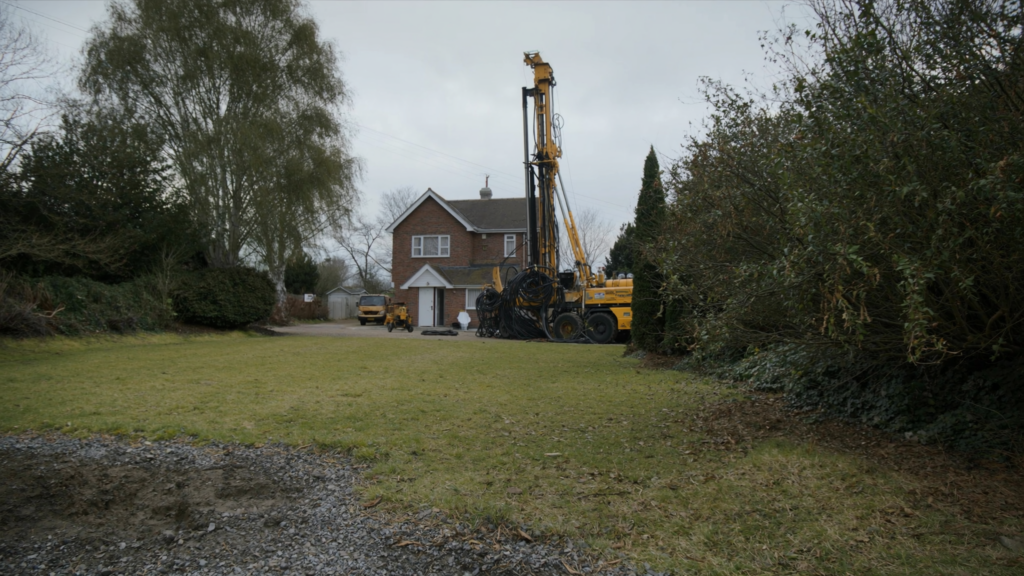
A surveyor will visit your property to conduct a visual inspection of the house and the outdoor area. They will measure the dimensions of rooms, check insulation levels, and assess the existing heating system. A thermal imaging camera may be used to identify areas of heat loss in the home. A trial pit or borehole may be dug to assess the soil type, depth, and thermal conductivity for the ground loop design (Energy Systems Catapult, 2026). The survey typically lasts between two and four hours, depending on the size of your property and the complexity of the ground conditions.
Who qualifies for the survey and who is automatically excluded
You must own the property and have sufficient outdoor space for a ground loop. For a horizontal loop, you typically need an area equivalent to 0.5 to 1.5 times the heated floor area of your home (Energy Saving Trust, 2026). Properties with a high heat demand (over 20 kW) or very poor insulation (U-values above 0.5 W/m²K) are often excluded from grant eligibility. A U-value is a measure of how well a building element (like a wall or roof) prevents heat from escaping; lower numbers mean better insulation. Listed buildings or properties in conservation areas may require additional planning permission before a survey can be arranged. Flats and apartments without exclusive access to a garden or land are automatically excluded from GSHP surveys for domestic installations (GOV.UK, 2026).
Quick numbers survey costs, grant amounts, and energy savings
| Item | Typical UK Figure |
|---|---|
| Survey cost (standalone) | £200 – £400 |
| Boiler Upgrade Scheme grant (2026) | £7,500 |
| Average installation cost (5-bed detached) | £18,000 – £28,000 |
| Annual heating bill saving vs. gas boiler | £500 – £1,200 |
Figures sourced from GOV.UK (Boiler Upgrade Scheme, 2026) and Energy Saving Trust (2026).
How the survey determines your Boiler Upgrade Scheme eligibility
The surveyor will produce a heat loss calculation (using MCS 020 or equivalent) to confirm the heat pump size is appropriate for your home (MCS, 2026). The property must have a suitable heat emitter system, such as underfloor heating or oversized radiators, to run at lower flow temperatures. The survey report must be submitted to your installer to apply for the £7,500 grant under the Boiler Upgrade Scheme. If the survey reveals the property is unsuitable, you may be offered a different low-carbon heating option, like an air source heat pump (GOV.UK, 2026).
How to verify your surveyor and installer are properly certified
The survey must be carried out by an MCS-certified installer or a qualified surveyor working for an MCS-certified company. MCS stands for the Microgeneration Certification Scheme, which sets quality standards for renewable energy technologies. Check the MCS Installer Database (MCS, 2026) to confirm the company holds current certification for ground source heat pumps. The installer should also be registered with TrustMark for consumer protection and warranty cover (TrustMark, 2026). For any electrical work involved in connecting the heat pump, the installer must be registered with NICEIC or NAPIT.
The direct answer what to expect from a ground source heat pump survey in the UK
A GSHP survey is a paid, on-site assessment (lasting 2–4 hours) that measures your home’s heat loss, checks your land area and ground conditions, and produces a report that confirms whether a ground source heat pump is feasible and eligible for the £7,500 Boiler Upgrade Scheme grant. The survey does not include installation; it is a separate, pre-installation step. You will receive a written report with a heat loss calculation, a ground loop design proposal, and a final cost estimate for the full installation. How the Boiler Upgrade Scheme grant works in 2026 Ground source heat pump installation costs and savings
Frequently Asked Questions
A ground source heat pump survey typically costs £200–£400 in the UK, according to industry estimates. This is roughly a tenth of the full installation cost.
The survey involves a visual inspection of your home and land, measuring room dimensions, checking insulation, and using a thermal imaging camera to find heat loss. A trial pit or borehole may be dug to assess ground conditions, as advised by the Energy Systems Catapult.
Yes, a survey is the essential first step before any ground source heat pump installation can proceed in the UK. Without a satisfactory survey, you cannot get a GSHP eligible for the Boiler Upgrade Scheme grant.
The survey typically lasts between two and four hours, depending on your property size and ground complexity. This includes the visual inspection, measurements, and any trial pit or borehole work.
You must own the property and have sufficient outdoor space for a ground loop. For a horizontal loop, you typically need an area equivalent to 0.5 to 1.5 times the heated floor area of your home, according to the Energy Saving Trust.