Solar photovoltaic panels are now installed on more than one million UK homes, and the most common property type taking them up is the three-bedroom semi-detached, the archetypal family home that sits at the heart of Britain’s housing stock. If you’re weighing up whether to go solar, the very first practical question is usually the most straightforward: how many panels do you actually need?
Most 3-bedroom houses in the UK need between 10 and 14 solar panels, forming a system of 3.5 kWp to 4 kWp, which is sized to match the typical annual consumption of 2,900 to 3,500 kWh cited by Ofgem. A fully installed system of this size costs between £6,000 and £9,000, with VAT currently at 0% for residential solar. The single most important thing to know is that your roof's orientation and pitch will directly affect how many panels you need, so always use an MCS-certified installer who will carry out a proper site assessment before recommending a system size.
- Most 3-bedroom UK homes need between 10 and 14 solar panels, forming a system of 3.5 kWp to 4 kWp
- Get at least 3 quotes from MCS-certified installers to ensure quality installation and eligibility for the Smart Export Guarantee
- A south-facing roof at 30 to 40 degrees pitch will generate the most electricity — check your roof orientation before requesting quotes
- Pair your solar installation with a battery storage unit to maximise self-consumption and reduce reliance on the grid during evenings
- Check whether your property is listed or in a conservation area before proceeding, as permitted development rights may not apply
- Use Ofgem's typical domestic consumption figure of 2,900 to 3,500 kWh per year as your baseline when sizing a system with your installer
- Register for the Smart Export Guarantee through your energy supplier after installation to earn payments for surplus electricity exported to the grid
- Understanding Solar Panels and How They Work for UK Homes
- How Many Solar Panels Does a Typical 3-Bed House Actually Need
- How Your Roof Affects the Number of Panels You Can Fit
- How Your Household Energy Use Shapes the Right System Size
- What a 3-Bed House Solar System Costs in 2026
- Solar Panel System Size Comparison for a 3-Bed Home
- Available Grants and Financial Support Worth Knowing About in 2026
- How to Choose the Right Solar Installer, a Step-by-Step Guide
- Verifying Your Installer's Credentials and Protecting Yourself
Most three-bedroom houses in the UK need between 10 and 14 solar panels, forming a system of around 3.5 kilowatt peak (kWp) to 4 kWp. This size of system is well matched to the typical annual electricity consumption of a three-bed home, which falls somewhere between 2,900 and 3,500 kilowatt hours (kWh) per year according to Ofgem’s typical domestic consumption figures. The exact number you’ll need depends on your roof’s size and orientation, how your household uses energy, and your budget, all of which this guide covers in practical detail.
Understanding Solar Panels and How They Work for UK Homes
Solar photovoltaic (PV) panels convert daylight, not just direct sunshine, into usable electricity for your home. This is an important distinction for UK homeowners, because Britain’s frequently overcast skies do not prevent solar panels from generating electricity; they simply reduce the output compared to a perfectly clear day. Modern solar panels generate meaningful amounts of power even on dull, cloudy days, which is why the technology works well throughout the UK, including in Scotland and the north of England.
It’s also worth clarifying upfront that this article focuses entirely on solar PV, which generates electricity. There is a separate technology called solar thermal, which uses sunlight to heat water directly. The two are often confused, but they are entirely different systems with different components, costs, and benefits. Solar thermal is much less commonly installed today; solar PV is the mainstream choice for UK homeowners.
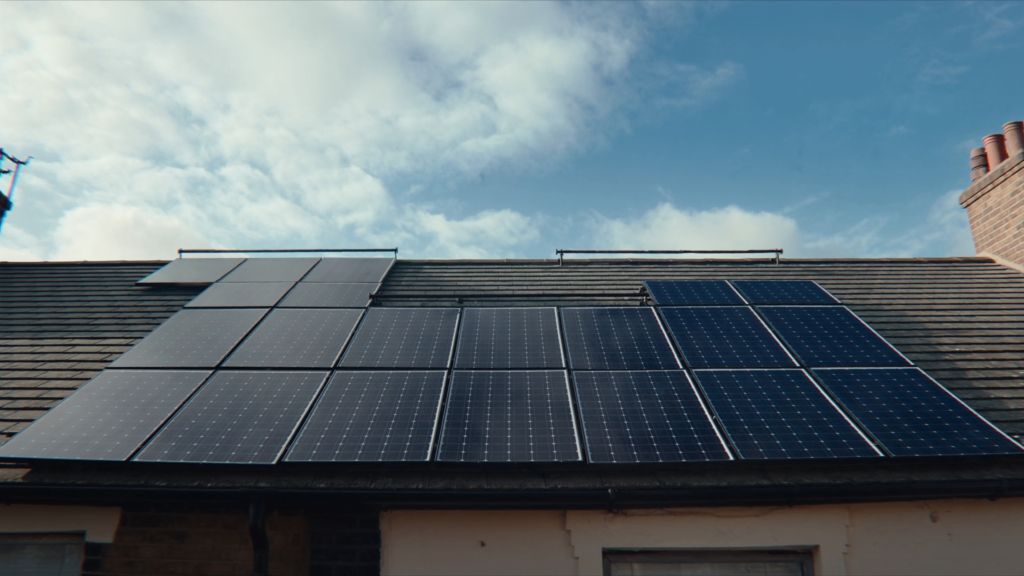
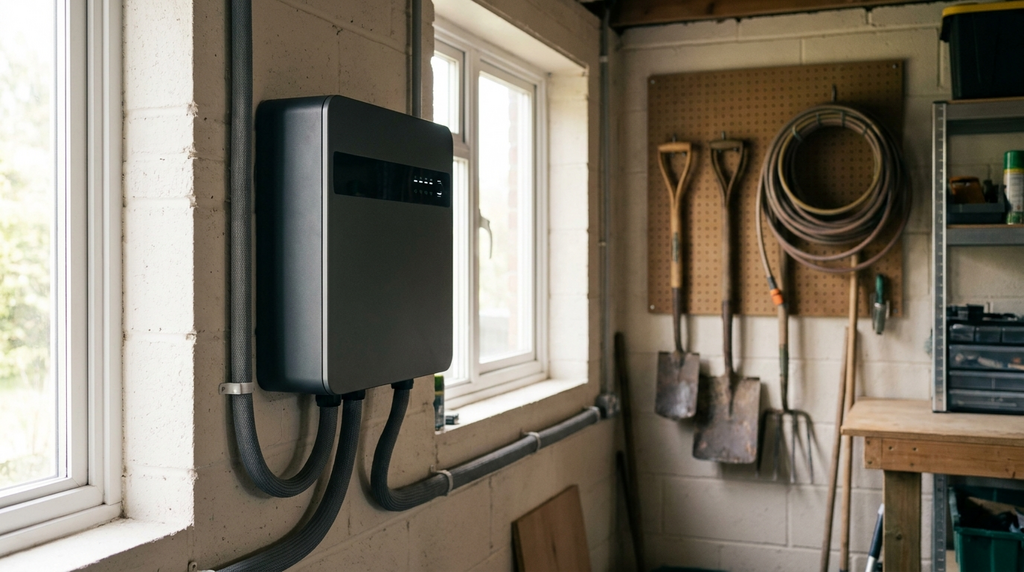
A standard home solar PV system has three main components. First, the panels themselves, which are mounted on your roof and contain photovoltaic cells that generate direct current (DC) electricity when exposed to light. Second, an inverter, which is a box typically installed in your loft or utility room that converts the DC electricity from the panels into alternating current (AC), the type your home’s appliances and sockets actually use. Third, an optional battery storage unit, which stores surplus electricity generated during the day so you can use it in the evening when your panels are no longer generating.
Throughout this article you’ll encounter the term kilowatt peak (kWp). This is the rated maximum output of a solar panel or system under standardised ideal conditions (known as Standard Test Conditions). It’s a theoretical ceiling rather than a guaranteed daily output, but it’s the standard industry measure used to describe and compare systems. A 4 kWp system, for instance, contains enough panels to produce a combined maximum of 4,000 watts at peak performance.
Practical tip, before you speak to any installer, take a few minutes to understand these three terms: solar PV, kWp, and inverter. Knowing what they mean will help you ask better questions and interpret quotes with confidence.
How Many Solar Panels Does a Typical 3-Bed House Actually Need
The clear answer is that most three-bedroom homes in the UK are well served by a system of 10 to 14 panels, typically sized between 3.5 kWp and 4 kWp. This range is broad enough to cover the majority of three-bed properties, from a modest terrace to a larger detached home.
To understand why, it helps to start with consumption. A typical three-bedroom house uses somewhere between 2,900 and 3,500 kWh of electricity per year, based on Ofgem’s typical domestic consumption values. A well-positioned 3.5–4 kWp solar system in the UK can generate roughly 3,000 to 3,600 kWh annually, meaning it has the potential to cover a very significant portion of your annual electricity demand, though how much of that generation you actually benefit from depends on when you use energy (more on this in a later section).
The reason “the right number” isn’t a single fixed figure is that solar panels are not a one-size-fits-all product. A three-bed home occupied by a family with an electric vehicle and a heat pump has vastly different energy needs to the same-sized house occupied by a retired couple who are out regularly. Equally, a home with a large, unobstructed south-facing roof can physically accommodate more panels than one with a small, north-facing roof divided by a chimney stack.
A standard modern solar panel is typically rated at between 350 watts (W) and 400W. This means a 4 kWp system would consist of ten 400W panels, or roughly eleven to twelve panels at 350W each. If an installer quotes you a system and doesn’t specify the wattage per panel, always ask, it’s the most straightforward way to sense-check whether the number of panels they’re proposing adds up to the system size they’re quoting.
Practical tip, divide the total system size in watts by the wattage per panel to check the maths on any quote you receive. A 4,000W system made up of 400W panels should contain exactly 10 panels, not eight and not fourteen.
How Your Roof Affects the Number of Panels You Can Fit
Your roof’s orientation, size, pitch, and any obstacles on it are among the most influential factors in determining how many panels you can install and how well they’ll perform. A good installer will assess all of these before finalising a system design.
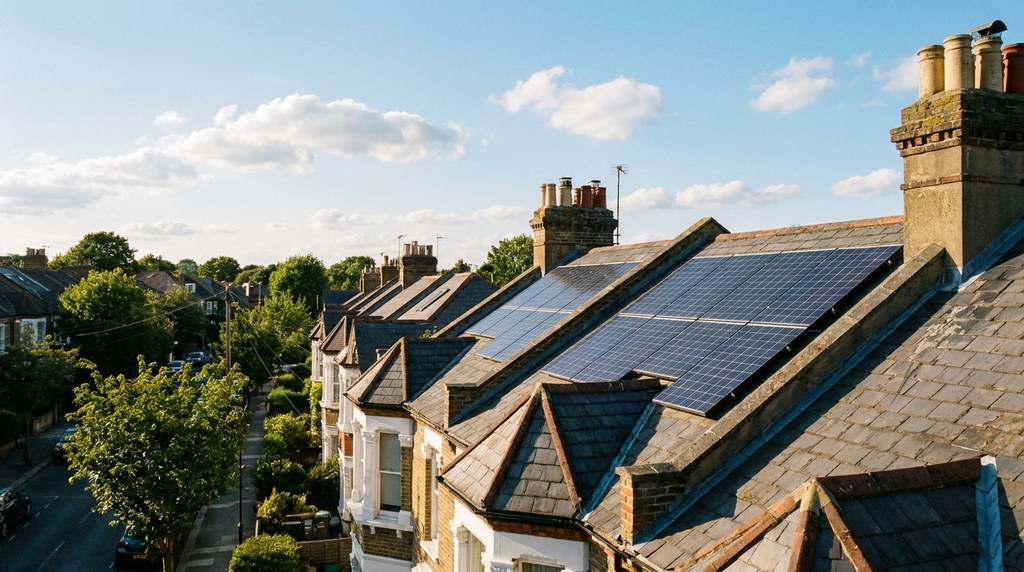
Roof orientation matters enormously. South-facing roofs are the gold standard in the UK, receiving the most direct sunlight across the course of a day and year. According to Energy Saving Trust guidance, a south-facing roof typically produces around 20% more electricity annually than an equivalent east- or west-facing roof. East and west orientations are still viable, many homes have panels split across both sides of a pitched roof, but a north-facing roof is generally considered unsuitable for solar panels, as it receives very little direct sunlight and would produce a poor return on investment.
Usable roof area sets the physical upper limit on how many panels you can install. Each standard solar panel occupies roughly 1.7 m² to 2 m² of roof space. A usable south-facing roof section of 20 m² could realistically accommodate 10 to 12 panels, depending on their physical dimensions. To put that into context, many three-bedroom semi-detached homes have a rear roof section of around 25 to 35 m², though the amount that is genuinely usable after accounting for obstacles is often less.
Roof obstacles reduce available space and require installers to leave clearance around them for both safety and practical reasons. Common obstacles include chimneys, skylights, roof windows (such as Velux-style openings), soil or vent pipes, and satellite dishes. Each one removes usable panel space and may affect the layout of the array. A professional installer will map these out as part of their survey.
Roof pitch also plays a role. The optimal pitch for solar panels in the UK is generally considered to be between 30 and 40 degrees, as this angle maximises the amount of sunlight the panels receive over the course of a year given the UK’s latitude. Very flat roofs (below around 15 degrees) can suffer from reduced performance and potential soiling, while very steep roofs (above 50 degrees) reduce the panels’ exposure to lower-angled winter sun.
Practical tip, before getting quotes, walk around your home and note your roof’s main orientation, count any obvious obstacles, and estimate the approximate usable area. This preparation will help you have a much more productive conversation with installers.
How Your Household Energy Use Shapes the Right System Size
The number of panels that makes financial sense for your home is closely linked to how much electricity your household actually uses, and importantly, when during the day you use it. Getting clarity on both before speaking to installers will significantly improve the quality of advice you receive.
The single most useful piece of information you can bring to any installer conversation is your actual annual electricity consumption in kWh. You’ll find this on your most recent annual energy bill, or on your smart meter’s in-home display or associated app if you have one. This figure is your baseline, it tells you and the installer how large a system would be needed to cover a meaningful proportion of your demand.
Lifestyle factors can shift this calculation significantly. Homes with an electric vehicle (EV) charged at home may consume an additional 2,000 to 4,000 kWh annually, depending on mileage. Homes with an air source heat pump as their primary heating system, increasingly common in new builds and retrofit properties, may add a further 3,000 to 6,000 kWh or more per year. Both of these dramatically increase the case for a larger system, and potentially for battery storage as well. air source heat pump costs and savings explained
The timing of your energy use matters just as much as the total amount. Solar panels generate most of their electricity between approximately 9am and 4pm. A household where adults are away from home at work during the day and use most of their electricity in the morning and evening will naturally self-consume a lower proportion of their solar generation. This wasted generation is either exported to the grid or sits unused.
Self-consumption rate is the percentage of your total solar generation that you actually use yourself rather than export to the grid. A higher self-consumption rate means more of your generated electricity is displacing grid electricity at the full unit rate, which is where the most meaningful bill savings come from. Households with low daytime self-consumption should seriously consider adding a battery storage unit, which captures surplus daytime generation and makes it available in the evening.
Practical tip, if you have a smart meter, download or request your half-hourly consumption data. This shows your usage pattern hour by hour and will reveal how much of your demand falls during solar generation hours, giving you a much clearer picture of whether battery storage would benefit you.
What a 3-Bed House Solar System Costs in 2026
Understanding the realistic cost of a solar system is essential before you start collecting quotes, so you can quickly identify whether a price is broadly reasonable or worth questioning.
In 2026, a fully installed solar PV system of 3.5 to 4 kWp for a three-bedroom house typically costs between £5,000 and £8,000. This range reflects genuine variation in panel brand quality, inverter specification, installer pricing, scaffolding requirements, and regional labour costs. London and the South East tend to be at the upper end of this range; parts of the Midlands and North may come in lower. Always obtain at least three written quotes before committing.
A typical installation quote should include the following components, and you should ask for an itemised breakdown if it isn’t provided
- The solar panels (number, brand, and wattage per panel)
- The inverter (make, model, and warranty period)
- Mounting hardware and roof fixings
- Electrical work and connection to the consumer unit
- Scaffolding hire and erection
- System commissioning and testing
- MCS certification documentation, which you’ll need for the Smart Export Guarantee
Adding a battery storage unit typically costs an additional £2,500 to £5,000 on top of the panel installation, depending on the battery’s usable capacity (measured in kWh). A 5–6 kWh battery is often sufficient for a three-bed home, while larger households or those with EVs may benefit from 10 kWh or more. Whether a battery is worth the additional outlay depends heavily on how much surplus generation your system is likely to produce and how little of your solar generation you currently use during the day.
One genuinely significant financial point worth highlighting is that VAT on residential solar panel installations remains at 0% in 2026. This has been the case since the government removed the 5% VAT rate that previously applied. On a £6,500 system, this is a saving of £325 compared to what you’d pay at the standard 20% rate, a meaningful reduction that is already factored into the prices quoted by reputable installers. solar panel costs and savings guide
Practical tip, if a quote seems unusually low, ask specifically whether it includes scaffolding, MCS certification, and all electrical work. These are the items most commonly omitted from headline prices by less reputable traders.
Solar Panel System Size Comparison for a 3-Bed Home
The table below sets out the key figures for five common system sizes that are relevant to a three-bedroom house, from a compact 3 kWp array to a more generous 5 kWp system. All generation estimates are based on a south-facing roof with a pitch of around 35 degrees, using typical UK irradiance data consistent with Energy Saving Trust solar calculator methodology and MCS guidance.
| System Size | Approximate Number of Panels | Estimated Annual Generation | Typical Installed Cost (excl. battery) | Estimated Annual Bill Saving | Approximate Roof Space Required |
|---|---|---|---|---|---|
| 3 kWp | 8 to 9 panels | 2,550 to 2,700 kWh | £4,500 to £5,500 | £450 to £650 | 14 to 18 m² |
| 3.5 kWp | 10 panels | 2,975 to 3,150 kWh | £5,000 to £6,500 | £520 to £750 | 17 to 20 m² |
| 4 kWp | 10 to 12 panels | 3,400 to 3,600 kWh | £5,500 to £7,500 | £600 to £850 | 20 to 24 m² |
| 4.5 kWp | 12 to 13 panels | 3,825 to 4,050 kWh | £6,000 to £8,000 | £650 to £950 | 22 to 26 m² |
| 5 kWp | 13 to 14 panels | 4,250 to 4,500 kWh | £6,500 to £9,000 | £700 to £1,050 | 25 to 28 m² |
A few important notes on interpreting this table
- Generation estimates assume a south-facing roof at optimal pitch. An east- or west-facing roof may generate 15–20% less annually.
- Bill savings are indicative and assume a reasonable self-consumption rate alongside Smart Export Guarantee (SEG) payments for exported electricity. Your actual savings will depend on your electricity tariff, your usage patterns, and the SEG rate your supplier offers.
- The SEG requires all licensed energy suppliers with over 150,000 customers to offer a tariff that pays you for surplus electricity exported to the grid. Rates vary between suppliers and change regularly, so always compare current SEG tariffs before choosing a supplier. Smart Export Guarantee explained
- All figures are indicative. Actual output and savings depend on roof orientation, shading from trees or neighbouring buildings, panel efficiency, inverter losses, and local weather patterns.
Practical tip, use the generation estimate column to cross-check what an installer tells you a system will produce. If their quoted annual generation figure is significantly higher than the range shown for your system size, ask them to explain the basis for that estimate.
Available Grants and Financial Support Worth Knowing About in 2026
Government financial support for solar panels is more limited than for heat pumps, but there are several schemes and ongoing benefits that three-bed homeowners should be aware of before making a decision.
ECO4, the Energy Company Obligation Scheme
ECO4 is a government-mandated scheme that requires larger energy suppliers to fund energy efficiency improvements for eligible households. It can cover solar PV installations for low-income or vulnerable households living in properties with a low Energy Performance Certificate (EPC) rating, typically EPC bands E, F, or G. Eligibility is means-tested and linked to receipt of certain qualifying benefits. If you think you might qualify, the best starting point is the government’s Simple Energy Advice (SEA) service, or contacting your energy supplier directly. ECO4 eligibility and how to apply
Great British Insulation Scheme
The Great British Insulation Scheme (GBIS) is primarily focused on insulation measures, loft insulation, cavity wall insulation, and solid wall insulation, rather than solar panels. It does not directly fund solar PV installations. However, improving your home’s insulation before or alongside solar panels is genuinely good practice: a better-insulated home reduces overall energy demand, which means a smaller (and cheaper) solar system can meet a higher proportion of your needs. The Great British Insulation Scheme closed on 31 March 2026. It funded insulation measures only and never covered windows or glazing. loft insulation costs and savings
Boiler Upgrade Scheme
The Boiler Upgrade Scheme (BUS) provides £7,500 towards the cost of an air source heat pump installation in England and Wales. It does not directly support solar PV. However, the two technologies work particularly well together: a heat pump is an electrical device, so adding solar panels to a heat pump home can meaningfully reduce the cost of running the heat pump during daylight hours. If you’re planning a broader home retrofit that includes moving away from a gas boiler, considering solar and a heat pump as a combined upgrade is well worth exploring with a qualified installer.
The Smart Export Guarantee, an Ongoing Benefit Rather Than a Grant
The Smart Export Guarantee (SEG) is not a grant but a continuous financial benefit that runs for as long as you have solar panels and an SEG contract. Under the scheme, energy suppliers with over 150,000 customers are legally required to offer a tariff that pays you for every unit of electricity you export to the grid. Rates are set by individual suppliers rather than the government, so they vary considerably. Checking and comparing current SEG tariffs from multiple suppliers when you install your system, and periodically thereafter, is worthwhile, as switching SEG supplier is straightforward and can meaningfully improve your returns over time.
Practical tip, even if you don’t qualify for ECO4, ensure your installer registers your system with MCS on completion. Without MCS certification, you cannot access the Smart Export Guarantee, which over a 25-year panel lifespan can represent thousands of pounds in export payments.
How to Choose the Right Solar Installer, a Step-by-Step Guide
Choosing the right installer is arguably more important than choosing the right panels. A well-specified system poorly installed will underperform and create problems; a slightly more modest system installed carefully by a reputable company will deliver reliable results for decades. Here is a clear process to follow.
- Check MCS certification first. The Microgeneration Certification Scheme (MCS) is the industry standard for solar PV and other small-scale renewable technologies. Only MCS-certified installers can provide installations that qualify for the Smart Export Guarantee. You can verify any installer’s MCS status on the official register at mcscertified.com, always check before accepting a quote.
- Look for TrustMark registration. TrustMark is the government-endorsed quality scheme for home improvement tradespeople. TrustMark-registered businesses have been vetted for technical competence, customer service standards, and trading practices. Registration does not guarantee perfection, but it provides an additional layer of accountability and a formal complaints resolution process if something goes wrong.
- Get a minimum of three written quotes. Each written quote should clearly state the system size in kWp, the number and wattage of panels, the brand and model of the inverter, the expected annual generation in kWh, the full scope of work included, and the total cost. Comparing like for like is only possible when all of this information is set out clearly.
- Ask about their survey process. A reputable installer will always carry out a survey of your property before providing a final confirmed price. This may be a physical roof survey, or in some cases a detailed remote survey using satellite imagery, aerial photography, and structural assessment tools. Be cautious about any company that provides a firm quote without any assessment of your specific property, they cannot know what they are quoting for.
- Check reviews and references. Look for recent installer reviews on Trustpilot, Google Reviews, or Which? Trusted Traders. Pay particular attention to reviews that mention the installation process and aftercare rather than just the sales experience. You can also ask the installer to provide references from recent local customers who would be willing to speak with you or allow you to see their installation.
- Confirm warranty terms in writing. Quality solar panels typically carry a 25-year performance warranty guaranteeing that output will not fall below a specified percentage of the original rated capacity. Inverters are usually warranted for 5 to 12 years, depending on the manufacturer. Ask about the workmanship warranty for the installation itself, this should cover any issues with the mounting, weatherproofing, or electrical work that emerge after installation.
Practical tip, when comparing quotes, don’t automatically choose the cheapest. A quote that is significantly lower than the other two is often lower for a reason: cheaper panels, a cheaper inverter, or work that has been scoped out. Always ask what accounts for the difference.
Verifying Your Installer’s Credentials and Protecting Yourself
Rogue traders operate in the solar industry as in all home improvement sectors, and the relatively high value of a solar installation makes it a target for unscrupulous operators. Taking a few straightforward verification steps before parting with any money is the best protection available to you as a homeowner.
MCS certification is the non-negotiable minimum. Without it, your installation will not qualify for the Smart Export Guarantee, and the quality assurance protections that MCS membership requires of its members, including proper system design, component quality standards, and post-installation paperwork, will not apply. Verify the installer’s MCS number on the register at mcscertified.com, not just by taking their word for it.
TrustMark registration should be verified at trustmark.org.uk. As noted above, this provides government-backed quality assurance and access to a formal dispute resolution process. DESNZ (the Department for Energy Security and Net Zero) endorses TrustMark as the standard for green home improvements.
The electrical work involved in a solar installation must be carried out by, or signed off by, a qualified electrician registered with a competent person scheme. For solar PV, this typically means the installer has an electrician on their team registered with NICEIC or NAPIT, which are the principal government-approved bodies for electrical installation work in the UK. Ask your installer specifically who will carry out the electrical works and whether that person is NICEIC or NAPIT registered, you can verify this on their respective websites.
Regarding payment, never pay the full cost upfront. A reasonable deposit of 10–25% is industry standard; the balance should be paid on completion. Be extremely wary of any installer asking for full payment before work begins. Where you’re paying by debit or credit card, a credit card payment of at least part of the cost provides additional consumer protection under Section 75 of the Consumer Credit Act.
Finally, make sure your installer provides you with all of the post-installation documentation you are entitled to receive. This includes your MCS installation certificate, your system’s generation data (either via a monitoring portal or physical display), any structural survey report, and the electrical installation certificate. You will need the MCS certificate to register for the Smart Export Guarantee with your energy supplier, without it, you cannot receive SEG payments.
Practical tip, photograph the MCS certificate and keep it somewhere safe, along with all warranty documents. If you sell your home, these documents add demonstrable value and will be requested by the buyer’s solicitor as part of the conveyancing process.
Choosing solar panels for a three-bedroom home is a significant financial decision, but it is one that is well supported by clear data, strong consumer protections, and a mature installer market. The key is to go in informed, knowing what size system makes sense for your home, what a fair price looks like, and which credentials to verify before signing anything. Take your time, get multiple quotes from MCS-certified and TrustMark-registered installers, and be realistic about savings rather than accepting optimistic projections at face value. Done right, a well-specified solar system is one of the most cost-effective and durable home improvements available to UK homeowners today.
Frequently Asked Questions
A typical 3-bedroom UK house needs between 10 and 14 solar panels, making up a system of roughly 3.5 kWp to 4 kWp. This size is built to match the average annual electricity consumption of 2,900 to 3,500 kWh per year as cited by Ofgem. Your exact number will depend on your roof's orientation, available space, and how much electricity your household uses.
A 3.5 kWp to 4 kWp solar PV system for a 3-bedroom home typically costs between £6,000 and £9,000 fully installed in the UK. Prices vary depending on panel brand, installer, and whether you add battery storage, which adds roughly £2,500 to £5,000. VAT on residential solar installations is currently 0%, which significantly reduces the overall cost compared to previous years.
A correctly sized solar PV system can generate enough electricity to cover a large proportion of a typical 3-bedroom household's annual usage, but not all of it — especially during winter months and at night. A 4 kWp system in the UK typically generates between 3,400 and 3,800 kWh per year, which could cover 80 to 100% of an average household's daytime consumption. Adding a battery storage system, costing £2,500 to £5,000, allows you to store surplus daytime generation for evening use.
In most cases, solar panels on a standard UK home are covered by permitted development rights and do not require planning permission. However, if your property is listed, in a conservation area, or in a National Park, you will likely need to apply for planning consent before installation. Always confirm with your local planning authority before proceeding, as rules can differ across England, Scotland, and Wales.
The Smart Export Guarantee (SEG) is a UK government-backed scheme that requires licensed energy suppliers to pay homeowners for surplus solar electricity exported back to the grid. Rates vary by supplier but typically range from 4p to 20p per kWh, with some tariffs offering more at certain times of day. To qualify, your system must be installed by an MCS-certified installer and be no larger than 5 MW in capacity.