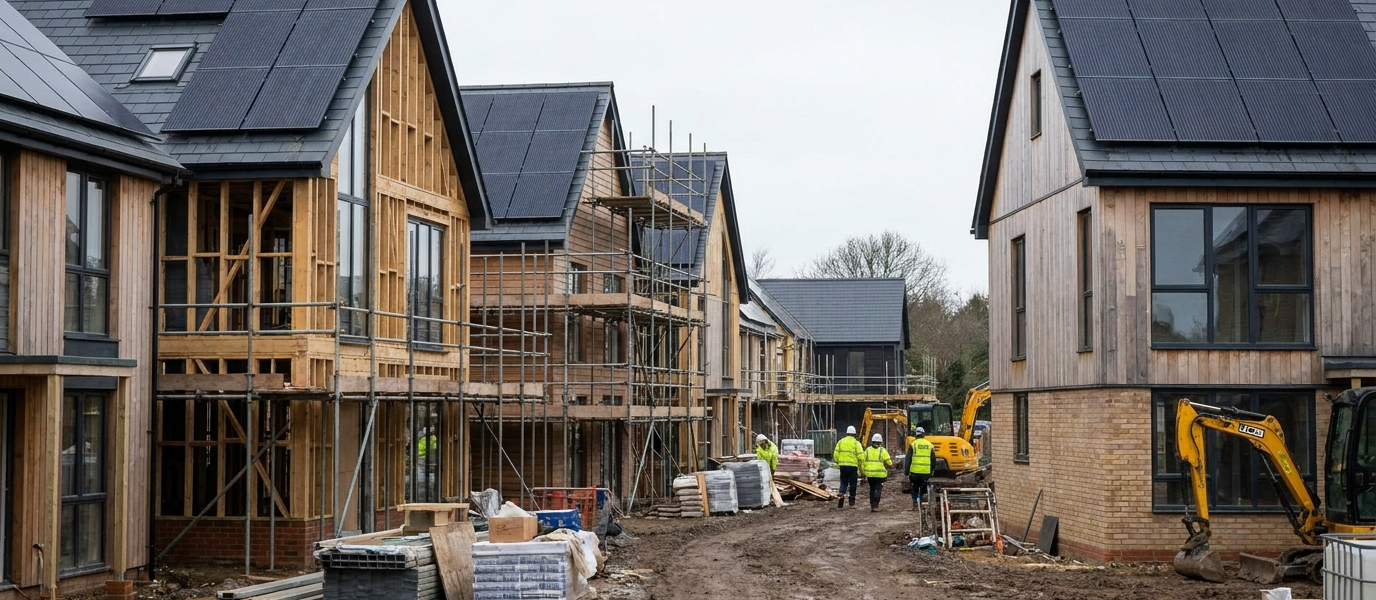
England’s new Future Homes and Buildings Standards, confirmed in March 2026, will require all new homes and major renovations to cut carbon emissions by up to 80% compared to current Building Regulations. The BCIS calls the shift “vital yet ambitious” and predicts construction costs will rise by 5-12%, driven by mandatory heat pumps, triple glazing and enhanced insulation. Pinsent Masons adds that developers face legal liability if homes fail to meet the new performance targets, raising the stakes for compliance.
Who qualifies, and who doesn’t
The standards apply to all new dwellings and certain major renovations in England from 2026. Projects that replace more than 25% of the building envelope, walls, roof, windows, will trigger the full requirements. Extensions and loft conversions may fall under a lighter touch but still need to meet higher fabric efficiency. The BCIS notes that the cost premium is steepest for small builders who lack economies of scale, with a typical 3-bed semi costing an extra £8,000-£15,000 to build.
What it costs a typical 3-bed semi
The BCIS puts the cost uplift at 5-12%, which on a £250,000 new build means an extra £12,500-£30,000. Pinsent Masons flags that this does not include the cost of mandatory heat pumps, which add £7,000-£12,000 alone. However, the running costs drop sharply. A home built to the new standard should use 40-50% less energy than one built to current regs, saving a typical household £400-£700 a year on gas and electricity. The EPC rating will likely hit Band B or A, compared to the current Band C average for new builds.
The catch: grants and funding gaps
But the grants landscape is uneven. The Boiler Upgrade Scheme provides £7,500 towards heat pumps, but it is for existing homes only, not new builds. The ECO4 scheme targets low-income households and does not cover new construction. For major renovations, the Home Upgrade Grant (HUG2) may help with insulation and heat pumps, but only in off-gas-grid areas. The BCIS warns that without targeted support, small developers may struggle to absorb the costs, potentially slowing housing delivery.
What this misses: enforcement and skills
Pinsent Masons highlights a deeper risk: the new standards rely on airtight construction and mechanical ventilation, which demand skilled installation. A poorly fitted heat pump or leaky ductwork can wipe out the efficiency gains, and trigger legal claims under the new performance-based compliance regime. The BCIS adds that the supply chain for triple glazing and high-performance insulation is not yet at scale, which could push prices higher than the 12% estimate. Both sources agree that the transition will require a step change in training and quality assurance across the industry.
Next steps for homeowners
If you are planning a new build or major renovation after 2026, start now. Engage a designer or architect who understands the new standards, most will need to retrain. For existing homes, the standards do not apply directly, but upgrading to heat pumps, triple glazing and better insulation will future-proof your property and improve its EPC rating. Check eligibility for the Boiler Upgrade Scheme (heat pumps) or HUG2 (off-gas-grid homes). The BCIS advises budgeting a 10% contingency for cost overruns. Pinsent Masons recommends a compliance audit before construction starts. The clock is ticking, the standards take effect in 2026, and early adopters will have the most options.
Frequently Asked Questions
No, they apply only to new builds and major renovations that replace more than 25% of the building envelope. If you are extending or converting a loft, you may need to meet higher fabric standards, but not the full heat pump requirement. For existing homes, upgrading to heat pumps and insulation remains voluntary, though grants like the Boiler Upgrade Scheme can help.
The BCIS estimates a 5-12% increase in build costs, or £8,000-£15,000 on a typical 3-bed semi. This includes mandatory heat pumps, triple glazing and enhanced insulation. However, running costs drop by £400-£700 a year, so the payback period is 15-25 years, depending on energy prices.
No, the Boiler Upgrade Scheme and ECO4 are for existing homes only. For major renovations, the Home Upgrade Grant (HUG2) may be available if you are off the gas grid. The BCIS and Pinsent Masons both recommend budgeting for the full cost and exploring local authority top-up schemes.




