Maidenhead’s Housing Story and Why Eco Upgrades Make Real Sense Here
Maidenhead sits in the Thames Valley in Royal Borough of Windsor and Maidenhead, with the river itself forming a natural boundary to the south of the town. It’s a place that expanded rapidly during the post-war decades, which means a large chunk of its housing stock, particularly across estates like Furze Platt, Cox Green, and Boyn Hill, dates from the 1950s through to the 1980s. These are the homes where eco upgrades deliver the biggest bang for your buck.
The town’s geography matters for energy too. Sitting in the broad Thames Valley, Maidenhead is relatively sheltered from the driving rain and winds that affect more exposed parts of the South East. It’s not high ground, the town centre sits at around 30 metres above sea level, though the land rises gently towards White Waltham and Furze Platt to the north. That sheltered position, combined with southern England sunshine levels, makes this a genuinely excellent location for solar panels and heat pumps alike.
And there’s a compelling financial reason to act. South East property values mean that every pound you spend on eco improvements adds real value to your home. A Band C property upgraded to Band B or Band A in Maidenhead commands a meaningful premium in one of England’s strongest housing markets.
How Energy Efficient Are Maidenhead Homes Really
The headline figure is encouraging, the average EPC rating in Maidenhead is Band C, which puts the town above the national average of Band D. In practical terms, that means many homes here are already reasonably well insulated and have relatively modern heating systems. But “above average” doesn’t mean “job done.”
A typical Band C home in Maidenhead uses around 10,500 kWh of gas per year and 3,000 kWh of electricity. At current 2026 energy prices, that works out to roughly £1,350 in gas costs and £870 in electricity, a combined annual bill of around £2,220 for heating, hot water, and power.
Compare that to a Band A home running on a heat pump with solar panels, you could realistically cut that total to under £900 per year. That’s over £1,300 in annual savings, which over a decade is more than £13,000 back in your pocket.
The homes with the most to gain are the semi-detached 1960s and 1970s properties that dominate estates like Pinkneys Green and Highfield, many still have partially upgraded insulation, older boilers, and no solar generation. Getting these from Band C to Band B or beyond is entirely achievable with a structured upgrade plan.
| EPC Band | Estimated Annual Energy Bill | Compared to Maidenhead Average |
|---|---|---|
| Band E or below | £3,100 – £3,800 | £900 – £1,600 more per year |
| Band D | £2,600 – £3,000 | £400 – £800 more per year |
| Band C (Maidenhead average) | £2,100 – £2,300 | Baseline |
| Band B | £1,400 – £1,800 | £300 – £900 saving per year |
| Band A | Under £1,000 | £1,100+ saving per year |
Solar Panels in Maidenhead, Better Returns Than Most of England
This is where Maidenhead genuinely shines, literally. The Thames Valley sits in one of the best solar irradiance zones in the UK, receiving around 1,150 kWh of solar energy per square metre per year. That’s meaningfully better than towns further north, and it means your panels generate more electricity for the same upfront cost.
Most semi-detached and detached homes in Maidenhead have south or south-west facing roofs that are well-suited to solar. The relatively low rooflines and lack of heavy tree shading across newer estates like Cox Green and Woodlands Park make installation straightforward. If you’re in one of Maidenhead’s conservation areas, including parts of Boyn Hill and the town centre, you’ll need to check with the Royal Borough of Windsor and Maidenhead’s planning department, as some properties require prior approval before installing panels on a front-facing roof.
Here’s what you can realistically expect in terms of costs and returns in 2026:
| System Size | Typical Cost (Installed) | Annual Generation | Annual Saving + Export | Payback Period |
|---|---|---|---|---|
| 3 kW (6 panels) | £5,500 – £6,500 | 2,700 – 2,900 kWh | £620 – £720 | 8 – 10 years |
| 4 kW (8 panels) | £6,800 – £8,000 | 3,600 – 3,900 kWh | £800 – £950 | 8 – 9 years |
| 6 kW (12 panels) | £9,500 – £11,500 | 5,400 – 5,800 kWh | £1,150 – £1,350 | 8 – 9 years |
Adding a battery storage system (typically £3,000 – £5,000 extra) makes a real difference here, it lets you use your solar generation in the evenings rather than exporting it cheaply. Given Maidenhead’s high electricity costs, keeping that power in the house is almost always worthwhile.
Practical tip, get at least three quotes from MCS-certified installers. Companies serving Maidenhead often also cover Marlow, Slough, and High Wycombe, so they tend to have good local availability and competitive pricing compared to more rural parts of Berkshire.
Heating Choices That Actually Work for Maidenhead Homes
Maidenhead’s relatively mild winters, the town sits in a climate zone with roughly 1,200 to 1,400 heating degree days per year, noticeably less than the Midlands or the North, mean your heating system doesn’t need to work as hard. That has real implications for which technology makes most sense.
Air Source Heat Pumps
For most semi-detached and detached homes in Maidenhead, an air source heat pump (ASHP) is the standout choice. They perform well in milder climates, exactly the conditions here, and the lower winter temperatures in the Thames Valley rarely push an ASHP beyond its comfortable operating range. Supply and installation typically costs £10,000 – £14,000 before the Boiler Upgrade Scheme grant (more on that below).
Running costs depend on your home’s insulation, but a well-insulated 4-bedroom detached home in Cox Green or Furze Platt could realistically heat the house and provide hot water for around £900 – £1,200 per year on a heat pump, broadly comparable to a gas boiler once you factor in current gas prices, and falling as electricity costs come down relative to gas.
Gas Boilers
A new A-rated condensing gas boiler is still a reasonable short-term option if your home needs replacing urgently and you’re not ready for a heat pump. Expect to pay £2,000 – £3,500 installed. Running costs for a typical Maidenhead semi will be around £1,100 – £1,400 per year at current gas prices. Bear in mind that gas boilers are heading for obsolescence, new builds will soon require alternatives, and resale value implications are growing.
Ground Source Heat Pumps
Ground source heat pumps are highly efficient but require either a large garden for horizontal ground loops or depth for vertical boreholes. They suit the larger detached properties found in areas like Cookham Rise and the edges of Bray, but for most Maidenhead semis with modest gardens, the disruption and extra cost (typically £20,000 – £35,000) puts them out of reach. Air source is the more practical option for most readers.
| Heating System | Install Cost | Annual Running Cost | Best Suited To |
|---|---|---|---|
| Gas Boiler (new) | £2,000 – £3,500 | £1,100 – £1,400 | Short-term replacement |
| Air Source Heat Pump | £10,000 – £14,000 | £900 – £1,200 | Most semis and detached homes |
| Ground Source Heat Pump | £20,000 – £35,000 | £750 – £1,000 | Large detached with garden space |
Where to Start With Insulation in a Maidenhead Home
Given that many Maidenhead homes are already at Band C, the question isn’t starting from scratch, it’s identifying where heat is still escaping and tackling those spots in the right order. Here’s how to prioritise, based on what saves the most money for the semi-detached and detached homes that dominate this town.
Loft Insulation
If your loft has less than 270mm of mineral wool insulation, topping it up is almost always the first thing to do. It’s cheap, quick, and delivers immediate returns. Cost around £300 – £500 for a typical semi, saving up to £200 per year on heating bills. Many homes in older Maidenhead estates like Norreys Drive and Furze Platt have partial loft insulation that simply needs topping up, a half-day job.
Cavity Wall Insulation
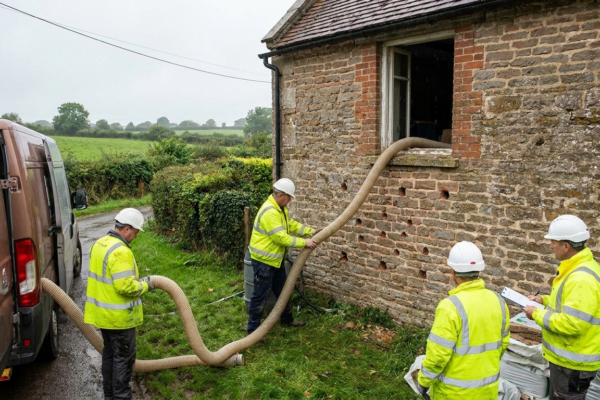
Most homes built between 1930 and 1990 in Maidenhead have cavity walls, and many still have unfilled cavities. Filling them costs £500 – £900 for a semi-detached and saves around £150 – £280 per year. Have a specialist check first, some 1970s properties have the wrong cavity width or damp issues that need sorting before filling.
Solid Wall Insulation
Older Victorian and Edwardian homes, particularly in the Boyn Hill conservation area and around Castle Hill, have solid walls, which lose heat much faster. External wall insulation costs £8,000 – £16,000 for a semi but can save £350 – £500 per year and has a transformative effect on comfort. Internal wall insulation is cheaper at £4,000 – £8,000 but reduces room size slightly.
Floor Insulation
Suspended timber floors, common in pre-1960s Maidenhead homes, can be insulated from below for around £1,000 – £2,000, saving roughly £70 – £120 per year. Less impactful than loft or walls, but worth doing once the bigger wins are ticked off.
Windows and Doors
Double glazing is already standard across most Maidenhead properties. If you still have single glazing, replacing it saves £100 – £180 per year at a cost of around £5,000 – £8,000 for a whole house. Triple glazing gives a further marginal improvement but rarely makes financial sense in Maidenhead’s mild climate unless you’re doing a full renovation anyway.
Grants and Funding Maidenhead Residents Can Actually Get in 2026
This is where things get genuinely useful, there’s more money available than most people realise, but you do need to know where to look.
The Boiler Upgrade Scheme
The government’s Boiler Upgrade Scheme offers a £7,500 grant towards an air source heat pump or ground source heat pump. This is available to any homeowner in England, regardless of income. Your installer applies on your behalf, you just need to own the property and have a valid EPC with no outstanding recommendations for loft or cavity wall insulation (sort those first if needed). This grant alone makes heat pump installations financially competitive with gas boilers over a 10-year view.
The Warm Homes Plan
The government’s Warm Homes Plan provides funding for insulation, heat pumps, and other improvements for households on lower incomes or benefits. If your household income is below around £36,000 or you receive certain benefits, you could qualify for heavily subsidised or fully funded upgrades. The Royal Borough of Windsor and Maidenhead administers referrals through the local authority, so it’s worth contacting them directly to check eligibility.
The Great British Insulation Scheme
This scheme covers insulation upgrades for homes in EPC bands D to G. If you have properties in your household at a lower band, or know neighbours who do, this is worth flagging. Grants cover cavity wall, loft, and solid wall insulation with contributions ranging from partial to full funding depending on income.
The Royal Borough’s Own Initiatives
The Royal Borough of Windsor and Maidenhead has published its own climate action commitments, and the council periodically runs additional retrofit support schemes for residents, particularly targeting fuel-poor households. Keep an eye on the RBWM website or contact their sustainability team, there are often additional top-up grants or interest-free loan schemes that don’t get much publicity.
Practical tip, before applying for anything, get a current EPC carried out. It costs around £80 – £120 and is the single most important document for unlocking grant funding.
Finding Good Installers Around Maidenhead
Maidenhead has solid installer coverage, partly because companies serving the town also operate across Marlow, Slough, High Wycombe, and Brac