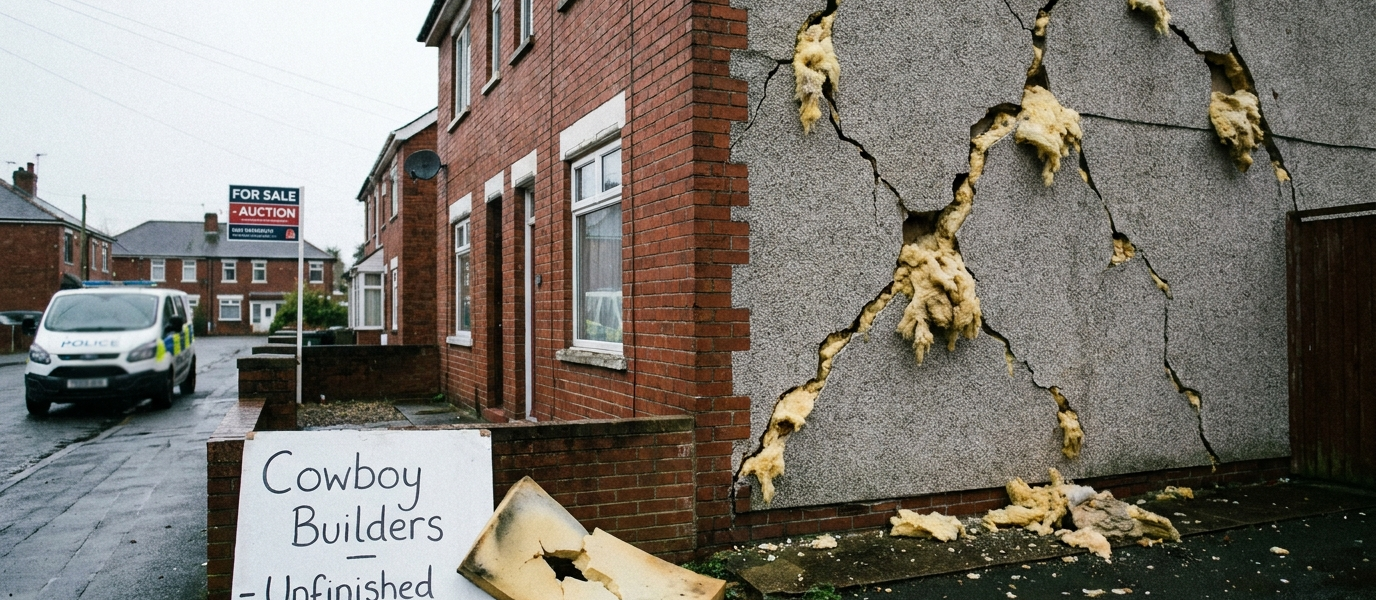
Four people were arrested last week on suspicion of defrauding £44 million from UK home insulation schemes. That figure is not a rounding error, it is roughly the annual budget for upgrading 4,000 social homes under the Social Housing Decarbonisation Fund.
As reported by The Guardian, the arrests follow a joint investigation by the National Crime Agency and the Insulation Fraud Unit. The alleged scam involved submitting false claims for cavity-wall and loft insulation work that was either never done or done so poorly it left homes damp and at risk of structural damage.
Who qualifies, and who doesn’t
ECO4, the current Energy Company Obligation, requires installers to be certified under PAS 2030 and TrustMark registered. Grants cover insulation, heating upgrades, and solar panels for low-income households and those on certain benefits. Yet the system relies on self-declaration from energy suppliers and their subcontractors.
The catch is that enforcement has been patchy. Ofgem, which oversees ECO4, told parliament last year it had identified £67 million in potential mis-spending across the wider ECO programme between 2020 and 2023. The £44m figure in this case suggests the problem is concentrated, not isolated.
What it means for a typical 3-bed semi
If you receive a cold call offering free loft insulation, the first question should be: who is paying? Legitimate ECO4 work is arranged through your energy supplier, not a van with a magnetic sign. The second question: can you see their PAS 2030 certificate? If they cannot produce it, do not let them on your property.
The Energy Saving Trust warns that poorly installed insulation can trap moisture, leading to mould and timber decay. Remedial work to remove defective insulation and treat damp costs anywhere from £1,500 to £5,000, far more than the grant value of the original job.
How to protect yourself
Three checks take five minutes. First, visit the TrustMark website and search the contractor’s name. Second, ask for their PAS 2030 certification number and verify it with the certification body. Third, never sign a ‘free survey’ form that commits you to work, legitimate assessors will not pressure you into same-day decisions.
The government has promised to strengthen fraud controls in the next phase of ECO, due to launch in 2025. But for now, the burden falls on the homeowner. If an offer sounds too good to be true, it is probably a crime scene waiting to happen.
Households on benefits or low incomes can still apply for ECO4 through their energy supplier. Use the official Ofgem-licensed route, not a third-party lead generator. Eligibility closes when the scheme ends in March 2026, so there is time, but not if you fall for a scam first.
Frequently Asked Questions
You can verify an ECO4 installer by checking the TrustMark website for their registration and asking for their PAS 2030 certification number to confirm with the certification body. Legitimate work is arranged through your energy supplier, not via cold callers, and you should never sign a 'free survey' form that commits you to work.
ECO4, the Energy Company Obligation, provides grants for insulation, heating upgrades, and solar panels to low-income households and those on certain benefits in the UK. It requires installers to be certified under PAS 2030 and TrustMark registered, and you apply through your energy supplier via the official Ofgem-licensed route.
Remedial work to remove defective insulation and treat damp from poor installation costs anywhere from £1,500 to £5,000 in the UK, according to the Energy Saving Trust. This is far more than the grant value of the original job, and can lead to mould and timber decay if left unaddressed.
The ECO4 scheme is set to close at the end of March 2026 in the UK, so eligible households have time to apply through their energy supplier. The government plans to launch a strengthened next phase of ECO in 2025 with tighter fraud controls.
If you receive a cold call offering free loft insulation, first ask who is paying, legitimate ECO4 work is arranged through your energy supplier, not a van with a magnetic sign. Second, ask for their PAS 2030 certificate, and if they cannot produce it, do not let them on your property, as poor installation can trap moisture and cause costly damage.




