Why Chorley Homeowners Are Turning to Double Glazing Right Now
There’s a particular kind of draughty chill that anyone who’s lived in a Chorley terrace knows well. You’ve got the heating cranked up, but somehow the living room still feels cold near the windows. That’s not just bad luck, it’s a direct consequence of the housing stock this town was built on, and it’s exactly why double glazing conversations are picking up pace across PR6, PR7, and the surrounding postcodes.
Sitting roughly equidistant between Preston and Wigan, Chorley occupies a spot in central Lancashire where the weather is reliably damp, moderately cold, and rarely forgiving in winter. Energy bills have settled at a painfully high plateau compared to five years ago, and with the average Chorley home burning through around 12,000 kWh of gas annually, right on the national median, residents here are doing the maths on heat loss and not liking what they see.
The town’s EPC average sits at Band D, which means there’s a real, tangible opportunity for improvement. Double glazing isn’t a magic bullet, but for the thousands of semi-detached and terraced properties around areas like Hartwood Green, Buckshaw Village, and the older streets closer to the town centre, upgrading windows is often the most straightforward first step in a meaningful home retrofit. And with Chorley Borough Council increasingly focused on energy efficiency as part of wider housing strategy, the timing has rarely felt better.
What Double Glazing Actually Involves for a Typical Chorley Home
Let’s be honest about what you’re dealing with if you own a typical Chorley property. The town’s residential landscape is largely made up of Victorian and Edwardian terraces in the older streets near the town centre, interwar semis across areas like Coppull and Adlington, and post-war council-era homes that were built solidly but with single-glazed steel or timber frames that have long since passed their best.
For a terraced property, say, one of the brick-built two-up-two-downs common on streets around Eaves Lane or Bolton Street, the main practical challenge is access. These homes sit close together, often with no side access, which means installers are working from the front and rear only. Scaffolding or working platforms may be needed for upper-floor windows, which adds to cost and complexity.
Victorian properties also tend to have non-standard window openings. Frames that look rectangular rarely measure up to modern standard sizes, and you’ll likely need made-to-measure units rather than off-the-shelf. This is worth knowing before you get quotes, because any installer offering suspiciously low prices on Victorian terraces may be planning to cut corners on fit quality.
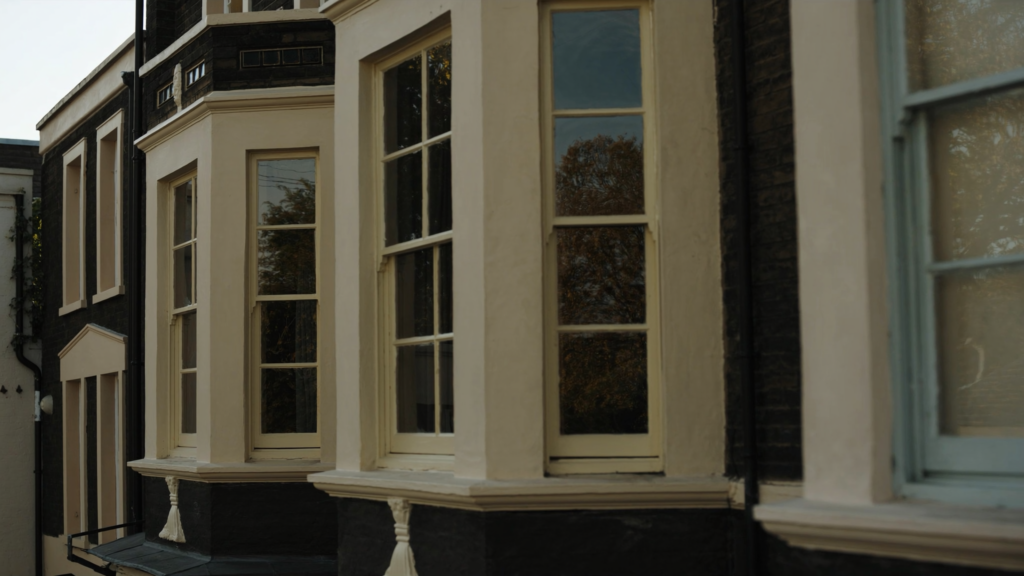
Interwar semis, the bay-fronted type you’ll find throughout Chorley’s western suburbs, come with their own quirk. Bay windows are beautiful but significantly more expensive to replace than a standard casement. Expect to pay a premium for proper bay frame configurations, and make sure any installer you hire has genuine experience fitting them rather than adapting flat-frame units to an angular bay opening.
Buckshaw Village, developed from the old Royal Ordnance Factory site, represents the newer end of Chorley’s housing spectrum. Many of these homes came with double glazing from the builder, but units installed in the early 2000s are now old enough that the argon gas fill has degraded and the seals are failing. If you’re seeing condensation between the panes, that’s your cue that replacement is overdue rather than optional.
How Much Double Glazing Costs in Chorley and the North West in 2026
Let’s talk numbers, because vague price ranges help nobody. The figures below are realistic for Chorley in 2026, based on standard uPVC double glazing with A-rated units. Costs vary based on frame material, glass specification, number of windows, and access difficulty, but this gives you a solid starting point for budgeting.
| Property Type | Number of Windows | Standard uPVC (A-rated) | Flush Sash / Timber Look uPVC | Triple Glazing Upgrade |
|---|---|---|---|---|
| Mid-terrace (2 bed) | 4–6 | £2,800 – £4,200 | £3,800 – £5,400 | £4,500 – £6,200 |
| End-terrace (3 bed) | 7–9 | £4,000 – £5,800 | £5,200 – £7,500 | £6,000 – £8,500 |
| Semi-detached (3 bed) | 8–11 | £4,500 – £6,500 | £6,000 – £8,500 | £7,000 – £10,000 |
| Semi-detached with bay window | 9–12 inc. bay | £5,500 – £7,800 | £7,200 – £10,000 | £8,500 – £12,000 |
| Victorian terrace (non-standard openings) | 5–8 | £4,200 – £6,800 | £5,800 – £9,000 | £7,000 – £11,000 |
Chorley sits in a reasonably competitive zone for installer pricing. You’re close enough to Preston and Wigan that most regional companies cover the area as a matter of course, which keeps competition healthy. Labour costs here run slightly below the South East, roughly 10–15% cheaper than the national average, but you won’t see the dramatic savings available further north in less populated areas.
Compare this to neighbouring towns and Chorley holds up well. Blackburn tends to run 3–5% cheaper for labour due to slightly lower overheads, while Preston is broadly similar. Wigan installers often quote comparably, though some larger companies based in Greater Manchester add a small travel premium for Chorley jobs. The sweet spot is finding a mid-sized installer genuinely based in the Chorley or South Ribble area rather than a national brand with a regional depot.
One cost factor unique to Chorley’s older streets is skip hire and disposal. Some narrow terraced streets in the town centre have parking restrictions and limited access that can bump up day rates by £100–£150 if the crew needs to transport materials further from a vehicle.
How Chorley’s Weather and Location Shape the Right Choices
Chorley isn’t on the coast, and it doesn’t sit in a particularly exposed upland position, but don’t let that lull you into thinking standard-spec windows are always sufficient. The town gets a reliable 750–900mm of rainfall annually, and the prevailing westerly and south-westerly winds bring damp air in from the Irish Sea with regularity. Moisture ingress around poorly sealed window frames is a genuine issue here, particularly in the older terraced stock.
What this means in practice is that your window seals and drainage channels matter as much as the glass specification. Any installer worth their salt in this part of Lancashire will make sure drainage slots in the window sill profile are correctly positioned and unobstructed. If you’re replacing timber frames that have rotted at the bottom corners, a very common finding in Chorley’s older terraces, make sure the new installation includes proper damp-proof membrane detailing at the sill.
The town sits at modest elevation, with areas like Brinscall and the western Pennine fringe nearby, but most of the residential area is relatively sheltered. You don’t face the wind-driven rain exposure that properties in, say, Pendle or the Ribble Valley uplands deal with, so you don’t necessarily need the most heavy-duty sealing systems. Mid-range weather sealing specifications are generally adequate for the bulk of Chorley’s housing.
One area where the local climate does push you toward a premium spec is thermal performance overnight. Chorley experiences around 1,600–1,750 heating degree days annually, that’s more than enough to make poorly performing windows a significant source of heat loss between October and March. The investment in at least A-rated units rather than basic B-rated glass pays back noticeably over a Lancashire winter.
The Products and Options That Actually Perform Well Here
Here’s an honest expert view for Chorley’s housing conditions, not a generic product catalogue.
- White uPVC casement with A-rated low-E glass, This is the workhorse choice for the majority of Chorley’s housing stock. It performs well thermally, handles the local moisture levels without degradation, and is priced competitively due to high regional installer familiarity. Look for a U-value of 1.2 W/m²K or better.
- Flush sash uPVC in grey or anthracite, If you’re in one of Chorley’s interwar semis and want to maintain a period aesthetic without the maintenance headaches of real timber, a flush sash profile in a contemporary colour is the modern answer. It sits flush in the frame rather than proud, looking far closer to the original steel windows of the era.
- Argon-filled units as standard, krypton for tight-spaced triple glazing, Argon fill is well worth specifying over air-filled units in this climate; the performance gain at modest extra cost is a straightforward win. If you’re going triple-glazed with a narrow overall frame depth (common on older properties with limited reveal depth), ask specifically about krypton-filled units which achieve better performance at thinner spacer widths.
- Triple glazing, worth it in certain situations, For north-facing rooms, rooms above unheated garages, or houses on slightly more exposed streets in Chorley’s northern residential areas, triple glazing delivers a genuine comfort improvement that goes beyond what the payback calculation alone suggests. The draught-elimination effect in a cold north-facing bedroom is very real.
- Laminated inner pane for ground-floor windows, Chorley town centre has its share of busy residential streets, and laminated glass on ground-floor units adds both security and modest acoustic benefit. On quieter suburban streets this is optional, but on thoroughfares like Eaves Green Road it’s worth the small premium.
What to avoid, Be cautious about any quote featuring basic 4mm glass with air fill at very low prices. These units are often imported to lower specification tolerances and don’t perform as stated. Always ask for the BFRC window energy rating certificate, not just a verbal claim of “A-rated.”
Finding a Trustworthy Double Glazing Installer Near Chorley
The North West has a dense network of double glazing companies, which is genuinely good news for competition and pricing, but it also means there are more poor operators than in less populated areas. Here’s how to navigate it sensibly.
Certifications to look for, FENSA registration is non-negotiable. FENSA-registered installers self-certify that their work complies with building regulations, which means you don’t need a separate building regulations application (saving around £250–£300). Always check FENSA registration directly on the FENSA website rather than taking a company’s word for it.
TrustMark accreditation is a strong secondary signal of quality, particularly for companies that also offer ancillary work like door installation. For any installer handling composite doors or conservatories alongside windows, Checkatrade or Which Trusted Traders reviews specific to local jobs are worth reading.
Questions worth asking
- Can you show me the BFRC certificate for the exact unit being installed in my home?
- What’s your process for dealing with non-standard frame sizes in older properties?
- Are you carrying out the installation with employed fitters or subcontractors?
- What does your guarantee cover and who underwrites it if your company closes?
Installer geography, Most reputable companies serving Chorley are based across a triangle roughly defined by Preston, Wigan, and Blackburn. Companies centred in Leyland or Bamber Bridge often give Chorley good service. Be slightly wary of larger national brands whose “local” branch is actually in Greater Manchester, they’re not always responsive for aftercare calls on smaller residential jobs.
Red flags, High-pressure same-day discounts, cash-only quotes, no physical business address, and any suggestion they’ll skip building regulations sign-off. Lead times in the North West currently run 4–8 weeks for made-to-measure units, so any promise of installation within two weeks for a full house should prompt questions.
Grants and Funding Available to Chorley Residents in 2026
Funding for window upgrades specifically is more restricted than for heating systems, but there are genuine routes to financial support worth exploring.
ECO4 (Energy Company Obligation), If your household is on qualifying means-tested benefits (including Universal Credit, Pension Credit, or Income Support) and your home is EPC Band D or below, you may qualify for fully or partially funded glazing as part of a wider retrofit package. The key point is that ECO4 rarely funds windows in isolation, they’re typically included as a measure alongside insulation or heating upgrades. Contact Chorley Borough Council’s energy advice service as your starting point, as they work with approved ECO4 assessors.
Great British Insulation Scheme (GBIS), GBIS can include glazing measures in certain circumstances, particularly where a property is significantly below average energy performance. Owner-occupiers and private tenants in Band D or lower properties may be eligible. Eligibility depends on both property rating and household income criteria.
Chorley Borough Council Local Support, Chorley Borough Council has previously administered Warm Homes funds through Lancashire County Council partnerships. Check directly with the council’s housing team at Chorley Town Hall for any active local discretionary grants, as these change throughout the year and aren’t always widely advertised.
Lancashire County Council Energy Schemes, Lancashire has historically run county-wide retrofit programmes delivered through local authority referral. These are means-tested but worth investigating if your household income is below around £36,000 per year.
Glazing is standard-rated for VAT at 20%. The zero rate for energy-saving materials covers insulation, heat pumps and solar panels; HMRC names secondary and double glazing as excluded (VAT Notice 708/6). Glazing is standard-rated for VAT at 20%, so a quote showing 20% VAT is correct and should not be challenged. HMRC names secondary and double glazing as excluded from the energy-saving materials zero rate (VAT Notice 708/6).
Planning Permission and Regulations for Chorley Properties
The good news first, for the vast majority of Chorley homeowners replacing windows in a like-for-like style, planning permission is not required. Replacing windows falls under permitted development rights as long as the replacement maintains a similar appearance to the original.
The more important regulatory step is building regulations compliance, which is required for all replacement glazing regardless of property type. This is automatically handled if you use a FENSA or Certass-registered installer. If you use a non-registered contractor, you’ll need to submit a building regulations application to Chorley Borough Council separately.
Conservation areas, Chorley town centre and parts of the older residential streets closer to the market area include properties that may fall within or adjacent to conservation designations. Astley Hall and its surrounding conservation area is the most prominent example locally. If your property is in a conservation area, you’ll typically need planning permission for any changes to windows that alter their appearance, including changing from timber to uPVC, or altering the glazing bar pattern. Check your property’s status via Chorley Borough Council’s planning portal before proceeding.
Listed buildings