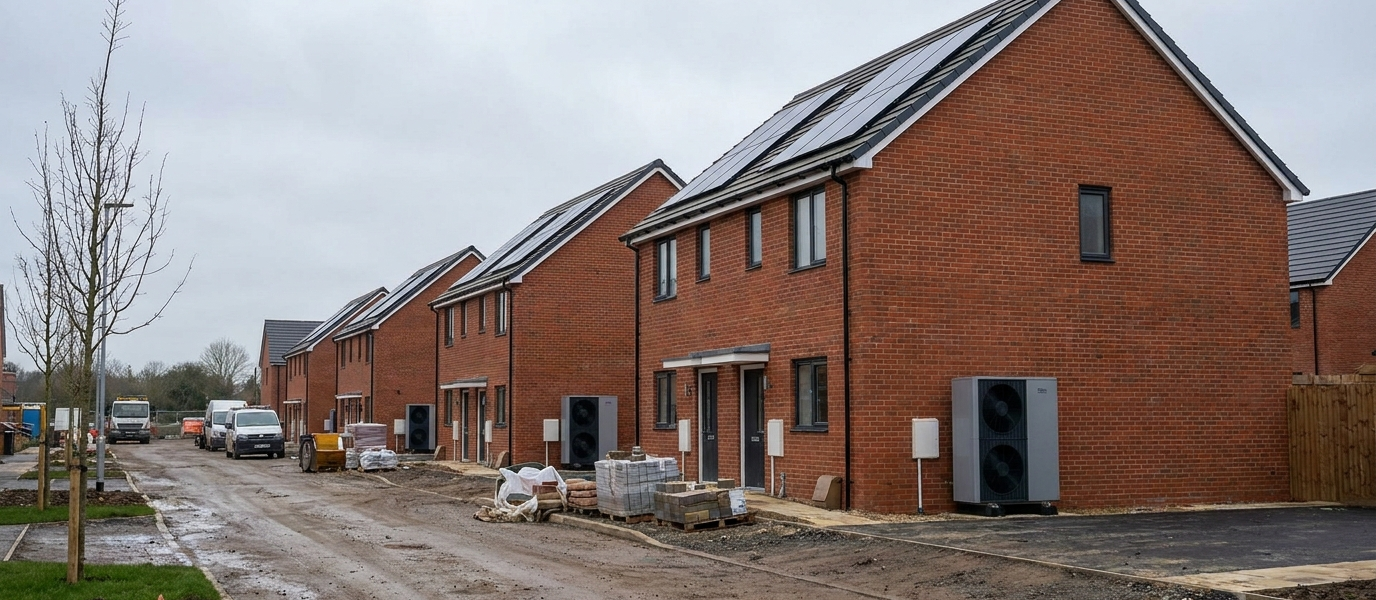
The housing secretary confirmed this week that from 2028, every new home in England must be built with on-site renewable energy generation and a heat pump. The announcement, as reported by Housing Today, marks the biggest shift in building regulations since the 2013 zero-carbon homes policy was scrapped.
The policy applies to all new-build homes, not just social housing or pilot schemes. Developers who want to connect a new estate to the gas grid after 2028 will be refused planning permission unless they can prove an exemption, which officials say will be rare.
Who pays, and who saves
Housebuilders will pass on the cost. The Home Builders Federation estimates that adding solar PV and a heat pump to a typical three-bed semi adds £7,500 to build costs. The government counters that energy bill savings of £300 a year on average will recoup that within 25 years, though the payback period is shorter if electricity prices fall relative to gas.
For a household buying a new home in 2028, the upfront price will be higher, but the running costs lower. Ofgem data shows the average gas-heated home spends £1,100 a year on heating and hot water; a heat-pump home with solar self-consumption can cut that to £700–£800. The gap will widen as the carbon price on gas rises.
EPC ratings will also improve. A new-build with solar and a heat pump should score band A or B automatically, whereas today many new homes scrape a C. That matters for resale value: a 2023 study by Nationwide found that homes with an EPC A sell for 14% more than equivalent D-rated properties.
The catch, grid capacity and installer shortage
But the policy assumes the grid can handle it. National Grid ESO has warned that without a major upgrade to local distribution networks, thousands of new heat pumps switching on simultaneously on a cold January evening could cause voltage drops. The government has pledged £6bn for network reinforcement by 2030, but the timeline is tight.
Installer capacity is another bottleneck. The Heat Pump Association estimates the UK needs 30,000 trained heat pump installers by 2028; today there are about 7,000. Solar installers are also in short supply. Builders will need to compete with retrofit demand, pushing up labour costs.
What this misses is the existing housing stock. Fourteen million UK homes still have gas boilers, and the government has no equivalent mandate for retrofit. The Energy Saving Trust calculates that retrofitting all homes to EPC C would cost £35bn, a figure the Treasury has not committed to.
What homeowners should do now
If you are buying a new-build after 2028, expect solar panels and a heat pump as standard. Check the developer’s warranty covers the heat pump for at least 10 years, some manufacturers offer 12. Ask whether the solar system includes a battery; without one, you export excess power at 5p/kWh and buy it back at 28p/kWh.
If you are renovating an existing home, the 2028 rule does not apply to you, but it signals the direction of travel. Gas boiler replacements will likely be banned in the early 2030s, according to the Climate Change Committee. Consider installing a heat pump now while the £7,500 Boiler Upgrade Scheme grant is available, it closes to new applications in 2028.
Households on standard variable tariffs should check whether their electricity supplier offers a time-of-use tariff optimised for heat pumps. Octopus Energy’s Cosy tariff, for example, charges 12p/kWh overnight versus 35p at peak. That can shave another £100 off annual bills.
Frequently Asked Questions
Yes, from 2028 every new home built in England must include on-site renewable energy generation, such as solar panels, and a heat pump. Developers will be refused planning permission to connect to the gas grid unless they can prove a rare exemption.
The Home Builders Federation estimates adding solar PV and a heat pump to a typical three-bed semi will add around £7,500 to build costs. However, the government says average energy bill savings of £300 per year will recoup this within 25 years, and payback could be quicker if electricity prices fall relative to gas.
Ofgem data shows the average gas-heated home spends £1,100 a year on heating and hot water, while a heat-pump home with solar self-consumption can cut that to £700–£800 per year. The savings will grow as the carbon price on gas rises.
National Grid ESO has warned that without major upgrades, voltage drops could occur on cold evenings when many heat pumps switch on simultaneously. The government has pledged £6bn for network reinforcement by 2030, but the timeline is tight and installer shortages are a concern.
No, the 2028 mandate only applies to new-build homes in England, not existing properties. However, it signals the direction of travel, and retrofitting all UK homes to EPC C would cost an estimated £35bn, which the Treasury has not yet committed to.





