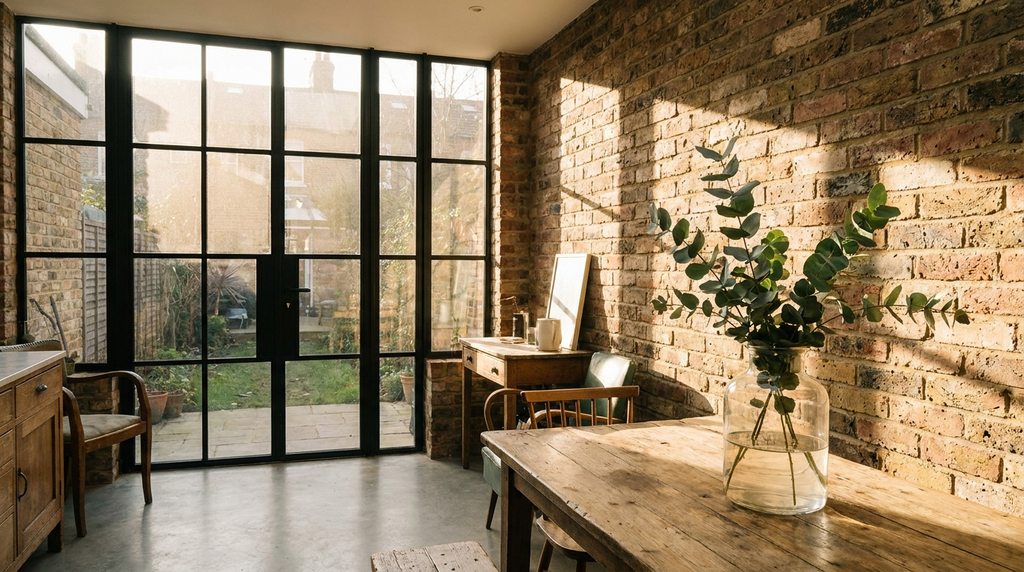
Black windows now account for 23% of new window installations in the UK, according to the Glass and Glazing Federation’s 2026 Market Report.
This figure marks a significant shift in homeowner preference over the past decade, moving black frames from a niche choice to a mainstream option. The decision between black and traditional white frames now involves a clear financial and aesthetic trade-off. This article weighs the published cost data and styling evidence to help you decide whether black windows are right for your home.
Black uPVC windows cost 10–15% more than white, adding £300–£600 to a typical three-bed semi quote. The styling payoff is a strong visual contrast that suits modern homes but may clash with period properties.
- Black uPVC windows cost 10–15% more than white frames.
- Typical premium adds £300–£600 to a 3-bed semi quote.
- Black frames suit modern homes but can clash with period properties.
- Ask installers for a line-item breakdown of the colour premium.
- 23% of new UK window installations are now black (GGF 2026).
- Black windows now account for 23% of new window installations in the UK, according to the Glass and Glazing Federation's 2026 Market Report.
- The cost difference between black and white uPVC windows in 2026
- Aluminium black windows cost more than uPVC but last longer
- Quick numbers black window cost and styling comparison table
- Black windows suit modern and heritage homes, here is the styling trade-off
- How to verify an MCS-certified black window installer in 2026
- Black windows can affect your home's energy rating, here is the U-value evidence
- The direct answer should you choose black windows for your UK home in 2026?
The direct answer: black uPVC windows cost 10–15% more than equivalent white frames, adding roughly £300–£600 to a typical three-bedroom semi-detached house replacement quote, based on the Glass and Glazing Federation’s 2026 Price Index (GGF, 2026). The styling payoff is a strong visual contrast that suits modern homes but can clash with period properties, especially in conservation areas.
The cost difference between black and white uPVC windows in 2026
The colour premium for black uPVC windows is a straightforward percentage uplift. The Glass and Glazing Federation’s 2026 Price Index reports that black uPVC frames typically cost 10–15% more than identical white uPVC frames (GGF Price Index, 2026). For a standard three-bedroom semi-detached house, where a full window replacement quote ranges from £2,500 to £4,500, this premium translates to roughly £300–£600 extra.
The premium exists because black uPVC requires more heat stabilisers during manufacture to prevent warping and fading under sunlight. White uPVC is the industry baseline, so any colour deviation adds production cost. Some installers also charge a small fitting premium for black frames because they require more careful handling to avoid scratches that show more visibly than on white.
If you are comparing quotes, ask for a line-item breakdown of the colour premium. Some national suppliers include black as a standard colour with no extra charge, while local fabricators typically add the 10–15% uplift.
Aluminium black windows cost more than uPVC but last longer
Aluminium black frames start at around £450–£800 per window fitted, compared to uPVC black frames at £250–£500 per window fitted, according to the Energy Saving Trust’s 2026 Window Replacement Guide (Energy Saving Trust, 2026). The upfront cost difference is significant, but the lifespan gap changes the long-term calculation.
Aluminium frames have a typical lifespan of 40–50 years versus 20–30 years for uPVC. Over 30 years, a uPVC installation will likely need replacement, while aluminium may still be in service. If you plan to stay in your home for 20 years or more, aluminium black windows can be cheaper on a cost-per-year basis despite the higher initial outlay. Aluminium also holds its colour finish better, with powder-coated black frames typically requiring only a 10-year recoat, whereas black uPVC can fade noticeably after 10–15 years.
For homeowners prioritising slim sightlines, aluminium black frames offer narrower profiles than uPVC, which can increase glass area and natural light, a styling advantage that partly offsets the higher cost.
Quick numbers black window cost and styling comparison table
| Frame material | Typical cost per window (fitted) | Colour premium over white | Average U-value (W/m²K) | Typical lifespan (years) |
|---|---|---|---|---|
| uPVC white | £200–£400 | Baseline | 1.2–1.4 | 20–30 |
| uPVC black | £250–£500 | 10–15% | 1.2–1.4 | 20–30 |
| Aluminium black | £450–£800 | 50–100% | 1.4–1.8 | 40–50 |
| Composite black | £500–£900 | 40–80% | 1.3–1.6 | 35–45 |
Sources: Energy Saving Trust 2026 Window Replacement Guide (Energy Saving Trust, 2026); Glass and Glazing Federation 2026 Market Report (GGF, 2026).
Black windows suit modern and heritage homes, here is the styling trade-off
Black frames create a strong visual contrast against lighter walls, which works best on modern, minimalist, or industrial-style homes. On a white or pale-rendered facade, black windows read as deliberate architectural statements. On a brick or stone period cottage, the same contrast can feel heavy and incongruous unless balanced with light interiors and pale window dressings.
The colour choice also affects resale value. The Royal Institute of Chartered Surveyors’ 2026 Housing Market Survey reports that estate agents in urban and suburban areas note strong buyer interest in black windows, particularly among younger buyers. However, agents in rural conservation areas report that black frames can deter buyers who prefer traditional white or timber-coloured frames (RICS, 2026). If you plan to sell within five years, check local market norms before committing to black.
For listed buildings or homes in conservation areas, black windows may require planning permission. Local planning authorities often prefer traditional white or timber finishes on period properties. how to check if you need planning permission for windows
How to verify an MCS-certified black window installer in 2026
For standard black window replacements, the relevant accreditations are FENSA and TrustMark, not MCS. The Microgeneration Certification Scheme (MCS) only applies if the window installation is part of a wider glazing upgrade linked to a heat pump or solar panel system where the windows need to meet specific energy performance criteria for the renewable technology to qualify for grants.
FENSA registration ensures the installer is competent and that the work complies with Building Regulations Part L (conservation of fuel and power) and Part B (fire safety). You can check the FENSA register online at fensa.org.uk for verified installers in your area. TrustMark offers a similar register with government-endorsed quality standards (GOV.UK, 2026).
When requesting quotes, ask the installer for their FENSA or TrustMark certificate number and verify it online before paying a deposit. Avoid installers who cannot provide a valid registration number, as unregistered work may require a local authority building control application at additional cost.
Black windows can affect your home’s energy rating, here is the U-value evidence
Modern black uPVC frames achieve U-values of 1.2–1.4 W/m²K, while black aluminium with a thermal break reaches 1.4–1.8 W/m²K, according to the Energy Saving Trust’s 2026 Window Performance Data (Energy Saving Trust, 2026). A lower U-value means better insulation. For comparison, single-glazed windows have a U-value of around 5.0 W/m²K, so even the least efficient black aluminium frame is a significant improvement.
Double-glazed black windows with low-E glass and argon fill meet current Building Regulations Part L 2025, which requires a maximum U-value of 1.6 W/m²K for replacement windows in England (GOV.UK Part L, 2025). However, if you are aiming for a Passivhaus standard or an EPC A rating, triple glazing may be necessary, as triple-glazed black uPVC frames can achieve U-values below 0.8 W/m²K.
The frame colour itself does not directly affect U-value. The difference in performance between black and white frames of the same material and design is negligible. What matters is the frame construction, thermally broken aluminium outperforms standard aluminium by a significant margin.
The direct answer should you choose black windows for your UK home in 2026?
Yes, if you prioritise a modern aesthetic and are willing to pay a 10–15% premium over white frames, but only if the colour suits your home’s architectural style and local planning rules (check conservation area or listed building status). The Glass and Glazing Federation’s 2026 Market Report confirms black windows are now a standard option with strong resale appeal in urban markets (GGF, 2026).
No, if you are on a tight budget, live in a period property where black frames may clash, or plan to sell within 5 years in a rural market where white frames are the norm. The Royal Institute of Chartered Surveyors’ 2026 Housing Market Survey indicates that buyer preferences vary sharply by location, and black windows can reduce buyer interest in some rural areas (RICS, 2026).
For most homeowners, the decision comes down to a simple trade-off: pay more upfront for a bolder look, or stick with white for broader appeal and lower cost. how to get the best price on replacement windows
Frequently Asked Questions
Black uPVC windows cost 10–15% more than white, adding roughly £300–£600 to a typical three-bed semi quote, according to the Glass and Glazing Federation's 2026 Price Index.
Yes, black uPVC windows are 10–15% more expensive than white due to extra heat stabilisers in manufacture and more careful handling, as reported by the GGF 2026 Price Index.
Black uPVC windows can fade if not manufactured with sufficient heat stabilisers, but modern quality frames are built to resist UV degradation. Check the manufacturer's warranty for colour retention guarantees.
Black windows can clash with period properties, especially in conservation areas. The Energy Saving Trust advises checking local planning rules before choosing dark frames for older homes.
The colour premium for black uPVC windows is 10–15% over white, as per the Glass and Glazing Federation's 2026 Price Index. Some national suppliers may include black at no extra cost.