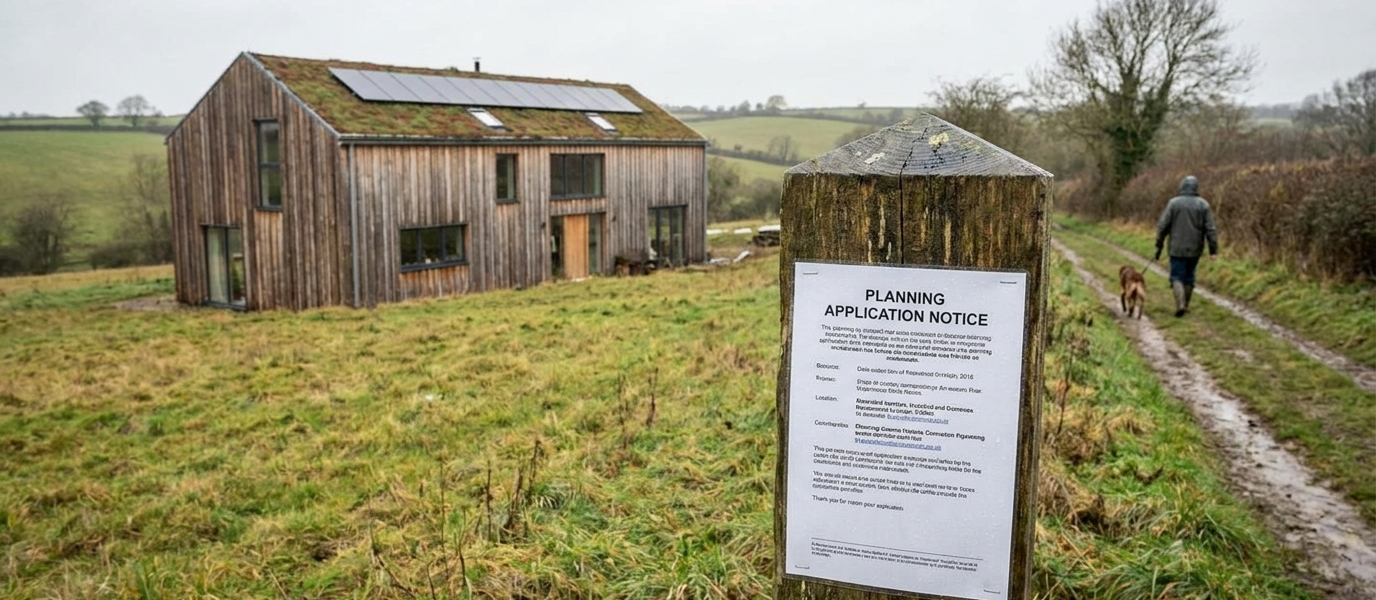
Seventy-five new eco homes are proposed for greenbelt land in Knutsford, Cheshire. The developer claims the scheme will deliver net-zero carbon emissions through solar panels, heat pumps, and high-grade insulation. This is not a minor planning application, it is a stress test for two competing government priorities: building 300,000 homes a year and preserving greenbelt land.
As reported by the Knutsford Guardian, the plan faces local opposition over the loss of open countryside. But the bigger question for UK homeowners is whether eco credentials can justify building on land that is normally off-limits.
Why greenbelt land matters to your energy bill
Greenbelt policy was built to prevent urban sprawl, not to block climate action. But every hectare of protected land that is built on reduces the carbon sink that fields and hedgerows provide. The trade-off is stark: a new eco home on greenbelt might save 3–4 tonnes of CO₂ a year compared to a 1990s semi, but the land itself loses its carbon storage capacity.
The government’s own climate advisors, the Climate Change Committee, have warned that building on peatland or ancient woodland cancels out the carbon gains from energy-efficient homes. Knutsford’s greenbelt is not peatland, but the principle holds. Homeowners considering eco upgrades should note that the carbon maths of new-builds is not always straightforward.
What this means for existing homes
For the 28 million existing UK homes, the Knutsford scheme is a useful benchmark. The developer is targeting an EPC rating of A, something fewer than 1% of homes currently achieve. To get there, they are specifying triple glazing, mechanical ventilation with heat recovery, and air-source heat pumps.
Retrofitting a 1930s semi to the same standard costs anywhere from £25,000 to £45,000, depending on wall type and existing heating system. The Boiler Upgrade Scheme currently offers £7,500 off a heat pump, but the remaining cost is still prohibitive for most households. The Knutsford homes will benefit from economies of scale that individual homeowners cannot replicate.
Yet there is a lesson here: the same technologies, solar PV, heat pumps, high-performance glazing, work on existing homes, albeit at a higher per-home cost. The Energy Saving Trust calculates that a typical 3-bed semi with full retrofit can cut heating demand by 60–70%, saving £800–£1,200 a year on energy bills at current price cap levels.
The planning gamble
The catch is that greenbelt development is politically toxic. Local councils routinely reject applications even when they meet net-zero criteria. The Knutsford scheme’s fate will be watched by developers nationwide. If it succeeds, expect a wave of ‘eco greenbelt’ applications. If it fails, the message is clear: sustainability alone does not override land protection.
For homeowners, the real action remains in retrofitting. The Great British Insulation Scheme closed on 31 March 2026. It funded insulation measures only and never covered windows or glazing. Those on standard tariffs can apply through their energy supplier. The deadline for ECO4 is March 2026, a firm date to act on.
Tory or Labour, the next government will face the same dilemma: how to build net-zero homes without trashing the countryside. The Knutsford decision, expected in early 2025, will be a bellwether. Homeowners should watch it, not because they will move there, but because the outcome will shape the cost and availability of eco materials and installers for years to come.
Frequently Asked Questions
Retrofitting a 1930s semi to an EPC A rating typically costs between £25,000 and £45,000 in the UK, depending on wall type and existing heating system. The Boiler Upgrade Scheme offers £7,500 off an air-source heat pump, but the total remains prohibitive for most households.
While eco homes with solar panels and heat pumps can save 3–4 tonnes of CO₂ a year compared to a 1990s semi, building on greenbelt land reduces carbon storage from fields and hedgerows. The Climate Change Committee warns that building on peatland or ancient woodland cancels out carbon gains, though Knutsford's greenbelt isn't peatland.
A full retrofit of a typical 3-bed semi can cut heating demand by 60–70%, saving £800–£1,200 a year on energy bills at current price cap levels. The Energy Saving Trust confirms these savings with technologies like solar PV, heat pumps, and high-performance glazing.
The Boiler Upgrade Scheme also provides £7,500 off a heat pump, but you'll need to cover remaining costs which can be substantial for full retrofits.
Greenbelt development is politically toxic in the UK, with local councils routinely rejecting applications even when they meet net-zero criteria. The Knutsford scheme tests whether sustainability can override land protection, but most councils prioritise preserving open countryside over climate action.



