Ground source heat pumps cost more than air source but save more annually
The central question for any UK homeowner weighing a heat pump is whether the higher upfront cost of a ground source system pays back through greater efficiency and lower running bills. Ground source heat pumps (GSHPs) extract heat from the ground via buried pipework, while air source heat pumps (ASHPs) draw heat from the outside air.
The answer is that GSHPs typically cost twice as much to install but can save 30–50% more on annual heating bills than an ASHP, according to the Energy Saving Trust (Energy Saving Trust, 2026).
The average installed cost for a GSHP in the UK is £24,000 to £32,000, compared to £11,000 to £15,000 for an ASHP (Energy Saving Trust, 2026). Annual running cost savings for a GSHP can be 30–50% higher than for an ASHP, depending on the property’s heat demand and the efficiency of the system (Energy Saving Trust, 2026). The Renewable Heat Incentive (RHI) closed to new applicants in 2022; the Boiler Upgrade Scheme (BUS) now provides a flat-rate grant of £7,500 for both GSHP and ASHP installations, not a per-kWh payment (GOV.UK, Boiler Upgrade Scheme page, 2026). GSHP efficiency is measured by the Seasonal Coefficient of Performance (SCOP); a typical GSHP achieves a SCOP of 3.5–4.5, while an ASHP achieves 2.5–3.0 (Energy Saving Trust, 2026).
Ground source heat pumps require more land than air source but are quieter
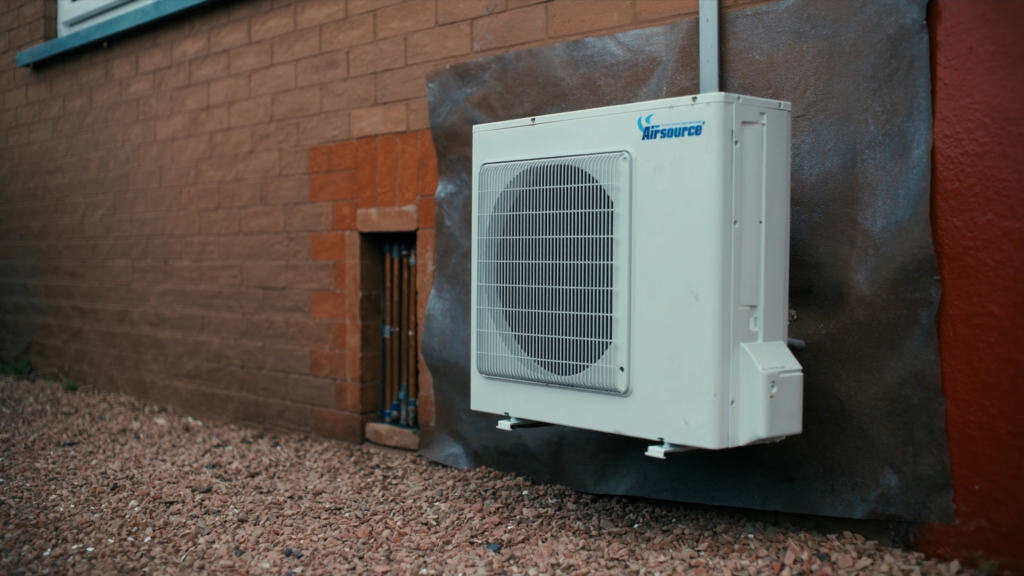
Space is the most common dealbreaker for GSHPs. A GSHP needs a horizontal trench array of 150–300 square metres of garden space, or a vertical borehole requiring a 100–200 metre deep drill rig access (Energy Saving Trust, 2026). An ASHP outdoor unit is typically 1–2 metres from the house wall and requires no ground excavation (Energy Saving Trust, 2026).
On noise, GSHPs have a clear advantage. GSHP ground loops operate silently; ASHP outdoor fans produce 40–55 dB noise at 1 metre (BRE, 2026, noise guidance for heat pumps). If you have a small garden or no garden at all, an ASHP is the only practical option. If you have a large garden and want minimal noise, a GSHP is the better choice.
Ground source heat pumps have a longer lifespan than air source but a higher upfront cost
Longevity is a key factor in the total cost of ownership. GSHP ground loops last 50+ years; the heat pump unit itself lasts 20–25 years (Energy Saving Trust, 2026). ASHP outdoor units typically last 10–15 years, with a shorter lifespan due to exposure to weather (Energy Saving Trust, 2026).
The payback period for a GSHP is 12–20 years, compared to 8–15 years for an ASHP, depending on the property’s heat demand and fuel prices (Energy Saving Trust, 2026). If you plan to stay in your home for 20 years or more, the longer lifespan of a GSHP may offset its higher upfront cost. For shorter ownership periods, an ASHP is likely to deliver a better return.
Quick numbers ground source vs air source heat pump comparison table
| Feature | Ground Source Heat Pump | Air Source Heat Pump |
|---|---|---|
| Installed cost (GBP) | £24,000–£32,000 | £11,000–£15,000 |
| Annual running cost saving vs gas boiler | 50–70% | 30–50% |
| SCOP | 3.5–4.5 | 2.5–3.0 |
| Outdoor unit lifespan | 20–25 years | 10–15 years |
| Land requirement | 150–300 m² trench or borehole | None |
| Noise level (dB at 1m) | Silent | 40–55 dB |
| Boiler Upgrade Scheme grant | £7,500 flat rate | £7,500 flat rate |
| Payback period (years) | 12–20 | 8–15 |
All figures are from the Energy Saving Trust and GOV.UK as of 2026. Your actual figures will depend on your property size, heat demand, and local installer pricing. heat pump running costs calculator
Ground source heat pumps are more efficient in cold weather than air source
Cold weather performance matters for UK winters. GSHP efficiency remains stable at SCOP 3.5–4.5 even at outdoor temperatures below 0°C (Energy Saving Trust, 2026). ASHP efficiency drops noticeably below 0°C, with SCOP falling to 2.0–2.5 in severe cold (Energy Saving Trust, 2026).
For a typical UK winter (average 5°C), both types perform well, but GSHP maintains higher efficiency across the season (DESNZ, 2026, heat pump performance data). If you live in a colder region such as northern Scotland or upland areas, the GSHP’s stable efficiency gives a larger advantage. For most of southern England, the difference is less pronounced.
Ground source heat pumps require MCS certification for grant eligibility and installer verification
To qualify for the Boiler Upgrade Scheme grant, the heat pump must be installed by an MCS-certified installer (GOV.UK, Boiler Upgrade Scheme page, 2026). GSHP installers must also hold TrustMark certification for consumer protection (TrustMark, 2026).
For vertical boreholes, the installer must comply with the Environment Agency’s water abstraction and borehole permitting rules (GOV.UK, Environment Agency, 2026). This adds a layer of regulatory complexity that does not apply to ASHPs. Always verify your installer’s MCS and TrustMark credentials before signing a contract. how to choose an MCS certified heat pump installer
Ground source heat pumps reduce carbon emissions more than air source but both cut emissions significantly
A GSHP reduces household carbon emissions by 60–70% compared to a gas boiler, while an ASHP reduces them by 40–50% (DESNZ, 2026, heat pump emissions factors). The carbon savings depend on the electricity grid carbon intensity; as the UK grid decarbonises, both types will see further reductions (DESNZ, 2026, UK grid carbon intensity projections).
For a typical 3-bedroom home, switching from gas to a GSHP saves 2–3 tonnes of CO2 per year, compared to 1.5–2 tonnes for an ASHP (Energy Saving Trust, 2026). If carbon reduction is your primary motivation, a GSHP gives the bigger absolute saving. However, the difference narrows as the grid becomes cleaner, and an ASHP still is a substantial improvement over a gas boiler. heat pump vs gas boiler carbon comparison
Frequently Asked Questions
A ground source heat pump costs £24,000 to £32,000 installed, according to the Energy Saving Trust (2026). That is roughly double the £11,000 to £15,000 cost of an air source heat pump.
Yes, a GSHP is more efficient (SCOP 3.5-4.5 vs 2.5-3.0) and quieter, but costs twice as much to install, per the Energy Saving Trust (2026). It is better if you have the space and budget.
The Boiler Upgrade Scheme provides a flat £7,500 grant for ground source heat pumps, as confirmed by GOV.UK (2026). The Renewable Heat Incentive closed to new applicants in 2022.
A horizontal trench array needs 150-300 square metres of garden, while a vertical borehole requires drill rig access for a 100-200 metre deep hole, says the Energy Saving Trust (2026).
No, ground source heat pumps are virtually silent because the ground loops operate without fans, unlike air source units which produce 40-55 dB noise at 1 metre (BRE, 2026).