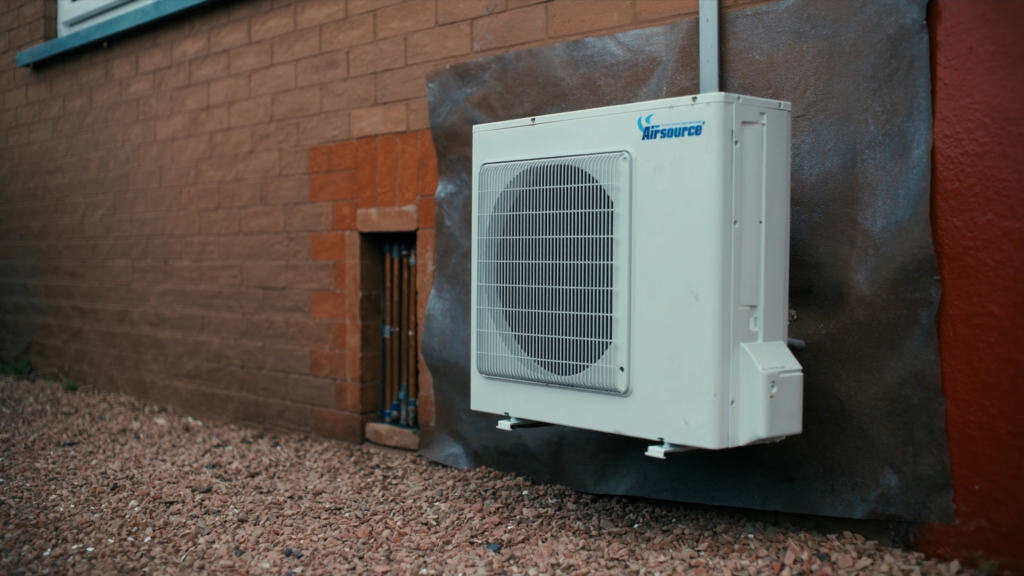
The average heat pump produces 40–60 dB, comparable to a refrigerator or quiet conversation
If you are considering a heat pump, noise is likely one of your main concerns. A properly installed air-source heat pump typically operates at 40–60 dB(A) at 1 metre, which is similar to a modern fridge (40 dB) or a quiet conversation (50 dB) (Energy Saving Trust, 2026). Ground-source heat pumps are quieter still, often running at 30–45 dB(A), because the compressor is indoors or buried underground.
Manufacturers quote sound power levels (LW) on the MCS database, but what you actually hear outdoors is the sound pressure level (Lp), which varies by distance and surroundings. The key regulation for most UK homes is the permitted development rights (PDR) noise limit of 42 dB(A) at the nearest neighbour’s property boundary (GOV.UK, 2023).
Quick numbers heat pump decibel levels and noise limits in table form
| Source of noise | Sound level (dB(A)) | Description / example | Source |
|---|---|---|---|
| Air-source heat pump at 1 m | 40–60 dB(A) | Similar to fridge or quiet conversation | Energy Saving Trust, 2026 |
| Ground-source heat pump at 1 m | 30–45 dB(A) | Quieter due to indoor/underground compressor | Energy Saving Trust, 2026 |
| Permitted development limit at neighbour boundary | 42 dB(A) | Legal limit for most UK homes (England) | GOV.UK, 2023 |
| Typical fridge | 40 dB(A) | Background kitchen noise | Energy Saving Trust, 2026 |
| Typical conversation | 50–60 dB(A) | Normal speech at 1 m | Energy Saving Trust, 2026 |
| Typical car at 10 m | 70–80 dB(A) | Passing vehicle | WHO environmental noise guidelines, 2018 |
The 42 dB permitted development noise limit is the legal boundary for most UK homes
Under permitted development rights (PDR), an air-source heat pump must not exceed 42 dB(A) at the nearest neighbour’s property boundary (1 m from the neighbour’s window or boundary) (GOV.UK, 2023). This limit applies to installations in England. Scotland, Wales, and Northern Ireland have separate but similar rules, so check with your local planning authority.
If the heat pump exceeds 42 dB or your property is in a conservation area, you need full planning permission. The MCS 020 standard sets out the noise testing and calculation methods installers must follow to prove compliance (MCS, 2026).
How to read manufacturer noise data, sound power vs. sound pressure
Manufacturers quote sound power level (LW, in dB) measured in a lab, while you experience sound pressure level (Lp) outdoors. The rule of thumb is that sound pressure at 1 m is roughly 10 dB lower than sound power; at 10 m it drops by another 20 dB (Heat Pump Association, 2026).
To check a model’s compliance, use the MCS database to find its sound power level. Then calculate the sound pressure at the neighbour’s boundary using the distance. For example, a unit with a sound power of 60 dB will produce about 50 dB at 1 m and 30 dB at 10 m. If the boundary is 2 m away, you need a unit with a sound power of around 52 dB or less to stay under 42 dB.
Choosing a quiet heat pump model, key specifications to compare
The quietest models on the MCS register include the Mitsubishi Ecodan (40–45 dB), Daikin Altherma (35–40 dB), and Vaillant aroTHERM plus (38–42 dB) (MCS register, 2026). Inverter-driven compressors and variable-speed fans reduce noise at lower loads, so look for these features.
Always check the sound power level in the MCS database and compare it to the 42 dB limit at your boundary. A model with a sound power of 55 dB at 1 m will likely need to be placed 3–4 m from the neighbour’s boundary to comply.
Installation placement and landscaping to reduce noise impact
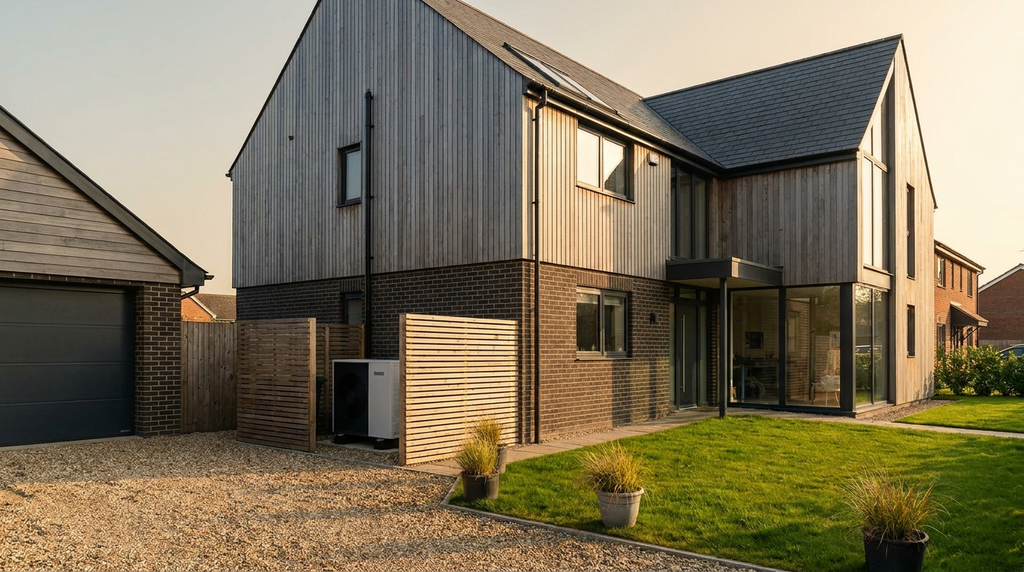
Position the unit at least 1 m from the neighbour’s boundary and away from windows, bedrooms, and seating areas (Energy Saving Trust, 2026). Place it on a vibration-dampening base (concrete pad or rubber mounts) to reduce transmitted noise.
Use a sound-absorbing fence or screen (solid, not slatted) between the unit and the neighbour, but ensure airflow is not blocked, leave at least 1 m clearance (MCS 020, 2026). Landscaping with dense shrubs or a brick wall can also help, but never restrict air intake or exhaust.
Guide to heat pump installation spacing and clearance requirements
How to verify your installer meets MCS and noise compliance standards
Installations must be carried out by an MCS-certified installer who follows MCS 020 (noise limits) and MCS 010 (installation requirements) (MCS, 2026). Check the installer’s MCS registration on the MCS website and verify they are also registered with TrustMark for consumer protection (TrustMark, 2026).
Request a noise assessment (calculation) from the installer before installation to confirm compliance with the 42 dB limit. The installer should provide a written statement showing the sound pressure level at the neighbour’s boundary based on the unit’s sound power and distance.
What to do if a neighbour complains about heat pump noise
First, measure the noise at the neighbour’s boundary. A smartphone app can give a rough guide, but a calibrated sound level meter is definitive. If the level exceeds 42 dB, the installer must rectify the issue under MCS warranty, contact the installer and MCS for enforcement (MCS complaints procedure, 2026).
If the level is under 42 dB but the neighbour is still disturbed, consider voluntary noise-reduction measures: relocation, screening, or a replacement unit. You can also contact the Energy Ombudsman if the installer refuses to act (Energy Ombudsman, 2026).
Dealing with neighbour disputes over home heating installations
Frequently Asked Questions
An air-source heat pump typically operates at 40–60 dB(A) at 1 metre, similar to a fridge or quiet conversation, according to the Energy Saving Trust (2026). Ground-source heat pumps are quieter at 30–45 dB(A).
Under permitted development rights in England, the noise limit is 42 dB(A) at the nearest neighbour's property boundary, as set by GOV.UK (2023). Scotland, Wales, and Northern Ireland have separate but similar limits.
Yes, but the installation must comply with the 42 dB(A) limit at the neighbour's boundary. You may need a planning application if the heat pump exceeds this level, as per GOV.UK (2023).
Choose a ground-source heat pump (30–45 dB) or position the air-source unit away from boundaries. Use anti-vibration mounts and ensure proper installation, as recommended by the Energy Saving Trust (2026).
Heat pumps can become louder if not maintained. Regular servicing, cleaning filters, and checking for loose components keep noise levels within the 40–60 dB range, according to the Energy Saving Trust (2026).