A heat pump’s outdoor unit must be at least one metre from your house wall, but the exact distance depends on the model and local noise rules
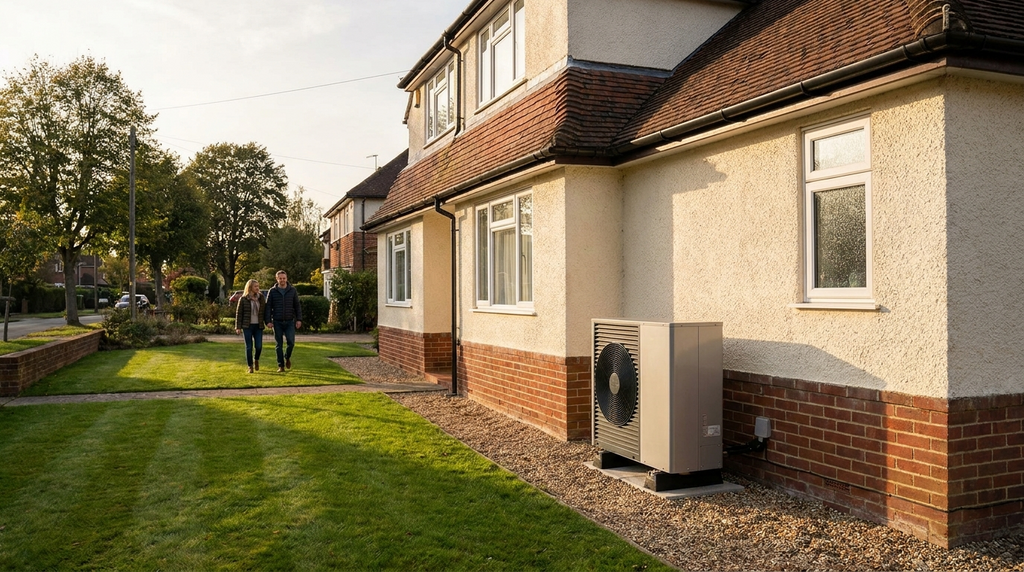
If you are planning to install an air-source heat pump, one of the first practical questions is where the outdoor unit will go. The minimum clearance for airflow around a heat pump’s outdoor unit is typically 1 metre, as specified in the MCS 020 standard from the Microgeneration Certification Scheme (MCS, 2026). This gap prevents recirculation of cold air and ensures the unit can draw enough air to operate efficiently, avoiding a drop in performance.
A heat pump's outdoor unit must be at least 1 metre from your house wall for airflow, per the MCS 020 standard. Noise regulations require 3–8 metres from a neighbour's window to stay under the 42 dB(A) limit. Check your model's specifications for exact distances.
- Minimum 1 metre clearance from your house wall for airflow (MCS 020 standard).
- Noise limit of 42 dB(A) at neighbour's window requires 3–8 metres distance.
- Permitted development rights require 1 metre from your own windows.
- Larger heat pump units may need 2–3 metres from the house wall.
- Check manufacturer specs for exact dB output to calculate needed distance.
- A heat pump's outdoor unit must be at least one metre from your house wall, but the exact distance depends on the model and local noise rules
- The legal noise limit determines how close a heat pump can be to your neighbour’s house, not your own
- The minimum distance from a bedroom window on your own property is also regulated
- Quick numbers minimum distances for a heat pump outdoor unit
- The distance from your property boundary is less strict than from a neighbour’s window
- How to verify your installer’s distance calculations (MCS certification)
- The exact distance a heat pump must be from your house is at least 1 metre for airflow, but the real answer depends on noise
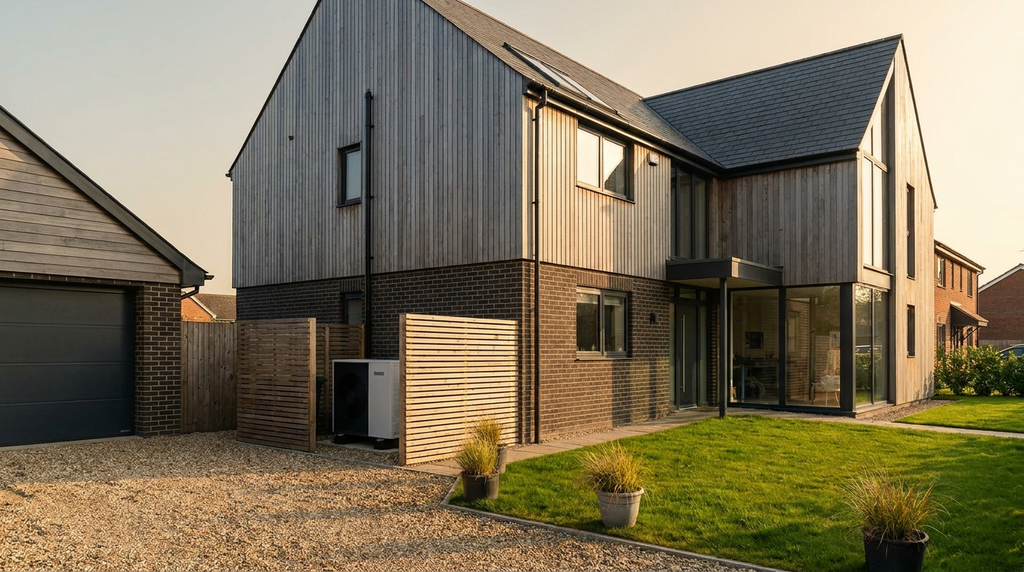
Greater distances of 2–3 metres may be required for larger units or if the unit is positioned near a boundary with a neighbour. The distance from the house wall is not the same as the distance from a bedroom window; noise regulations often set a stricter limit for that (see below).
The legal noise limit determines how close a heat pump can be to your neighbour’s house, not your own
The permitted noise level from a heat pump at a neighbour’s property is 42 dB(A) during the day and 42 dB(A) at night, under the UK’s Permitted Development Rights for heat pumps (GOV.UK, 2026). This is measured at the nearest noise-sensitive window (bedroom or living room) of the neighbouring dwelling.
A typical air-source heat pump emits 55–65 dB(A) at 1 metre. The distance required to bring that below 42 dB(A) at the neighbour’s wall is usually 3–8 metres, depending on the model (manufacturer data; MCS 020). If the unit cannot meet the 42 dB(A) limit, planning permission is required, and the distance may need to be increased or a quieter unit selected.
The minimum distance from a bedroom window on your own property is also regulated
Permitted development rights require the heat pump’s outdoor unit to be at least 1 metre from any window on your own house (GOV.UK, Permitted Development Rights, Class G, 2026). The 42 dB(A) limit applies only to neighbours; for your own house, the unit can be closer, but noise inside your home may still be a concern.
Many installers recommend placing the unit at least 2–3 metres from your own bedroom window to avoid sleep disturbance, though this is not a legal requirement. This is a practical recommendation based on typical sound levels rather than a regulation.
Quick numbers minimum distances for a heat pump outdoor unit
| Distance type | Minimum (legal/regulatory) | Recommended (for performance/noise) |
|---|---|---|
| Distance from house wall | 1 metre (MCS 020) | 2–3 metres for larger units |
| Distance from own bedroom window | 1 metre (Permitted Development Rights) | 2–3 metres to avoid sleep disturbance |
| Distance from neighbour’s window (to meet 42 dB(A)) | Varies; typically 3–8 metres | As calculated by MCS noise assessment |
| Distance from property boundary (if not a window) | No specific legal minimum | At least 1 metre for maintenance access |
Sources: GOV.UK Permitted Development Rights (2026); MCS 020 (2026); manufacturer installation guides.
The distance from your property boundary is less strict than from a neighbour’s window
The permitted development rules do not specify a minimum distance from the boundary itself; the only limit is the noise level at the neighbour’s window. If the unit is placed within 1 metre of the boundary but the noise at the neighbour’s window is below 42 dB(A), it is generally permitted.
Some local planning authorities may have additional conditions, such as requiring the unit to be set back from the boundary by 1 metre or more in conservation areas. Check with your council (GOV.UK, local planning authority guidance, 2026). This is a variable that depends on your specific location.
How to verify your installer’s distance calculations (MCS certification)
Your installer must be MCS-certified to install a heat pump under permitted development rights. You can check an installer’s MCS certificate number on the MCS register website (MCS register, 2026). The installer must produce a noise assessment that calculates the distance needed to meet the 42 dB(A) limit at the neighbour’s window, following the MCS 020 standard.
If the installer cannot provide a written noise assessment, do not proceed. The unit may be too close and require planning permission, which adds time and cost. How to find an MCS-certified heat pump installer
The exact distance a heat pump must be from your house is at least 1 metre for airflow, but the real answer depends on noise
To answer the keyword query directly: the minimum distance from the house wall is 1 metre (MCS 020). The unit must also be at least 1 metre from any window on your house (Permitted Development Rights).
To comply with noise regulations for neighbours, the distance may need to be 3–8 metres or more, depending on the unit’s sound level and the location of neighbouring windows. Always get an MCS-certified installer to measure and confirm the distances for your specific property. Understanding heat pump noise levels and permitted development
Frequently Asked Questions
At least 1 metre, as specified by the MCS 020 standard from the Microgeneration Certification Scheme. This gap prevents cold air recirculation and ensures efficient operation. Larger units may require 2–3 metres.
42 dB(A) at the nearest neighbour's window, both day and night, under UK Permitted Development Rights (GOV.UK, 2026). This typically requires the unit to be 3–8 metres away, depending on its noise output.
Yes, but it must be at least 1 metre from any window on your own property under Permitted Development Rights (GOV.UK, Class G, 2026). The 42 dB(A) noise limit only applies to neighbours, not your own home.
Only if it cannot meet the 42 dB(A) noise limit at the neighbour's property. If the distance required exceeds permitted development limits, planning permission is needed. Most installations comply with the 1 metre rule.
At least 1 metre from your house wall, but the distance to a neighbour's boundary depends on noise. For a typical unit emitting 55–65 dB(A), expect 3–8 metres to stay under the 42 dB(A) limit at their window.