Ground source heat pumps are the most reliable heating option for off-grid homes without mains gas
Off-grid homes in the UK typically rely on oil, LPG, or electric resistance heating, all of which carry high running costs and significant carbon emissions. Ground source heat pumps (GSHPs) offer a fundamentally different approach, extracting heat from the ground via buried pipe loops and requiring only electricity to run the compressor and pump.
For off-grid homes, the key advantage is consistent, year-round performance regardless of outside air temperature, unlike air source heat pumps which lose efficiency in cold weather. GSHPs typically deliver 3–4 kWh of heat per 1 kWh of electricity (a coefficient of performance, or CoP, of 3–4), making them far more efficient than oil, LPG, or electric resistance heating (Energy Saving Trust, 2026).
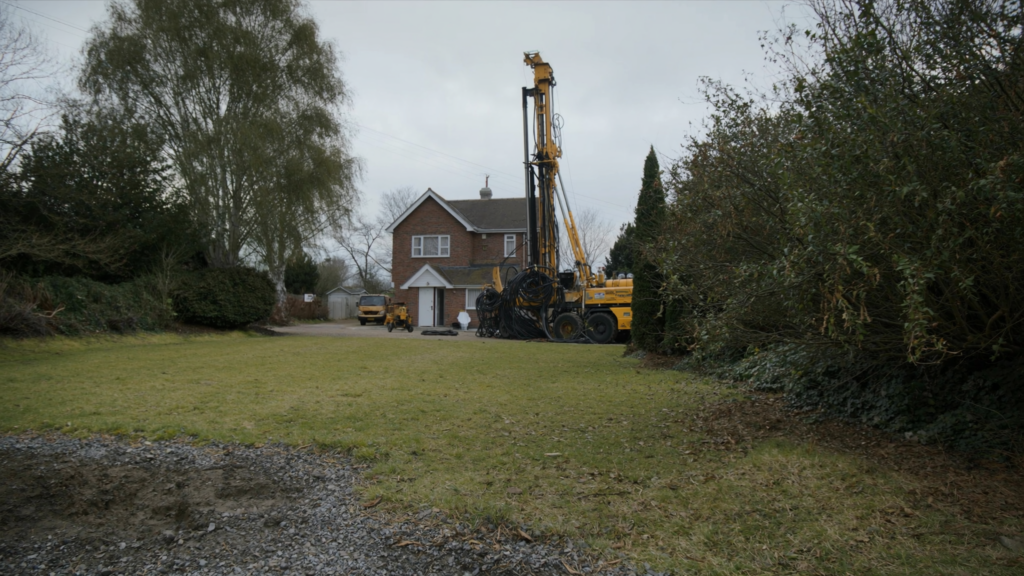
The ground loop can be laid horizontally in trenches if you have sufficient land, or vertically in boreholes for smaller plots. Both methods provide stable ground temperatures of 10–12°C year-round, which is why GSHP performance does not drop in winter (MCS, 2026).
A GSHP system for an off-grid home costs £14,000–£21,000 installed
The typical installed cost for a 6–10 kW GSHP system in a UK off-grid property, including ground loop, heat pump unit, and buffer tank, ranges from £14,000 to £21,000 according to DESNZ “Heat Pump Ready” programme cost data (DESNZ, 2026). The ground loop type significantly affects this total.
Horizontal trench loops, which require roughly 50–100 metres of land per kW of heating capacity, cost £8,000–£12,000 to install. Vertical boreholes, used where land is limited, cost £12,000–£18,000 depending on depth and geology (MCS installer directory, 2026). Additional costs include £800–£1,500 for a hot water cylinder if your existing cylinder is not compatible, and £500–£1,000 for electrical connection upgrades (GOV.UK, 2026).
These figures exclude any site-specific groundworks such as tree root removal or rock excavation, which can add £1,000–£3,000 in difficult conditions.
The Boiler Upgrade Scheme covers £7,500 of the GSHP cost for off-grid homes
The Boiler Upgrade Scheme (BUS) offers a flat £7,500 grant towards a GSHP installation, regardless of property size or location (GOV.UK, 2026). Off-grid homes are eligible if they have a valid Energy Performance Certificate (EPC) with no outstanding recommendations for loft or cavity wall insulation.
The grant is deducted from the installer’s quote at point of sale, not claimed separately by the homeowner. This means your net cost after the BUS grant is £6,500–£13,500 for a typical system (Ofgem, 2026).
You must use an MCS-certified installer to qualify. The grant is available for properties in England and Wales; separate schemes apply in Scotland through Home Energy Scotland.
Quick numbers annual running costs and savings versus off-grid alternatives
| Heating system | Annual fuel cost (3-bed off-grid home) | Annual CO₂ emissions (kg) |
|---|---|---|
| GSHP (CoP 3.5) | £800–£1,200 | 1,200–1,800 |
| Oil boiler | £1,800–£2,600 | 4,500–6,500 |
| LPG boiler | £2,200–£3,200 | 5,000–7,000 |
| Electric resistance heating | £2,400–£3,600 | 3,600–5,400 |
Assumptions: 12,000 kWh heat demand for a typical 3-bed off-grid home, GSHP CoP 3.5, electricity at 24p/kWh, oil at 65p/litre, LPG at 85p/litre, all from DESNZ “Energy Price Statistics” (DESNZ, 2026). Carbon factors from BEIS/DESNZ conversion tables. The GSHP’s emissions reflect the current grid-electric mix; if powered by solar PV, emissions approach zero.
Payback period for a GSHP in an off-grid home is 3–7 years when replacing oil or LPG
With the £7,500 BUS grant, the net cost of a GSHP is £6,500–£13,500. Annual savings compared to oil are £1,000–£1,400; compared to LPG, £1,400–£2,000; and compared to electric resistance heating, £1,600–£2,400 (Energy Saving Trust, 2026).
Simple payback ranges from 3 to 7 years depending on the fuel being replaced and the total system cost. For example, replacing an oil boiler with a £14,000 GSHP (net £6,500 after grant) saving £1,200 per year gives a payback of approximately 5.4 years.
The GSHP unit itself has a lifespan of 20–25 years, while the ground loop lasts 50 years or more (MCS, 2026). This means after payback, you benefit from 13–18 years of reduced running costs.
A GSHP can run on off-grid electricity from solar PV, batteries, or a generator
GSHPs require a 1.5–3 kW electrical supply for the compressor and circulation pump. This can be met by a 3–5 kW solar PV array with battery storage in a typical off-grid setup (Energy Saving Trust, 2026). During winter months when solar generation is low, a backup generator (diesel or LPG) can power the GSHP; a 5 kVA generator is sufficient for most 6–10 kW heat pumps.
Off-grid GSHP systems should include a buffer tank of 100–200 litres. This reduces short-cycling and allows the heat pump to run during generator or battery operation without frequent on-off cycling (MCS, 2026).
sizing a solar array for a heat pump battery storage options for off-grid homes
You must use an MCS-certified installer to qualify for the BUS grant and building regulations
The Boiler Upgrade Scheme requires the heat pump and installer to be certified under the Microgeneration Certification Scheme (MCS) (GOV.UK, 2026). Building Regulations Part L (England) and equivalent regulations in Scotland and Wales also require MCS certification for the system, or a full SAP calculation to demonstrate compliance.
To verify an installer, search the MCS database at mcsdirectory.com for certified GSHP installers in your area and check they hold MCS 020 (heat pump) certification (MCS, 2026). Using an uncertified installer voids the BUS grant and may cause compliance issues when selling the property.
how to check an MCS installer's credentials
Frequently Asked Questions
£14,000–£21,000 installed for a 6–10 kW system, according to DESNZ 2026 cost data. Horizontal loops cost £8,000–£12,000; vertical boreholes cost £12,000–£18,000.
Yes. GSHPs maintain full efficiency in cold weather with CoP 3–4, while air source heat pumps lose performance below 0°C, per MCS 2026 data. GSHP is more reliable off grid.
The Boiler Upgrade Scheme offers £7,500 towards GSHP installation. ECO4 may also cover eligible off-grid households. Check GOV.UK for current criteria.
Yes. GSHPs need electricity for the compressor and pump. Off-grid homes with solar PV and battery storage can run them sustainably, reducing grid reliance.
GSHP systems last 20–25 years for the heat pump unit and 50+ years for ground loops, per MCS installer data. Minimal maintenance is needed compared to oil or LPG.