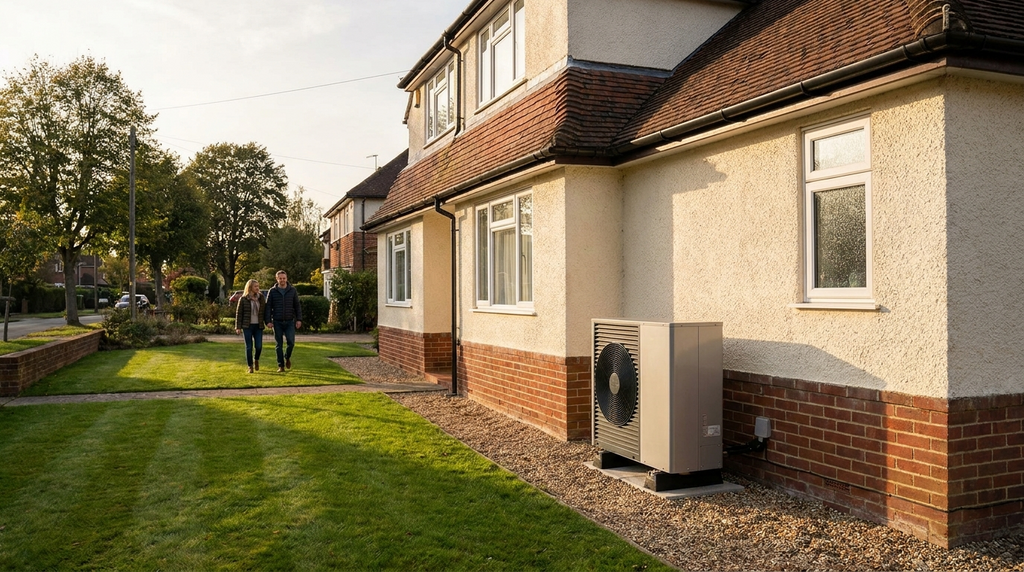
Horizontal loops cost roughly £14,000 less than vertical loops for an average 3-bedroom home
A ground source heat pump extracts heat from the ground using a buried pipe loop. The loop can be laid horizontally in trenches or drilled vertically into boreholes. The choice between the two affects the installation cost, the land you need, and the system’s efficiency.
A typical 8–12 kW ground source heat pump installation with a horizontal loop costs £19,000–£25,000, while a vertical loop system costs £33,000–£45,000 (Energy Saving Trust, 2026). The horizontal loop needs a trench 1–2 metres deep across a land area of 600–800 m², whereas the vertical loop requires boreholes 50–150 metres deep but only 10–20 m² of ground space.
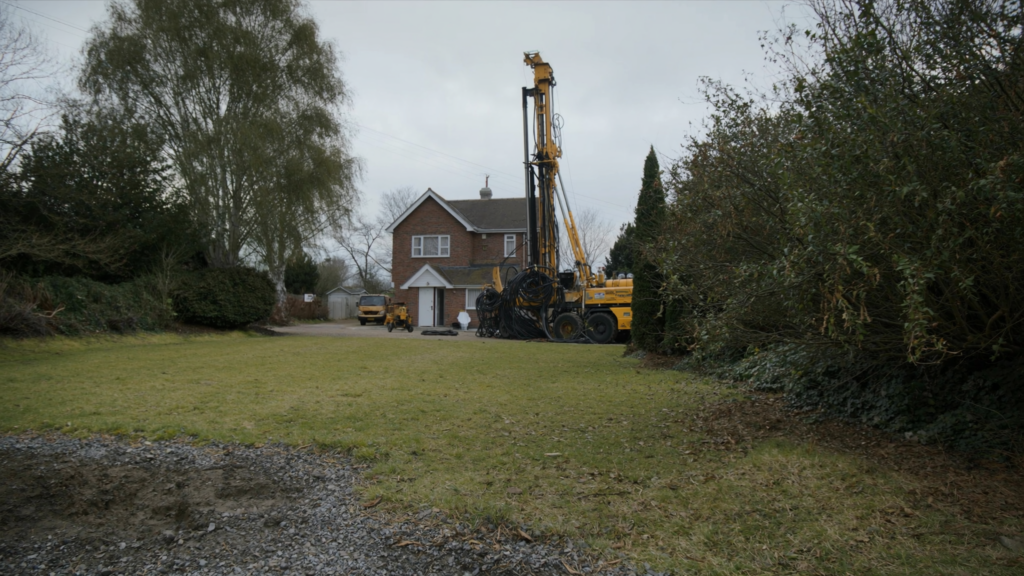
The cost difference is driven by excavation versus drilling. Horizontal loops use a digger for trenches at £15–£25 per metre. Vertical loops require specialist drilling rigs at £60–£100 per metre (MCS Register, installer cost data 2026). The final price depends on soil type, access, and whether the ground is clay, chalk, or rock, rock doubles vertical drilling costs.
Vertical loops deliver a higher coefficient of performance (CoP) in winter
CoP measures heat output per unit of electricity input. A CoP of 4 means 4 kW of heat for every 1 kW of electricity. Vertical loops draw from stable ground temperatures of 10–12°C year-round, while horizontal loops are influenced by seasonal surface temperatures, dropping to 2–4°C in shallow soil in winter (DESNZ, Ground Source Heat Pump Performance Data 2026).
The higher CoP of vertical systems reduces running costs by roughly 10–15% annually compared to horizontal loops, though the upfront saving of horizontal often outweighs this in mild climates. Real-world monitoring by the Energy Systems Catapult found vertical systems maintained CoP above 4.0 in February, while horizontal systems averaged 3.2 (Energy Systems Catapult, Heat Pump Performance Report 2026).
Quick numbers horizontal vs vertical loop for a 3-bedroom semi-detached home (8 kW heat pump)
| Metric | Horizontal Loop | Vertical Loop |
|---|---|---|
| System cost (installed) | £19,000–£25,000 | £33,000–£45,000 |
| Land area required | 600–800 m² | 10–20 m² |
| Depth of loop | 1–2 m | 50–150 m |
| Average CoP (annual) | 3.0–4.0 | 3.5–4.5 |
| Running cost per year (10,000 kWh heat demand, 28p/kWh) | £700–£933 | £622–£800 |
| Lifespan of ground loop | 50+ years | 50+ years |
| Typical annual carbon saving vs gas boiler | 2.5–3.5 tonnes CO₂ | 2.5–3.5 tonnes CO₂ |
Sources for the above figures: Energy Saving Trust, 2026; DESNZ, 2026; Ofgem tariff data 2026.
The direct answer choose horizontal if you have 600+ m² of land, choose vertical if your garden is small or you want maximum efficiency
Horizontal loops are the best value for homeowners with a large, accessible garden. The trench area must be clear of trees, buildings, and underground services. If your garden is smaller than 600 m², vertical loops are the only practical option. Vertical loops are also necessary where the soil is too shallow for trenches, such as on rocky ground or where the water table is high.
Horizontal loops can be installed in a day or two with a digger. Vertical loops take 2–5 days of drilling and require a wider access route for the rig. Both systems qualify for the same Boiler Upgrade Scheme grant of £7,500 (GOV.UK, Boiler Upgrade Scheme 2026).
Compare air source vs ground source heat pump costs
Eligibility and installer verification you must use an MCS-certified installer for both loop types to claim the grant
The Boiler Upgrade Scheme requires the heat pump and installer to be MCS-certified (Ofgem, BUS Guidance 2026). Horizontal loops need a ground survey to check soil thermal conductivity and avoid water pipes, gas lines, or tree roots. Vertical loops require a borehole permit from the local authority (Environment Agency, Ground Source Heat Pump Guidance 2026).
For vertical loops, the driller must also be registered with the British Drilling Association (BDA) or hold a relevant environmental permit if the borehole exceeds 15 metres (BDA, Code of Practice 2026). Always ask the installer for their MCS certificate number and check it on the MCS Register (mcscertified.com) before signing a contract.
The long-term running cost difference vertical loops save £80–£130 per year on electricity bills
Based on a 10,000 kWh annual heat demand and typical CoP values: a horizontal loop with CoP 3.5 uses 2,857 kWh of electricity, while a vertical loop with CoP 4.0 uses 2,500 kWh. At 28p/kWh (Ofgem price cap, October 2026), the horizontal system costs £800 per year and the vertical system costs £700 per year, a saving of £100 per year.
Over 20 years, the vertical loop’s extra upfront cost of £14,000–£20,000 would not be recouped via energy savings alone. The horizontal loop is cheaper in total cost of ownership for most homes. However, vertical loops maintain their CoP in very cold winters, so homes in northern England or Scotland may see a larger annual saving (DESNZ, Heat Pump Performance in Cold Climates 2026).
Ground source heat pump running costs explained
Which loop type has the higher total installed cost and why the gap is narrowing
Horizontal loops are cheaper because trenching costs £15–£25 per metre, while vertical drilling costs £60–£100 per metre (MCS installer cost survey 2026). The cost gap is narrowing due to rising fuel prices for diggers and increased demand for vertical drilling rigs. In 2026, the gap is roughly £14,000, down from £18,000 in 2023.
Horizontal loops may require additional pipework if the ground is clay or sandy, which adds 10–15% to the trenching cost. Vertical loops have no such variability. Both loops have the same lifespan of 50+ years and similar maintenance costs, annual checks of the heat pump unit only (Heat Pump Association, Maintenance Guide 2026).
Frequently Asked Questions
A horizontal loop system costs £19,000–£25,000, while a vertical loop system costs £33,000–£45,000 for an average 3-bedroom home, according to the Energy Saving Trust (2026).
Vertical loops are more efficient with a coefficient of performance (CoP) of 3.5–4.5 compared to 3.0–4.0 for horizontal loops, according to DESNZ (2026).
A horizontal loop requires 600–800 m² of land with trenches 1–2 metres deep, as specified by the MCS Register.
Yes, vertical loops need only 10–20 m² of ground space, making them suitable for smaller gardens, according to the Energy Saving Trust.
Yes, rock soil doubles vertical drilling costs to £60–£100 per metre, while clay or chalk is cheaper, based on MCS Register installer cost data (2026).