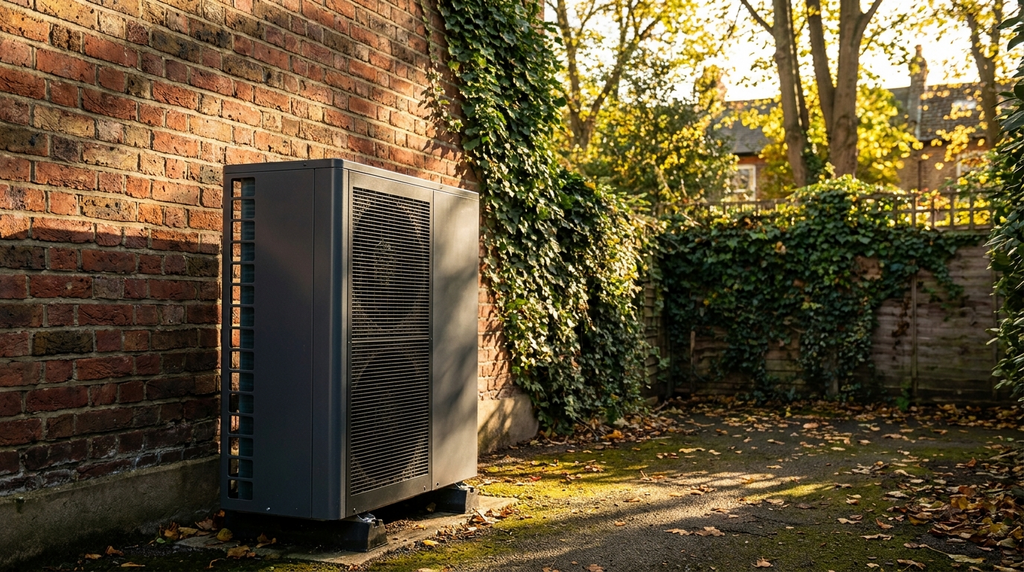
The single most important thing to know before choosing a ground source heat pump for an old house
A ground source heat pump (GSHP) can work well in older UK homes, but only if the building has adequate insulation and a properly designed low-temperature heating system. The pump itself is not a standalone fix.
For a typical pre-1930s solid-wall house, the heat loss must be reduced to below 50 W/m² before a GSHP becomes cost-effective. This usually requires wall insulation, floor insulation, and double or triple glazing (Energy Saving Trust, 2026).
GSHP systems for old houses almost always need a larger ground loop or deeper boreholes than a new-build because older homes have higher heat demand. The upfront cost is typically £14,000–£21,000 installed for an 8–12 kW system (Energy Saving Trust, 2026).
How ground source heat pumps differ from air source heat pumps for old houses
GSHPs extract heat from the ground at a stable 8–12°C year-round, whereas air source heat pumps (ASHPs) lose efficiency in cold weather. This makes GSHPs more reliable for old houses with high heat demand in winter.
GSHPs typically achieve a Seasonal Coefficient of Performance (SCOP) of 3.5–4.5 for well-designed systems in old houses, compared to 2.5–3.5 for ASHPs in the same building (DESNZ Heat Pump Performance Data, 2026). SCOP measures how many units of heat a pump produces for each unit of electricity it uses. A SCOP of 4.0 means the pump produces four units of heat for every one unit of electricity.
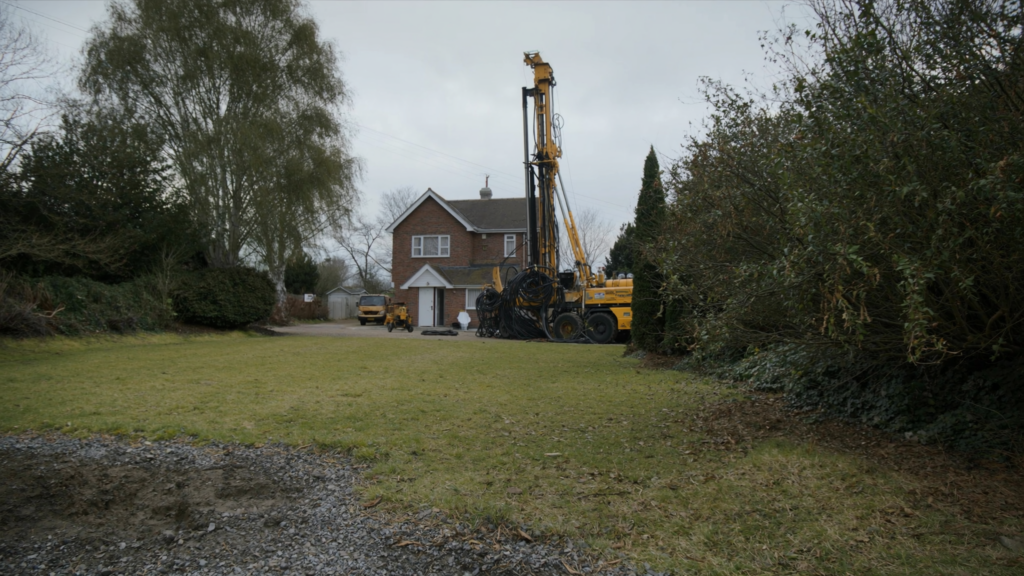
The ground loop installation requires significant outdoor space. Horizontal loops need 600–800 m² for a typical old house, while deep boreholes require 100–150 metres per borehole. This is not feasible for all properties. GSHPs have a longer lifespan of 20–25 years for the heat pump unit and 50+ years for the ground loop, compared to 12–15 years for ASHPs (Energy Saving Trust, 2026).
Quick numbers cost, efficiency, and payback for GSHPs in old houses
| Heat pump size | Typical cost (installed) | Annual running cost | SCOP | Annual CO₂ saving | Payback period |
|---|---|---|---|---|---|
| 8 kW | £14,000–£17,000 | £700–£900 | 3.5–4.5 | 2,500–3,000 kg | 12–15 years |
| 10 kW | £16,000–£19,000 | £850–£1,050 | 3.5–4.5 | 3,000–3,500 kg | 14–17 years |
| 12 kW | £18,000–£21,000 | £1,000–£1,200 | 3.5–4.5 | 3,500–4,000 kg | 15–18 years |
Costs and savings are based on a typical pre-1930s solid-wall house. Running costs assume an electricity rate of 24p/kWh. Payback periods include the £7,500 Boiler Upgrade Scheme grant (Energy Saving Trust, 2026; GOV.UK Boiler Upgrade Scheme, 2026).
Which ground source heat pump brand and model is most suitable for old houses
The best GSHP for an old UK house is a high-temperature model with flow temperature up to 65°C and an inverter-driven compressor. Old houses often have larger radiators or underfloor heating that needs higher flow temperatures. The Vaillant geoTHERM plus and Nibe F1245 are the most commonly recommended options by MCS-registered installers for old houses (MCS Product Database, 2026).
For old houses with existing radiator systems rather than underfloor heating, a GSHP with a SCOP rating above 4.0 at 55°C flow temperature is essential. Check the MCS product database for tested SCOP values at 55°C, not just the standard 35°C rating (MCS, 2026).
Brands with UK service networks and MCS-certified installer training programmes are preferable for old houses because installation complexity is higher and aftercare matters more. Vaillant, Nibe, and Mitsubishi Electric all have established UK support networks (Vaillant UK, 2026; Nibe UK, 2026).
The direct answer to “best ground source heat pump for old houses UK”
For most old UK houses (pre-1930s solid-wall, up to 150 m²), the best ground source heat pump is a 10–12 kW high-temperature model with a SCOP of at least 3.8 at 55°C flow temperature. It should be installed with a borehole ground loop if space allows, and paired with a 250–300 litre buffer tank. The Vaillant geoTHERM plus or Nibe F1245 are the most commonly recommended options by MCS-registered installers for old houses.
The decision depends on your house’s heat loss, available land for the ground loop, and whether you qualify for the Boiler Upgrade Scheme grant. The grant is £7,500 for GSHPs in England and Wales from 2026 (GOV.UK, 2026). No single model is universally best. The right choice matches your house’s specific heat demand, ground conditions, and existing heating system.
How to arrange a heat loss survey for your home
Eligibility, certification, and how to verify an installer for a GSHP in an old house
For a GSHP installation in the UK, the installer must be MCS-certified (Microgeneration Certification Scheme) for the heat pump to qualify for the Boiler Upgrade Scheme grant. Check the MCS register at mcscertified.com (MCS, 2026).
The installer must also hold TrustMark accreditation for consumer protection. For electrical work, they must be registered with NICEIC or NAPIT. Verify these at trustmark.org.uk and niceic.com (TrustMark, 2026).
For borehole ground loops, the installer must comply with the Environment Agency’s water abstraction and drilling regulations. Check that the installer has a valid permit if drilling deeper than 15 metres (Environment Agency, 2026).
How the Boiler Upgrade Scheme grant affects the choice of GSHP for old houses
The Boiler Upgrade Scheme (BUS) offers £7,500 towards a GSHP for homeowners in England and Wales at the 2026 rate (GOV.UK, 2026). This covers roughly 35–50% of the typical installation cost for an old house.
The grant is only available for MCS-certified heat pumps and installations. The chosen brand and model must appear on the MCS product database. Check this before buying (MCS, 2026).
For old houses, the BUS grant makes a higher-cost GSHP more affordable. The £7,500 fixed grant is the same regardless of system cost. Spending more on an efficient model can be better value because the grant covers a larger proportion of the upfront cost (DESNZ Boiler Upgrade Scheme statistics, 2026).
Complete guide to the Boiler Upgrade Scheme grant eligibility
Frequently Asked Questions
Yes, but only after reducing heat loss below 50 W/m² with insulation and double glazing. The Energy Saving Trust states that wall insulation, floor insulation, and glazing upgrades are usually needed for pre-1930s solid-wall homes.
An 8–12 kW system costs £14,000–£21,000 installed, according to the Energy Saving Trust. The ground loop adds significant cost and space requirements.
A horizontal loop needs 600–800 m² of land, while boreholes require 100–150 metres per borehole. The Energy Saving Trust notes that older homes with higher heat demand need larger loops than new builds.
Yes, GSHPs maintain efficiency in cold weather with a SCOP of 3.5–4.5, compared to 2.5–3.5 for ASHPs in the same building. DESNZ data shows GSHPs are more reliable for high heat demand in winter.
The heat pump unit lasts 20–25 years and the ground loop lasts 50+ years, according to the Energy Saving Trust. This is longer than the 12–15 year lifespan of an air source heat pump.