Every January, somewhere in the UK, a homeowner opens their electricity bill and stares at the same flat unit rate charged for the washing machine running at 2am as it does at 2pm. They wonder whether there is a smarter arrangement, one that rewards them for moving consumption to quieter hours. Economy 7 has existed as exactly that promise for decades. The problem is that the promise only holds up under specific circumstances, and a surprising number of homes are quietly paying more because they switched without checking whether the maths worked for them first.
Economy 7 tariff is worth it for all-electric homes with storage heaters or overnight EV charging, where at least 40% of electricity use falls in the off-peak window. Daytime rates typically reach 30p to 35p per kWh, so households on gas central heating or with daytime-heavy usage usually pay more than on a standard tariff.
- Economy 7 only saves money if at least 40% of your electricity use falls within the overnight off-peak window, calculate your usage split before switching.
- Check your exact off-peak hours with your supplier before assuming the standard midnight to 7am window applies, regional and supplier variations can shift this significantly.
- All-electric homes with storage heaters and off-peak hot water cylinders are the strongest candidates, gas central heating households typically pay more on Economy 7.
- Electric vehicle owners who charge overnight can benefit from Economy 7, but compare it against dedicated EV tariffs first as those often offer lower overnight rates.
- Get 3 quotes from MCS-certified or NAPIT-registered installers before upgrading storage heaters or adding controls to maximise Economy 7 savings.
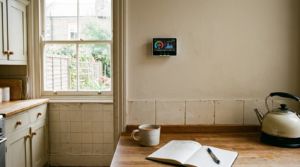
- Use a smart meter to track exactly when you use electricity across several weeks before switching, this data is the single most reliable way to assess whether Economy 7 suits your home.
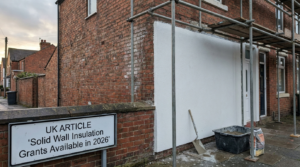
- Check eligibility for the Great British Insulation Scheme and ECO4 funding in 2026 if your home uses electric heating, as upgrades funded through these schemes can increase Economy 7 savings substantially.
- What Economy 7 Actually Is and What It Is Not
- The Two-Rate Reality and What You Actually Pay Per Unit in 2026
- The Homes That Genuinely Benefit and the Ones That Do Not
- Storage Heaters, the Original Economy 7 Partnership
- Grants and Support Available in 2026 and What Is on the Table
- What Switching Actually Involves and What Surprises People
- Common Mistakes That Installers and Advisers Keep Seeing
- How to Verify Your Installer or Adviser Is Qualified
Economy 7 is a time-of-use electricity tariff that charges two different unit rates, a lower rate for approximately seven overnight hours and a higher rate during the remaining daytime hours. It is genuinely worth it for all-electric homes with storage heaters, off-peak hot water cylinders, or electric vehicles that charge overnight. For homes on gas central heating, or where most electricity use happens during the day, it typically costs more than a standard single-rate tariff.
This article works through the actual numbers, the home types that benefit, the grant support available in 2026, and the mistakes that experienced installers and energy advisers keep encountering. The goal is not to push you toward switching, it is to give you the information to make that judgement yourself.
What Economy 7 Actually Is and What It Is Not
Economy 7 is a legacy two-rate electricity tariff. The name refers to the approximately seven hours of cheaper overnight electricity that suppliers offer under the arrangement. During that off-peak window, typically running from around midnight to 7am, though the exact hours vary, you pay a substantially lower unit rate. Outside that window, you pay a daytime rate that is higher than what a standard single-rate customer pays.
That last point is the one most comparison sites gloss over. The off-peak window is not the same across all suppliers or all regions. In some areas, particularly those served by older distribution network infrastructure, the overnight period may start later, end earlier, or shift seasonally. One region’s Economy 7 window might begin at 11pm; another’s might not start until 1am. If you programme your storage heaters, dishwasher, or immersion heater based on an assumption rather than the confirmed hours your supplier has assigned to your meter, you may be running appliances in the expensive period while believing you are in the cheap one. This is not a theoretical risk, it is one of the most common reasons homeowners find Economy 7 delivering no savings despite apparently doing everything right.
It is also worth being clear about what Economy 7 is not. It is not a modern smart tariff. Products such as Octopus Agile or Octopus Go, which use half-hourly pricing based on wholesale electricity market conditions, are a different category entirely. Those tariffs use smart meter data to charge variable rates that can shift hour by hour. Economy 7 is older infrastructure, a fixed two-rate system that has existed in its current form since the 1970s and was designed primarily to sell off-peak electricity generated by nuclear power stations that could not easily be throttled overnight. Understanding that history matters because it explains why the system is inflexible and why it is increasingly being displaced by smarter alternatives.
smart electricity tariffs compared for UK homeowners
The Two-Rate Reality and What You Actually Pay Per Unit in 2026
The numbers are where the decision lives, and they are less flattering to Economy 7 than the marketing summary suggests.
In 2026, indicative Economy 7 unit rates, which vary by supplier and region and are subject to Ofgem‘s price cap framework, typically run as follows. Daytime rates frequently sit in the range of 30 to 35 pence per kilowatt-hour. Overnight rates can fall to roughly 15 to 20 pence per kilowatt-hour. A standard single-rate tariff, by contrast, typically charges in the region of 24 to 25 pence per kilowatt-hour at all times. Always verify current rates directly with your supplier or via Ofgem’s published price cap data, as these figures move with each quarterly update.
What this means in practice is straightforward but easy to miss. The overnight rate is genuinely cheap, roughly half the daytime rate. But the daytime rate is significantly above what a standard tariff customer pays. You are not simply getting a discount on some of your electricity. You are getting a large discount on a portion of it and paying a premium on the rest. Whether that trades in your favour depends entirely on the proportion of your usage that falls in the off-peak window.
The break-even figure that homeowners most commonly do not know before switching is approximately 40 percent. If fewer than roughly 40 percent of your total electricity consumption falls within the overnight off-peak window, you are likely to pay more annually on Economy 7 than you would on a standard tariff. This figure shifts slightly depending on the exact rates your supplier offers, but it is a reliable working threshold. For context, the average UK household uses electricity predominantly during waking hours, which for most people means the break-even point is not reached without a deliberate strategy to move significant loads overnight.
| Feature | Standard Single Rate | Economy 7 |
|---|---|---|
| Typical day unit rate (2026) | ~24–25p/kWh | ~30–35p/kWh |
| Typical night unit rate (2026) | Same as day | ~15–20p/kWh |
| Standing charge | Standard rate | Comparable or slightly higher |
| Ideal overnight usage share | Not applicable | 40% or more of total consumption |
| Best-suited heating system | Any | Night storage heaters, off-peak immersion |
| Typical annual impact (3-bed home, gas heating) | Baseline | Likely higher than standard |
| Typical annual impact (3-bed all-electric, storage heaters) | Higher than Economy 7 | Potentially lower, subject to usage split |
The standing charge is a detail worth examining. Economy 7 standing charges are often comparable to or marginally above those on standard tariffs. Over a year, this can add a modest but real amount to your bills regardless of how cleverly you manage your overnight usage. It is not a dealbreaker but it erodes the overnight savings slightly, which matters most when you are close to the break-even threshold.
The Homes That Genuinely Benefit and the Ones That Do Not
Economy 7 is genuinely worth it for homes with storage heaters, off-peak hot water cylinders, or electric vehicle chargers that can be scheduled overnight. It is unlikely to save money in homes relying on gas central heating or where most electricity use happens during the day.
The home that wins on Economy 7 looks roughly like this. It is all-electric, no gas boiler, no gas hob. It heats with night storage heaters that charge up during the off-peak window and release warmth through the day. Hot water comes from an immersion heater on a timer, running between 2am and 5am. An electric vehicle sits in the driveway charging every night from 11pm. In this scenario, the household might genuinely shift 50 to 60 percent of its total electricity consumption into the cheap period, and the savings over a standard tariff can be meaningful, potentially several hundred pounds annually in a larger all-electric property.
The home that loses looks quite different. It has a gas boiler for heating and hot water. Its electricity use is spread across lighting, cooking, a television, a laptop, and perhaps a tumble dryer used on weekend afternoons. Very little of that is schedulable to run overnight. The elevated daytime rate, 30 to 35p/kWh against a standard rate of 24 to 25p/kWh, applies to nearly all of its consumption. That household is paying a premium for cheap overnight electricity it barely uses.
The working-from-home variable deserves particular attention in 2026. Remote and hybrid working is now embedded in the working patterns of a substantial proportion of UK households. People who work from home are running computers, monitors, heating, and kettles during the day, precisely the hours Economy 7 charges its premium rate. This quietly and consistently undermines Economy 7 savings for a large proportion of households, and it is a point that very few tariff comparison sites acknowledge. If your household’s daytime occupancy has increased in recent years without a corresponding shift in your overnight electricity consumption, the maths may have moved against Economy 7 without your bill clearly telling you so.
working from home energy costs and how to reduce them
Storage Heaters, the Original Economy 7 Partnership
Night storage heaters and Economy 7 were effectively built for each other, and understanding how they work together explains why the tariff can be so valuable in the right home, and so irrelevant in others.
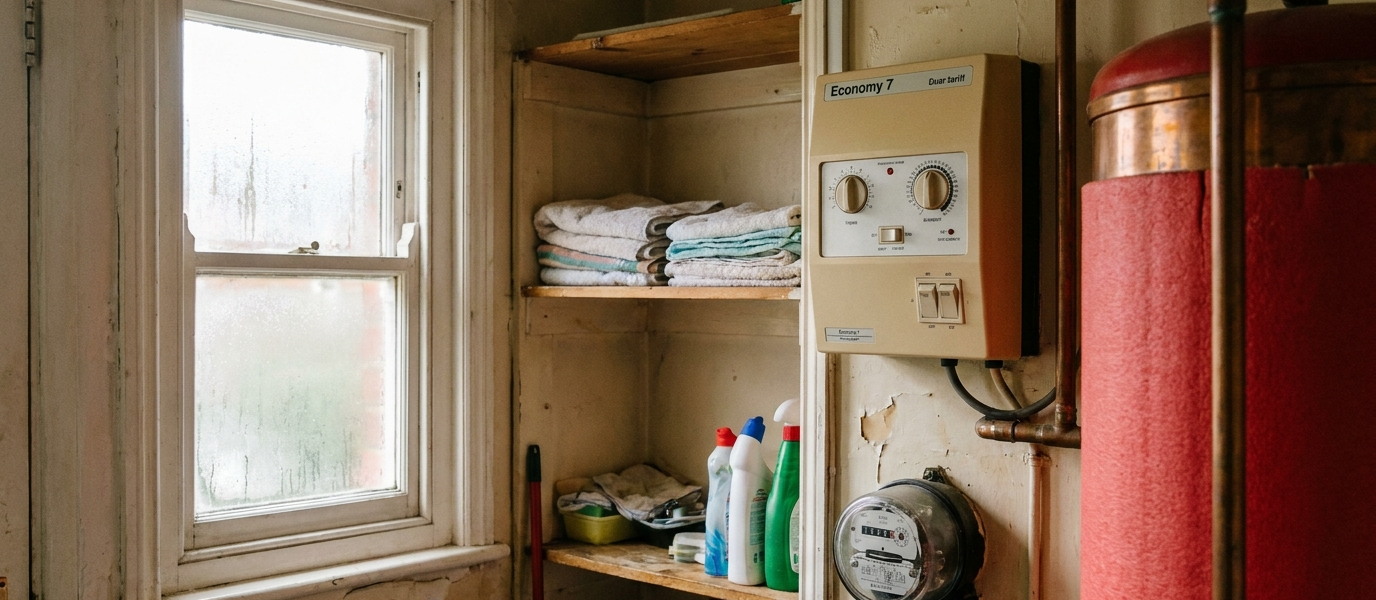
A storage heater is an electric heater that draws power during the overnight off-peak period to heat high-density ceramic bricks inside a well-insulated casing. Those bricks store thermal energy and release it gradually throughout the following day. The heater uses almost no electricity during the day. In a home where Economy 7 is the tariff, the heater charges at 15 to 20p/kWh and provides warmth at no further electricity cost during the expensive hours. The system works because the load is both large, a typical storage heater draws 1.5 to 3.5 kilowatts, and entirely schedulable.
The problem many homeowners face is that they have Economy 7 but older storage heaters from the 1980s or early 1990s. Those older units operate on a basic input and output dial system with limited precision. They frequently over-charge on mild nights, meaning they heat the bricks to full capacity on an autumn evening when less heat will be needed the next day, and the excess warmth dissipates overnight into an empty house. They also discharge heat in a fixed, relatively uncontrolled way, meaning warmth can be largely spent by early afternoon. The result is a home that is warm at 10am and cool by 5pm, with the household reaching for an expensive panel heater in the evening.
Newer automatic or smart storage heaters address this directly. They use thermostatic controls and, in some cases, connectivity features that allow them to modulate charging based on the next day’s weather forecast and the household’s typical schedule. The heat output is managed more precisely, reducing waste. These models are significantly more effective at exploiting the Economy 7 tariff, and many are eligible for grant funding under ECO4 or the Great British Insulation Scheme in 2026.
The cost of storage heater replacement in 2026 typically runs to between £500 and £1,000 per unit fully installed, depending on the size of the heater and the complexity of the wiring. For a three-bedroom home requiring four or five heaters, that represents a meaningful outlay. Grant funding under ECO4 can reduce or eliminate this cost for eligible households, which we cover in the section below.
modern storage heaters guide for UK homes
Grants and Support Available in 2026 and What Is on the Table
Three schemes are directly relevant to homeowners considering Economy 7 upgrades in 2026. Each has different eligibility criteria and coverage.
ECO4 (Energy Company Obligation 4) is a Government-funded scheme that requires large energy suppliers to fund energy efficiency improvements for low-income or fuel-poor households. Measures covered include storage heater upgrades, loft insulation, cavity wall insulation, and solid wall insulation. Eligibility is based on household income, benefits received, and the property’s EPC rating. For a household on qualifying benefits or below an income threshold, ECO4 can fund the full cost of a storage heater replacement and associated insulation work. Applications are typically made through energy suppliers or via a registered installer, the Energy Saving Trust‘s eligibility checker at energysavingtrust.org.uk is a useful starting point.
GBIS (Great British Insulation Scheme) targets properties in EPC bands D and below. Its primary focus is insulation, loft, cavity wall, and in some cases solid wall, rather than heating systems directly. However, for an Economy 7 household, improving insulation is not a separate consideration. A well-insulated home retains the heat from storage heaters far longer, which directly improves the tariff’s effectiveness. A storage heater in a draughty, poorly insulated 1960s semi-detached loses its stored warmth hours earlier than the same heater in a well-insulated property. Pairing GBIS-funded insulation with an Economy 7 storage heater upgrade is the combination that tends to deliver the most consistent results.
BUS (Boiler Upgrade Scheme) offers a grant of £7,500 toward the installation of an air source heat pump. It is worth mentioning here for a specific reason. Some homeowners in all-electric properties consider whether an air source heat pump might be a better long-term heating solution than storage heaters. Heat pumps pair most effectively with modern smart time-of-use tariffs rather than Economy 7, because they can be programmed to run during the cheapest half-hourly periods identified by a smart meter, rather than being tied to a fixed overnight window. Economy 7’s rigidity is less well-suited to heat pump operation than a flexible smart tariff. If you are weighing a major heating upgrade, this distinction matters.
Grant availability and eligibility criteria under ECO4 and GBIS can shift during the year as funding is reviewed and allocated. Always verify current eligibility directly with your energy supplier or via the Energy Saving Trust before making commitments based on anticipated grant support.
What Switching Actually Involves and What Surprises People
The most common surprise homeowners encounter when trying to switch to Economy 7 is discovering that their meter is not compatible. Economy 7 requires a dual-register meter, a meter that records daytime and overnight consumption separately, so your supplier can apply different rates to each. Many older homes have a single-register meter that records only total consumption. Smart meters can be set to operate on a two-rate basis, but they must be configured correctly by your supplier, and not all suppliers routinely do this as part of a standard Economy 7 switch. Sorting out the meter change adds time to the process, sometimes several weeks, and in some circumstances there is a cost involved, though this varies by supplier.
- Contact your current energy supplier and ask whether your property has a dual-register meter or a smart meter configured for two rates.
- If you have a smart meter with in-home display, check whether your current half-hourly usage data shows a meaningful proportion of consumption in overnight hours, this gives you a real-world consumption split before you commit.
- Use your supplier’s Economy 7 comparison tool or an independent calculator to model your likely annual bill based on your actual usage split, not an assumed one.
- Ask your supplier to confirm in writing the exact off-peak window hours that apply to your property and region before you set any appliance timers.
- Review exit terms, in 2026, Economy 7 is available from a narrowing pool of suppliers as the market moves toward smart time-of-use products. Confirm whether your preferred supplier actively supports Economy 7 and what the switching or exit conditions are.
The narrowing availability point is worth dwelling on. Several suppliers that previously offered Economy 7 as a standard product have shifted their focus toward smart tariffs, and in some cases Economy 7 is now only available to existing customers or to those who specifically request it. This is not necessarily a problem, but it limits your ability to compare Economy 7 deals across the market in the way you could with a standard tariff.
Common Mistakes That Installers and Advisers Keep Seeing
After spending time in homes with Economy 7 setups across a range of property types, Victorian terraces with retrofitted storage heaters, 1960s purpose-built all-electric flats, and newer builds with legacy tariffs carried over from previous occupants, a pattern of recurring errors becomes clear.
Mistake one is assuming that all overnight use is cheap. The off-peak window has a hard end time. A tumble dryer set to start at 5am and running for a 90-minute cycle will finish at 6:30am. If the off-peak window in that region ends at 6am, only half the cycle ran at the cheap rate. Depending on how often this happens, the saving per cycle can be minimal. Knowing your confirmed window and timing appliances to complete within it, not just start within it, is the detail that makes the difference.
Mistake two is not recalculating after a lifestyle change. Getting a dog that needs to be let out at 6am, having a baby who changes the household’s entire sleep schedule, retiring, or beginning to work from home all shift daytime electricity consumption upward. What worked well two years ago on Economy 7 may now cost you more. Reviewing your tariff suitability annually, rather than switching and forgetting, is the habit that prevents this.
Mistake three is switching to Economy 7 storage heaters without addressing insulation first. In a typical 1970s semi-detached with uninsulated loft and original single-glazed windows, storage heaters are fighting against constant heat loss. The ceramic bricks charge overnight and the heat they contain bleeds through the walls, windows, and ceiling at a rate that can halve the available warmth before mid-morning. Spending on insulation before or alongside the heating upgrade, particularly loft insulation, which remains one of the most cost-effective interventions available, is the sequence that produces reliable results.
The non-obvious point that most articles on this topic miss entirely concerns solar panels. If you have solar photovoltaic panels installed and are on Economy 7, the combination is almost always counterproductive. Solar generation peaks between roughly 10am and 3pm, precisely the hours Economy 7 charges its most expensive daytime rate. Any electricity your panels do not generate during those hours, you are buying at 30 to 35p/kWh. Your solar export, meanwhile, earns you a comparatively modest Smart Export Guarantee rate. A modern smart time-of-use tariff or a flexible EV tariff is almost always a better pairing for a solar home than Economy 7, because it allows you to buy grid electricity during the genuinely cheapest periods rather than being locked to a fixed overnight window.
solar panels and electricity tariff pairing guide for UK homes
How to Verify Your Installer or Adviser Is Qualified
Economy 7 itself requires no installation, it is a tariff, changed by contacting your supplier. The work that typically accompanies it, replacing storage heaters, installing a new immersion heater, or upgrading a consumer unit to accommodate new loads, is a different matter. Electrical work of this kind must be carried out by a competent electrician, and competence here has a specific, verifiable meaning.
NICEIC (National Inspection Council for Electrical Installation Contracting) and NAPIT (National Association of Professional Inspectors and Testers) are the two principal competent person schemes for electrical work in England and Wales. An electrician registered with either scheme is authorised to self-certify certain types of electrical installation work without requiring a separate building control inspection. Both schemes maintain publicly searchable online registers. You can verify any electrician’s registration on the NICEIC website at niceic.com or the NAPIT website at napit.org.uk before agreeing to any work.
TrustMark is the Government-endorsed quality scheme that applies to all installers carrying out work funded under ECO4 or GBIS. TrustMark registration is a requirement for grant-funded installations, without it, the work will not be eligible for scheme funding. Checking TrustMark registration at trustmark.org.uk takes under a minute and provides reassurance that the installer has met quality and consumer protection standards assessed by an independent body.
| Accreditation | Relevant For | How to Verify | Required For Grant Work |
|---|---|---|---|
| NICEIC | Electrical installation (storage heaters, consumer units) | niceic.com, public register | Indirectly, must also hold TrustMark for ECO4/GBIS |
| NAPIT | Electrical installation (alternative to NICEIC) | napit.org.uk, public register | Indirectly, must also hold TrustMark for ECO4/GBIS |
| TrustMark | All ECO4 and GBIS funded work | trustmark.org.uk, public register | Yes, mandatory for all grant-funded installations |
| MCS | Heat pump installation (if considering BUS grant) | mcscertified.com, public register | Yes, mandatory for BUS heat pump grant |
One practical note worth adding. When you receive quotes for storage heater installation or associated electrical work, ask each contractor directly whether they hold the relevant accreditation and then verify it yourself. A reputable installer will not object to this. The combination of NICEIC or NAPIT registration plus TrustMark is the baseline to look for when grant funding is involved.
Making the Decision That Is Right for Your Home
Economy 7 is not a trick and it is not a relic not worth thinking about. For the right household, all-electric, with storage heaters or an EV, and the discipline to push significant loads overnight, it remains a practical and potentially cost-effective tariff in 2026. The overnight rate is genuinely low, and if you can reliably put 40 percent or more of your total consumption into that window, the maths can work in your favour.
But the homes for which Economy 7 is the right answer have narrowed as working patterns have shifted, as gas central heating remains dominant in the UK housing stock, and as smarter alternatives have emerged. The tariff rewards a specific kind of household. If yours does not match that profile, switching in hope rather than on the basis of a calculated usage split is likely to produce disappointment on your next bill.
The most useful single step before making any decision is to pull three months of actual half-hourly usage data from your smart meter, your supplier or the energy display unit in your home can usually provide this, and calculate what proportion genuinely falls between midnight and 7am. If that figure is comfortably above 40 percent, the conversation with your supplier is worth having. If it is well below that, your energy is better spent looking at other efficiency measures first.
whole-house energy efficiency audit, where to start for UK homeowners
Frequently Asked Questions
Off-peak hours vary by supplier and region, but typically run for around seven hours overnight, commonly between midnight and 7am. However, some suppliers shift this window to as late as 1am to 8am, and in some regions the hours differ entirely. Always confirm your exact off-peak window directly with your supplier before adjusting when appliances run.
In 2026, typical Economy 7 off-peak rates range from around 10p to 15p per kWh, while daytime rates on the same tariff often reach 30p to 35p per kWh. Standard single-rate tariffs sit at roughly 24p to 28p per kWh. This means daytime Economy 7 use costs significantly more than on a flat-rate tariff, so shifting usage overnight is essential.
Economy 7 can reduce EV charging costs if you consistently charge during the off-peak window, potentially saving £300 to £500 per year compared to daytime charging on a standard tariff. However, dedicated EV tariffs from suppliers such as Octopus Energy and OVO often offer overnight rates as low as 7p to 10p per kWh, which may deliver greater savings than Economy 7 alone.
Yes. The ECO4 scheme and Great British Insulation Scheme are both active in 2026 and can fund storage heater upgrades or replacement for eligible low-income households. Local authority flexible eligibility routes also allow some households above standard income thresholds to qualify. Contact your energy supplier or local council to check eligibility before paying for upgrades yourself.
Compare your annual spend by multiplying your daytime and overnight kWh usage by the respective Economy 7 rates, then compare the total against a standard single-rate tariff using your total annual kWh. If less than 40% of your consumption falls in the off-peak window, Economy 7 is likely costing you more. A smart meter reading over several weeks gives the most accurate usage split to run this calculation.