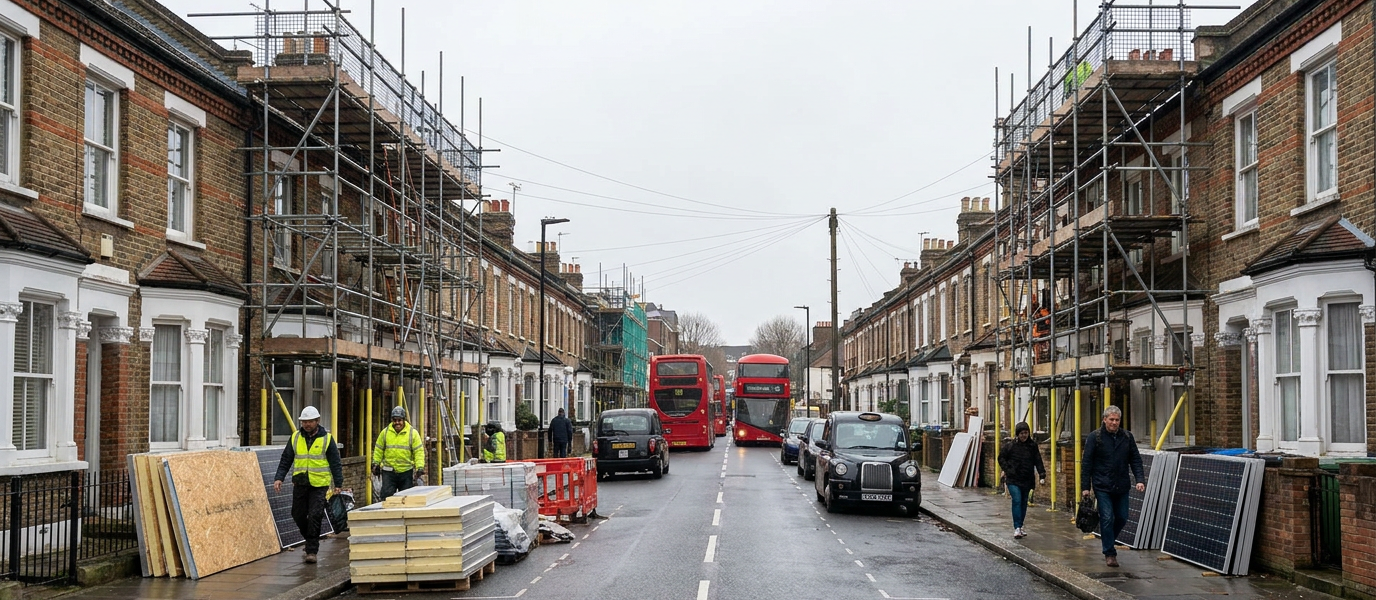
Twenty thousand homes. That is the number London boroughs now propose to retrofit in a coordinated bid to cut energy bills and carbon emissions. The plan, announced by London Councils this week, would see insulation, heat pumps, and solar panels installed across the capital’s least efficient housing stock, much of it pre-1930s terraces and 1960s council blocks with EPC ratings of D or below.
As reported by London Councils, the proposal calls for £1.8bn in government funding over five years. The pitch is straightforward: spend public money upfront to unlock private savings and reduce the £1.2bn London households collectively waste on heat leaking through walls and roofs each year.
Who qualifies, and who doesn’t
The plan targets social housing and low-income owner-occupiers first. That mirrors the existing Energy Company Obligation (ECO4) scheme, which mandates energy suppliers to fund upgrades for households on benefits or with low incomes. But London’s proposal goes further: it aims to retrofit whole streets rather than individual homes, reducing costs through bulk purchasing and standardised designs.
Private landlords and higher-income homeowners are not included. That is a gap. A typical 3-bed semi in Zone 3, with solid brick walls and single glazing, might need £25,000–£35,000 of work to reach EPC C. Without grants, few can afford it. The London Councils’ proposal acknowledges this but offers no solution for the 40% of homes owned outright by pensioners on modest incomes but above benefit thresholds.
What it costs a typical 3-bed semi
Take a 1930s semi in Walthamstow: uninsulated cavity walls, loft insulation that has settled to 50mm, a gas boiler from 2005. Retrofitting with 200mm loft insulation, cavity wall fill, triple-glazed windows, an air-source heat pump, and 4kW of solar panels would cost roughly £28,000–£32,000. Under the proposed plan, the household might pay nothing if income-qualified, or around £5,000–£8,000 under a co-payment model.
Energy Savings Trust figures suggest such a home could save £800–£1,200 annually on bills at current price cap levels (standing at £1,923 from October 2024). Payback for the co-paying household: six to eight years. For the fully funded household: immediate cash-flow relief.
But the catch is delivery. The UK has roughly 250,000 trained retrofit installers. To hit the government’s target of upgrading 19 million homes by 2050, the Construction Industry Training Board estimates we need 500,000. London alone would need an extra 5,000–7,000 heat pump and insulation fitters over the next three years. The boroughs’ proposal includes a workforce plan, but training takes time.
What this means for homeowners outside London
The London plan is not yet funded. It is a proposal to central government, which has committed £6.6bn to energy efficiency this parliament, less than a third of the £20bn the Climate Change Committee says is needed.
Homeowners elsewhere should not wait. The Great British Insulation Scheme closed on 31 March 2026. It funded insulation measures only and never covered windows or glazing. ECO4 runs until March 2026 and covers heat pumps and solar for eligible households. Check eligibility on gov.uk now. The next window for the Boiler Upgrade Scheme (grants of £7,500 for heat pumps) opens in April 2025.
London’s ambition is welcome. But without a national delivery machine, it risks becoming another well-intentioned press release. Homeowners who act on existing schemes today will be warmer next winter, and that is a better bet than waiting for a plan that may never arrive.
Frequently Asked Questions
Retrofitting a typical 1930s 3-bed semi in London, including 200mm loft insulation, cavity wall fill, triple-glazed windows, an air-source heat pump, and 4kW solar panels, costs roughly £28,000–£32,000. Under London's proposed plan, income-qualified households might pay nothing, while others could pay £5,000–£8,000 via a co-payment model.
The London Councils' plan proposes retrofitting 20,000 homes across the capital with insulation, heat pumps, and solar panels, targeting social housing and low-income owner-occupiers first. It calls for £1.8bn in government funding over five years to cut energy bills and carbon emissions, focusing on whole-street upgrades rather than individual homes.
The plan prioritises social housing tenants and low-income owner-occupiers, mirroring the existing Energy Company Obligation (ECO4) scheme. Households on benefits or with low incomes may receive fully funded upgrades, but private landlords and higher-income homeowners are excluded, including pensioners with modest incomes above benefit thresholds.
According to the Energy Savings Trust, a retrofitted 3-bed semi in London could save £800–£1,200 annually on energy bills at the October 2024 price cap of £1,923. For households co-paying £5,000–£8,000, payback takes six to eight years, while fully funded homes see immediate cash-flow relief.
The government has committed £6.6bn to energy efficiency this parliament, but the Climate Change Committee says £20bn is needed, and London's £1.8bn plan is still a proposal awaiting funding.




