The average UK semi-detached home needs at least £15,000 of retrofit work to reach EPC band C. For most households, that figure alone kills the project before it starts.
Now a new guidance document, as reported by Scottish Housing News, proposes a different route: upgrade entire streets at once, not one house at a time. The idea is simple but carries real consequences for household budgets and installation timelines.
Why place-based retrofit matters to your energy bill
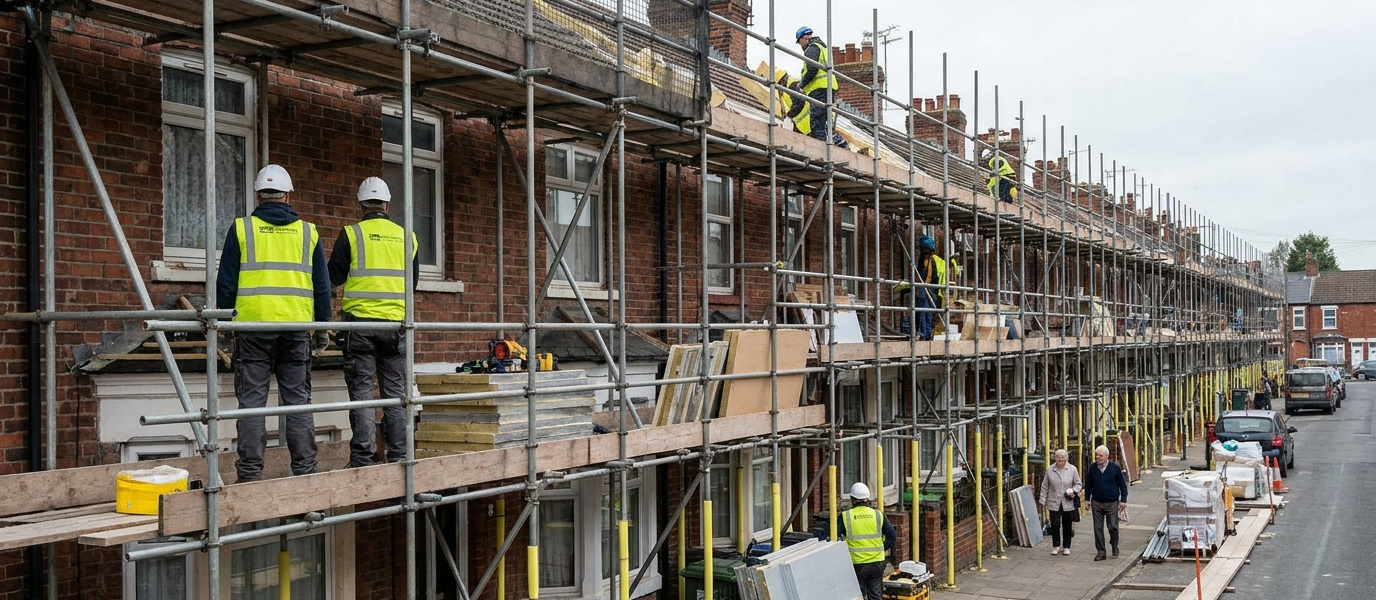
Individual retrofit projects face three blockers that place-based delivery can sidestep. First, cost: a single heat pump installation runs £7,000–£13,000, but bulk procurement across 20 homes can shave 15–25% off that figure. Second, disruption: scaffolding, skips, and contractor visits stretch over weeks for one house but compress into days for a terrace. Third, installer capacity: the UK has roughly 4,000 certified heat pump installers, place-based contracts give them guaranteed work, so they show up.
Ofgem’s latest data shows 47% of homes in England still have EPC ratings of D or below. At current installation rates, reaching net-zero targets by 2050 would require every single home to be retrofitted twice over. Place-based delivery doesn’t solve the skills gap, but it makes the economics work better for both households and contractors.
Who qualifies, and who doesn’t
The guidance targets social housing providers and local authorities first, not individual owner-occupiers. If you live in a housing association property, your landlord can apply for place-based funding through the Social Housing Decarbonisation Fund. For private homeowners, the route is less direct: you need your local council to launch a street-by-street programme in your area.
Energy Saving Trust analysis suggests that streets with at least 60% solid-wall construction and pre-1990 build dates are most likely to be prioritised. If you live in a 1930s semi with cavity walls, you may wait longer, those homes are cheaper to retrofit individually, so the bulk benefit is smaller.
The catch is timing. The government’s current grant programmes, Boiler Upgrade Scheme, Great British Insulation Scheme, run until 2028 at latest. Place-based delivery typically takes 18–24 months from council application to first installation. Homeowners on standard variable tariffs who need urgent bill relief may not have that luxury.
What it costs a typical 3-bed semi
A typical 3-bed semi in Manchester or Glasgow using 12,000 kWh of gas and 3,000 kWh of electricity annually would need: loft insulation (£500–£800), cavity wall insulation (£1,200–£1,800), a heat pump (£9,000–£13,000), and double glazing (£4,000–£6,000). Total: roughly £15,000–£22,000.
Under a place-based scheme, the same package could drop to £12,000–£17,000, savings that come from shared scaffolding, bulk material orders, and one contractor managing multiple homes in a row. The Boiler Upgrade Scheme grant of £7,500 would still apply, bringing the net cost to £4,500–£9,500.
But these figures assume your street qualifies and your local authority applies. Officials have not confirmed when applications open for the new guidance’s implementation phase. Homeowners should contact their council’s retrofit coordinator, most larger councils now have one, and ask if a place-based programme is planned for their postcode.
Three things to do this week
Check your EPC rating on gov.uk. If it’s D or below, email your local authority’s housing department and ask about place-based retrofit plans. Then call Energy Saving Trust on 0800 444 202, they maintain a list of approved installers in each region. The guidance is new, but the window to act is not infinite: grant budgets are fixed, and streets that organise first get funded first.
Frequently Asked Questions
Under a place-based scheme, a typical 3-bed semi in the UK could cost £12,000–£17,000 for a full retrofit package including a heat pump, insulation, and double glazing. This is £3,000–£5,000 less than individual work due to shared scaffolding and bulk orders, and the £7,500 Boiler Upgrade Scheme grant can reduce net costs to £4,500–£9,500.
It's less direct than for social housing tenants, private homeowners need their local council to launch a street-by-street programme in their area. The guidance targets social housing providers and local authorities first, so check if your council is planning a scheme for your street.
Place-based delivery typically takes 18–24 months from the council's application to the first installation. However, once work starts, disruption is compressed into days for a terrace rather than weeks for a single house, thanks to shared scaffolding and coordinated contractor visits.
Streets with at least 60% solid-wall construction and pre-1990 build dates are most likely to be prioritised, according to Energy Saving Trust analysis. If you live in a 1930s semi with cavity walls, you may wait longer because those homes are cheaper to retrofit individually.
They can lower costs by 15–25% through bulk procurement, but the 18–24 month timeline means homeowners on standard variable tariffs needing urgent bill relief may not benefit quickly. Current grant programmes like the Boiler Upgrade Scheme run until 2028, so timing is key.




