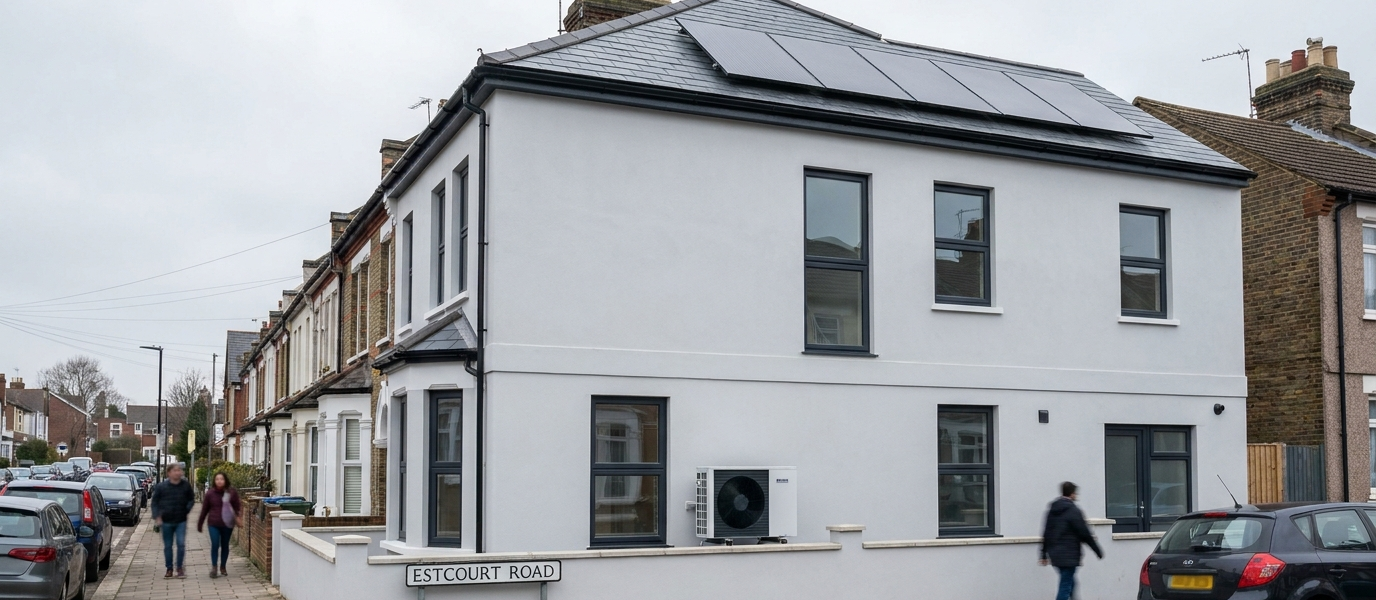
Only 2% of homes in England and Wales hold an EPC A rating – and most of those were built that way. A Victorian terrace in Watford just joined that tiny club, not through demolition and rebuild, but through a targeted retrofit funded by the Warm Homes Grant.
As reported by Watford.gov.uk, the home received cavity-wall insulation, loft insulation, an air-source heat pump, and solar photovoltaic panels. The result: an EPC A rating and a property that now costs far less to heat and power.
What the Warm Homes Grant covers
The Warm Homes Grant, run by local authorities in partnership with the Energy Saving Trust, targets low-income households in poorly insulated homes. It covers the full cost of eligible measures, including insulation, heat pumps, solar panels, and sometimes glazing. The Watford case shows the grant can fund a whole-house retrofit, not just a single measure. For a typical three-bed semi, a full package like this would cost £15,000–£25,000 if paid privately.
What it costs a typical UK home
Most UK homes sit at EPC D or E. Moving from a D to a C saves roughly £300–£500 a year on energy bills, according to Ofgem data. An EPC A rating pushes savings higher – potentially £800–£1,200 annually for a typical semi, depending on fuel prices. The catch: only households on certain benefits or with a household income below £31,000 qualify for the Warm Homes Grant. The Great British Insulation Scheme closed on 31 March 2026. It funded insulation measures only and never covered windows or glazing.
Who qualifies – and who doesn’t
The Watford case is a proof of concept, not a universal offer. The Warm Homes Grant is means-tested and area-specific. The Great British Insulation Scheme closed on 31 March 2026. It funded insulation measures only and never covered windows or glazing. But full retrofits to EPC A remain rare – and expensive – for most households. The Energy Saving Trust estimates that only 1 in 20 homes could reach an EPC A without major structural changes.
What this means for your EPC rating
If you’re planning upgrades, the order matters. Insulation first, then heat pumps, then solar panels – that’s the sequence that maximises EPC points. A heat pump alone on an uninsulated home may only add a few points. The Watford property gained roughly 30–40 EPC points across the package. For context, each EPC band is 21 points wide (A: 92–100, B: 81–91, etc.). A typical D-rated home needs about 30 points to reach C – achievable with loft and cavity insulation plus a heat pump.
Households on standard variable tariffs should check their EPC now. If it’s below C, the grants above may apply. Applications for the Warm Homes Grant open through local councils – Watford’s scheme is currently closed to new applicants, but other areas run similar programmes. The Boiler Upgrade Scheme runs until 2028. The key date: 31 March 2027, when current grant allocations end. Plan accordingly.
Frequently Asked Questions
A full retrofit to an EPC A rating, like the Watford Victorian terrace, typically costs between £15,000 and £25,000 for a three-bed semi if paid privately. However, the Warm Homes Grant can cover the full cost for eligible low-income households. Without grants, achieving EPC A is rare and expensive, with the Energy Saving Trust estimating only 1 in 20 homes can reach it without major structural changes.
The Warm Homes Grant is a UK government scheme run by local authorities and the Energy Saving Trust, targeting low-income households in poorly insulated homes. It covers the full cost of measures like insulation, heat pumps, and solar panels. To qualify, your household income must be below £31,000 and you must be on certain benefits; it's area-specific, so check with your local council.
Moving from an EPC D to a C saves roughly £300–£500 a year, according to Ofgem data, while reaching an EPC A can save £800–£1,200 annually for a typical semi-detached home, depending on fuel prices. The Watford retrofit achieved these higher savings through a combination of insulation, a heat pump, and solar panels.
The Boiler Upgrade Scheme runs until 2028, but note that grants are subject to availability and may close to new applicants.
To maximise EPC points, upgrade in this order: insulation first (loft and cavity wall), then an air-source heat pump, and finally solar panels. A heat pump alone on an uninsulated home adds few points, but a typical D-rated home needs about 30 points to reach a C, achievable with loft and cavity insulation plus a heat pump. The Watford property gained 30–40 points across the full package.





