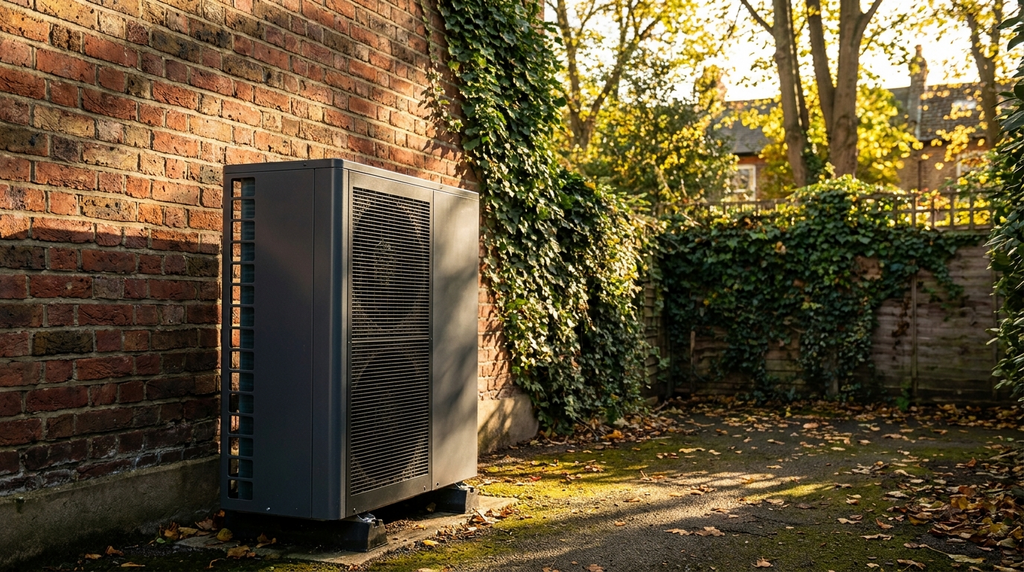
Air source heat pump installations in Scotland rose 34% in 2025, according to the Microgeneration Certification Scheme (MCS) data dashboard.
The MCS dashboard recorded 12,400 new air source heat pump installations in Scotland during 2025, a 34% increase on 2024 (MCS Data Dashboard, 2026). Scotland’s colder climate and higher heating demand mean heat pump performance and sizing differ from England. This article explains the specific UK Government and Scottish Government schemes, installer requirements, and cost breakdowns relevant to Scottish homeowners.
How the Scotland-specific grant and loan scheme changes your upfront cost
The Home Energy Scotland (HES) scheme combines a grant of up to £7,500 with an optional interest-free loan of up to £7,500, totalling £15,000 in available support (Home Energy Scotland, 2026). Eligibility requires the property to be owner-occupied, have a valid Energy Performance Certificate (EPC), and use an MCS-certified installer. The grant and loan are not available for properties with existing mains gas heating unless the gas boiler is being replaced as part of a whole-house heat pump installation. This means a typical Scottish home on oil, LPG, or electric heating can access the full £15,000, while a gas-heated home can only access the loan portion unless it switches entirely.
Quick numbers typical air source heat pump cost and savings for a Scottish home
| Metric | Detached 3-bed (100m²) | Semi-detached 3-bed (80m²) | Flat (50m²) |
|---|---|---|---|
| Upfront cost (after £7,500 grant) | £8,000–£12,000 | £6,000–£9,000 | £4,000–£6,000 |
| Annual running cost vs. gas boiler | £800–£1,100 (gas: £900–£1,200) | £650–£900 (gas: £750–£1,000) | £400–£600 (gas: £450–£650) |
| Annual CO₂ saving vs. gas boiler | 1.8–2.5 tonnes | 1.4–2.0 tonnes | 0.9–1.3 tonnes |
| Typical SCOP (Seasonal Coefficient of Performance) | 2.9–3.3 | 3.0–3.4 | 3.1–3.5 |
Costs are based on 2026 installation prices and running cost data from the Energy Saving Trust savings calculator (Energy Saving Trust, 2026). SCOP figures are drawn from MCS installer database averages for Scotland (MCS Installer Database, 2026). Running costs assume a variable electricity tariff of 24p/kWh and gas at 6p/kWh; actual savings depend on your home’s insulation and heating patterns.
The exact SCOP you can expect from an air source heat pump in Scotland’s climate
The Seasonal Coefficient of Performance (SCOP) for a properly sized air source heat pump in Scotland typically ranges from 2.8 to 3.5 (Energy Saving Trust, 2026). A SCOP of 3.0 means the heat pump delivers 3 kWh of heat for every 1 kWh of electricity consumed. Scotland’s lower winter outdoor temperatures reduce SCOP by roughly 0.2 to 0.4 compared to southern England, but modern units are designed for this. The key variables are the specific model’s low-temperature rating and the quality of your home’s insulation. A well-insulated home with underfloor heating will achieve the higher end of the range, while a draughty property with radiators sized for a gas boiler will sit at the lower end.
How to verify your installer is certified for the Scotland grant
The installer must be MCS (Microgeneration Certification Scheme) certified and registered on the MCS installer database (MCS Installer Search, 2026). For the HES grant, the installer must also be TrustMark registered (TrustMark, 2026). Check the installer’s MCS certificate number and confirm it is valid on the MCS website before signing a contract. The Gas Safe Register does not cover heat pumps, so MCS and TrustMark are the only recognised certification schemes for grant eligibility.
Why your home’s heat loss calculation is the single most important factor for sizing
The MCS standard (MIS 3005) requires a detailed room-by-room heat loss calculation before any installation (MCS MIS 3005, 2025). A heat pump sized for a 10kW heat loss will cost roughly £1,000 more per kW than a 6kW unit, but under-sizing causes poor efficiency and high bills. The calculation must account for Scotland’s design outdoor temperature (typically -3°C to -5°C, depending on postcode). Insulation upgrades before installation can reduce the required heat pump size by 20–40%, lowering both upfront cost and running costs.
The direct answer is an air source heat pump worth it for a Scottish home in 2026?
Yes, for most Scottish homes off the gas grid, an air source heat pump is the most cost-effective low-carbon heating option, with total grant/loan support of up to £15,000 (Home Energy Scotland, 2026). For homes on mains gas, the payback period is typically 10-15 years without additional insulation, but the SCOP and grant make it viable with good insulation. The key trade-off is higher upfront cost (even after grant) versus lower running costs (30-50% less than electric heating) and reduced carbon emissions. The annual CO₂ saving of 1.4–2.5 tonnes for a typical Scottish home makes it one of the most effective single actions you can take for household emissions.
What the Scottish Government’s New Build Heat Standard means for your replacement decision
From April 2024, all new homes in Scotland must use low-carbon heating, effectively banning gas boilers in new builds (Scottish Government New Build Heat Standard, 2023). For existing homes, the standard does not apply, but the push to phase out fossil fuel heating means gas boiler replacements may become less common by the late 2020s. Installing a heat pump now avoids a future forced replacement and locks in current grant levels. The £7,500 grant and £7,500 loan are available until at least March 2027, but funding levels are reviewed annually.
Compare air source heat pump running costs vs oil boiler for Scottish homes
Frequently Asked Questions
After the £7,500 Home Energy Scotland grant, a typical detached 3-bed costs £8,000–£12,000, a semi-detached costs £6,000–£9,000, and a flat costs £4,000–£6,000. These figures are based on 2026 installation data from the Energy Saving Trust.
Yes, but only the loan portion unless you replace your gas boiler entirely. The full £15,000 grant and loan is available for homes on oil, LPG, or electric heating. This rule is set by Home Energy Scotland (2026).
Typical SCOP values range from 2.9–3.5 depending on property type: 2.9–3.3 for detached, 3.0–3.4 for semi-detached, and 3.1–3.5 for flats. These figures are from MCS data for Scotland's climate.
Annual CO₂ savings range from 0.9–2.5 tonnes depending on property size: 1.8–2.5 tonnes for a detached 3-bed, 1.4–2.0 tonnes for semi-detached, and 0.9–1.3 tonnes for a flat. Data from the Energy Saving Trust (2026).
Yes, a valid Energy Performance Certificate (EPC) is required for eligibility under the Home Energy Scotland scheme. The property must also be owner-occupied and use an MCS-certified installer.