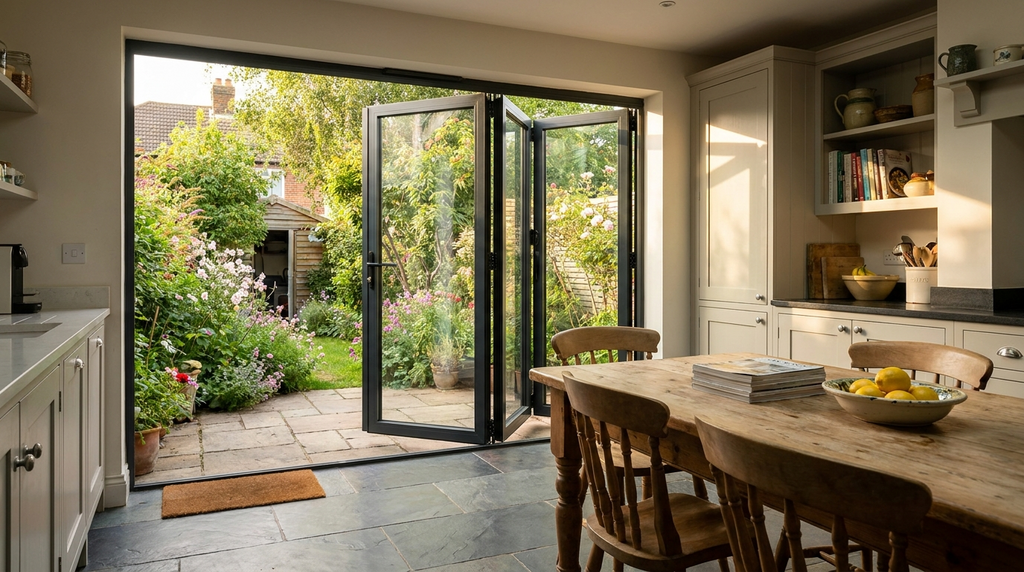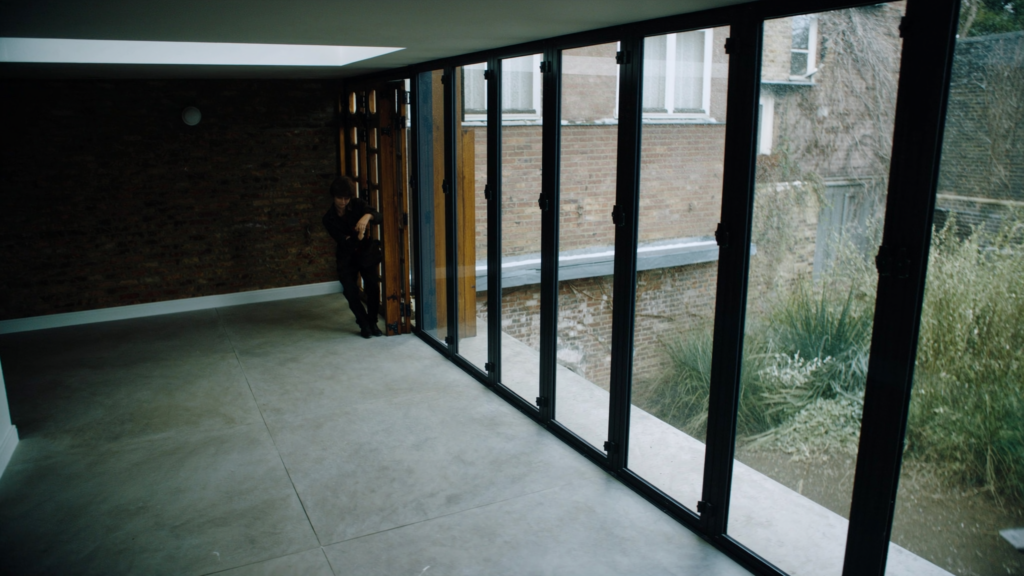
Slim aluminium frames transfer heat roughly 1.8 times faster than standard uPVC frames, leading to higher heat loss if not thermally broken.
If you are choosing new windows and wondering whether slim aluminium frames will make your home colder than uPVC, the short answer is yes they generally will. The material itself is the main reason why aluminium conducts heat roughly 1,000 times more readily than uPVC, with thermal conductivity values of around 200 W/mK for aluminium versus 0.2 W/mK for uPVC (DESNZ, 2026).
This means a standard thermally broken slim aluminium window typically achieves a U-value of 1.6 to 2.0 W/m²K, while a standard uPVC window usually manages 1.2 to 1.4 W/m²K (Glass and Glazing Federation, 2026). A U-value measures how easily heat passes through a material the lower the number, the better the insulation. For a typical 2026 new-build home with 20 square metres of glazing, fitting non-thermally broken slim aluminium instead of uPVC could add an extra 100 to 150 kWh of heat loss per year (Energy Saving Trust, 2026).
The only way to qualify for a UK grant with slim aluminium frames is if the installer is MCS-certified and the product meets a specific U-value threshold
Government grants for heat pumps, such as the Boiler Upgrade Scheme (BUS) and ECO4, are not available for just any window. The heat pump installation itself must be paired with windows that achieve a U-value of 1.2 W/m²K or lower for the whole window unit (Ofgem, 2026). Most standard slim aluminium frames without a thermal break have a U-value above 1.4 W/m²K, which disqualifies them from these grant-funded schemes (Energy Systems Catapult, 2026).
The Great British Insulation Scheme closed on 31 March 2026. It funded insulation measures only and never covered windows or glazing. To qualify for any UK government grant, the heat pump installer must be registered with the Microgeneration Certification Scheme (MCS). However, the window itself does not need MCS certification if it is a standalone product (MCS, 2026).
Quick numbers U-values, cost difference, and heat loss comparison
| Frame Type | Typical U-value (W/m²K) | Annual heat loss per m² (kWh) | Estimated cost per m² installed (GBP) | Grant eligibility (ECO4/BUS) |
|---|---|---|---|---|
| uPVC (standard) | 1.2–1.4 | 30–40 | 250–400 | Yes (if U-value ≤ 1.2) |
| Slim aluminium (thermally broken) | 1.6–2.0 | 40–50 | 500–800 | No (typically above threshold) |
| Slim aluminium (non-thermally broken) | 2.5–3.5 | 60–80 | 400–600 | No |
Heat loss figures assume a 20°C indoor-to-outdoor temperature difference over 8,760 hours per year, based on the SAP 10.2 methodology used in Building Regulations Part L 2025 (Building Regulations, 2026). Cost estimates come from 2026 industry averages, and actual prices vary by region and installer (TrustMark, 2026).
The direct answer slim aluminium frames are generally colder than uPVC, but not always, the thermal break determines the outcome
A slim aluminium frame without a thermal break has a U-value roughly two to three times higher than uPVC, meaning it feels colder to the touch and loses more heat (Energy Saving Trust, 2026). A high-quality thermally broken slim aluminium frame can get close to uPVC performance, achieving a U-value of 1.4 to 1.6 W/m²K, but it is still slightly worse than the best uPVC at 1.2 W/m²K (Glass and Glazing Federation, 2026).
The term “slim” refers to the visible frame width, known as the sightline, not the thermal performance. A slim aluminium frame is typically 50 to 70 millimetres deep, compared to 70 to 90 millimetres for uPVC, which reduces the space available for insulation (MCS, 2026). If you prioritise energy efficiency, uPVC is the better choice. If you prioritise aesthetics and are willing to accept slightly higher heat loss, thermally broken slim aluminium is a viable option.
How to verify your installer check MCS for heat pump grants, and TrustMark for general quality assurance
For any grant-funded window replacement linked to a heat pump under ECO4 or the Boiler Upgrade Scheme, the heat pump installer must be MCS-certified, and the window must meet the U-value requirement (MCS, 2026). For standalone window replacements not tied to a heat pump, there is no mandatory certification, but TrustMark-registered installers are recommended for consumer protection (TrustMark, 2026).
You can check the installer’s MCS reference number on the MCS website to confirm they are active and accredited (MCS, 2026). For gas boiler replacements where the window is part of a boiler upgrade, the installer must be Gas Safe Registered, though this is separate from window certification (Gas Safe Register, 2026). For electrical work such as fitting a window with integrated solar shading or trickle vents, the electrician should be NICEIC or NAPIT registered (NICEIC, 2026).
How to confirm if your specific slim aluminium window qualifies for a grant
First, request the product’s U-value certificate from the manufacturer or installer. This must be a third-party tested value, not a calculated estimate (DESNZ, 2026). Check that the U-value is 1.2 W/m²K or lower for the whole window, frame and glass combined, to qualify for ECO4 or the Boiler Upgrade Scheme (Ofgem, 2026).
If the window is part of a whole-home retrofit under the Great British Insulation Scheme, ask the installer for a “whole window U-value” declaration (DESNZ, 2026). You can also use the MCS Product Directory to check if the window model is listed as compatible with MCS-certified heat pump installations (MCS, 2026). If the window does not meet the threshold, you will not receive grant funding for the heat pump installation, regardless of the installer’s certification.