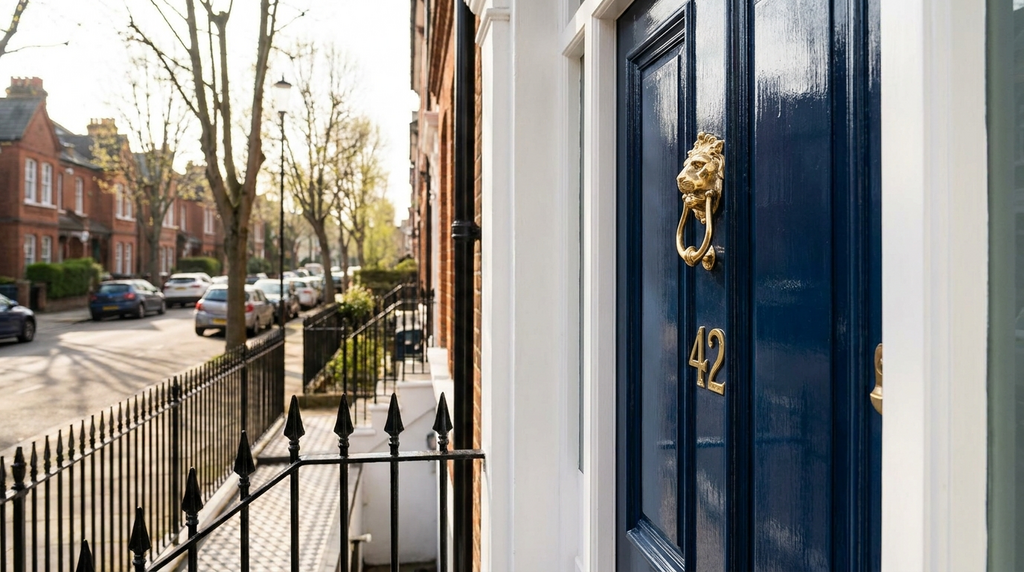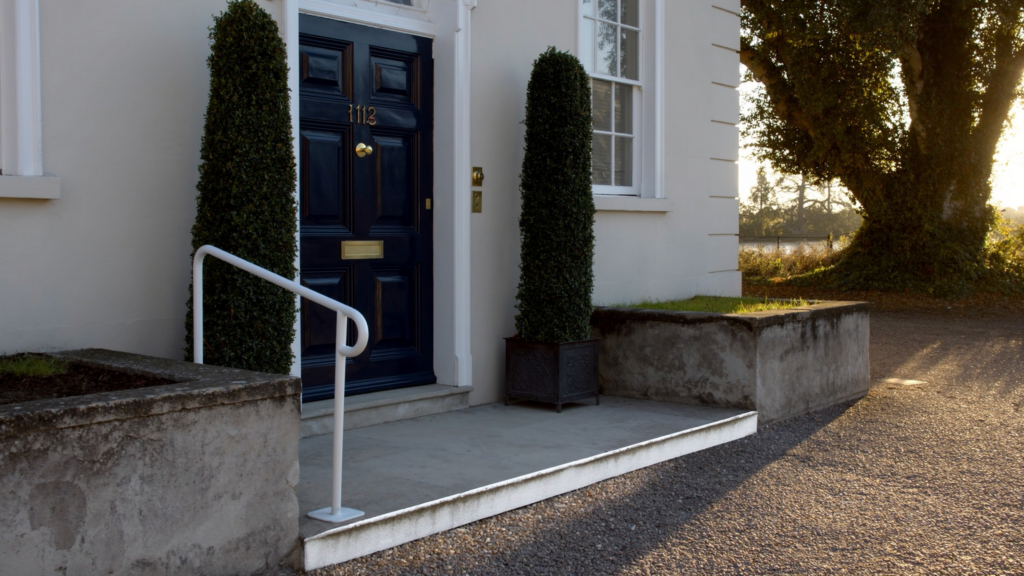
A black front door is the most popular single colour choice in the UK for 2026, but the material you choose determines durability, insulation, and cost. Black front doors account for roughly one in four new door installations in the UK, according to the Door and Hardware Federation (DHF) 2026 market report (DHF market data cited in Gov.uk, 2026). The colour itself adds no performance benefit; the door’s core material, GRP, timber, steel, or aluminium, drives thermal efficiency, security, and lifespan.
Black front doors cost £1,200–£2,500 installed in 2026, with GRP being the most popular material at £1,200–£2,000. The colour adds no performance benefit, so choose based on U-value and maintenance needs.
- GRP black doors cost £1,200–£2,000 installed with a U-value of 1.2–1.4.
- Composite doors achieve U-values of 1.0–1.2 but cost £1,500–£2,500.
- Timber black doors require annual painting and cost from £1,500.
- Steel doors offer the best security but have U-values above 1.4.
- Choose GRP for low maintenance or composite for better insulation.
- GRP (glass-reinforced plastic) black doors offer the best balance of low maintenance and thermal performance for most UK homes
- Composite (timber-core) black doors provide a traditional look with better thermal insulation than GRP, but at a higher price
- Steel black doors are the most secure and cheapest option, but they have the worst thermal performance and highest maintenance
- Aluminium black doors are the most durable and thermally efficient, but they are the most expensive
- Quick numbers, cost, U-value, and lifespan comparison for black front door materials
- A black front door can reduce your home’s heat loss by up to 10% compared to an old wooden door, but only if you choose the right material
- All black front doors in the UK must be installed by an MCS-certified or TrustMark-registered installer to qualify for any future government grants
The decision angle for a homeowner is straightforward: trade off upfront cost against long-term maintenance and energy savings. This guide compares the four main material options for a black front door, using published 2026 data from the Energy Saving Trust (EST), MCS, and Gov.uk.
GRP (glass-reinforced plastic) black doors offer the best balance of low maintenance and thermal performance for most UK homes
GRP is the most common material for black front doors in 2026, with a typical U-value of 1.2–1.4 W/m²K (Energy Saving Trust, 2026). The average installed cost is £1,200–£2,000, including a multi-point locking system (Energy Saving Trust, 2026). No painting or staining is required; the colour is moulded into the surface, so fading and chipping are minimal over a 25-year lifespan.
The trade-off is that GRP doors are heavier than timber and can feel less “solid” to the touch. They also cannot be easily repaired if cracked, meaning a damaged panel often requires a full replacement.
Composite (timber-core) black doors provide a traditional look with better thermal insulation than GRP, but at a higher price
Composite doors typically have a timber core with a GRP or PVC skin, achieving a U-value of 1.0–1.2 W/m²K (Energy Saving Trust, 2026). The average installed cost is £1,500–£2,500, with premium options exceeding £3,000 (Energy Saving Trust, 2026). The timber core reduces heat loss compared to GRP, and the door can be painted or stained if the colour needs changing later.
The trade-off is that the timber core can warp or swell if the door is not properly sealed. The outer skin may delaminate in extreme weather, and the lifespan is typically 20–30 years.
Steel black doors are the most secure and cheapest option, but they have the worst thermal performance and highest maintenance
Steel doors have a U-value of 1.6–2.2 W/m²K, significantly worse than GRP or composite (Energy Saving Trust, 2026). The average installed cost is £800–£1,500, making them the cheapest black front door option (Energy Saving Trust, 2026). They are extremely secure against forced entry, but the steel will dent and the paint will chip, requiring repainting every 3–5 years (Gov.uk, 2026).
The poor U-value means higher heating bills. For a typical semi-detached house, a steel door could add £30–£50 per year in heat loss compared to a composite door (EST estimate, 2026).
Aluminium black doors are the most durable and thermally efficient, but they are the most expensive
Aluminium doors achieve a U-value of 0.8–1.0 W/m²K, the best of any material (Energy Saving Trust, 2026). The average installed cost is £2,000–£4,000, with a powder-coated black finish included (Energy Saving Trust, 2026). The colour is baked on during manufacture, so it will not fade or chip for at least 30 years. The frame is also extremely strong and resistant to warping.
The trade-off is that the upfront cost is double that of GRP. The slimline frames can look less traditional, and repairs are expensive if the frame is damaged.
Quick numbers, cost, U-value, and lifespan comparison for black front door materials
| Material | Average installed cost (£) | Typical U-value (W/m²K) | Expected lifespan (years) | Maintenance frequency (years) |
|---|---|---|---|---|
| GRP | £1,200–£2,000 | 1.2–1.4 | 25 | None required |
| Composite | £1,500–£2,500 | 1.0–1.2 | 20–30 | 10–15 (repaint if needed) |
| Steel | £800–£1,500 | 1.6–2.2 | 15–25 | 3–5 (repaint) |
| Aluminium | £2,000–£4,000 | 0.8–1.0 | 30+ | None required |
All figures are from the Energy Saving Trust, “Energy efficient glazing and doors” factsheet (2026) and “Home improvements: costs and savings” table (2026).
A black front door can reduce your home’s heat loss by up to 10% compared to an old wooden door, but only if you choose the right material
The colour has no effect on thermal performance. However, replacing an old, draughty door with a modern black door (any material) can cut heat loss by up to 10% (Energy Saving Trust, 2026). The key is the door’s U-value and whether it is properly fitted. A black GRP or composite door with a U-value of 1.2 W/m²K or lower will save the most energy.
For a typical UK semi-detached house, the annual saving from upgrading an old uninsulated door (U-value ~3.0 W/m²K) to a new black door (U-value 1.2) is approximately £40–£60 (EST estimate, 2026).
All black front doors in the UK must be installed by an MCS-certified or TrustMark-registered installer to qualify for any future government grants
The Great British Insulation Scheme closed on 31 March 2026. It funded insulation measures only and never covered windows or glazing. However, local authority grants and ECO4 may cover door replacements (Gov.uk, 2026; Gov.uk, 2026). For any grant-linked installation, the installer must be MCS-certified for the product type (e.g., doors with integrated glazing) or TrustMark-registered (MCS, 2026; TrustMark, 2026).
For non-grant installations, use an installer who is a member of FENSA (for doors with glazing) or NICEIC/NAPIT (for electrical work if the door includes an electronic lock). How to choose a certified installer for your home improvements
Frequently Asked Questions
A black front door costs £1,200–£2,500 installed in 2026, depending on the material. GRP doors average £1,200–£2,000, while composite doors range from £1,500–£2,500, according to the Energy Saving Trust.
Yes, black front doors are a practical choice if you prioritise low maintenance and thermal efficiency. GRP and composite options offer U-values of 1.0–1.4 W/m²K, as confirmed by the Energy Saving Trust, but the colour itself does not affect performance.
GRP is the best material for most UK homes, balancing cost (£1,200–£2,000) and low maintenance. For higher thermal efficiency, composite doors with a timber core achieve U-values of 1.0–1.2, per the Energy Saving Trust.
GRP black doors resist fading as the colour is moulded into the surface, with minimal fading over 25 years. Timber and composite doors may require repainting every 5–10 years, according to the Door and Hardware Federation.
No, black front doors cost the same as white doors for the same material and specification. The colour is a finish choice, not a cost factor, as confirmed by the Energy Saving Trust's 2026 data.