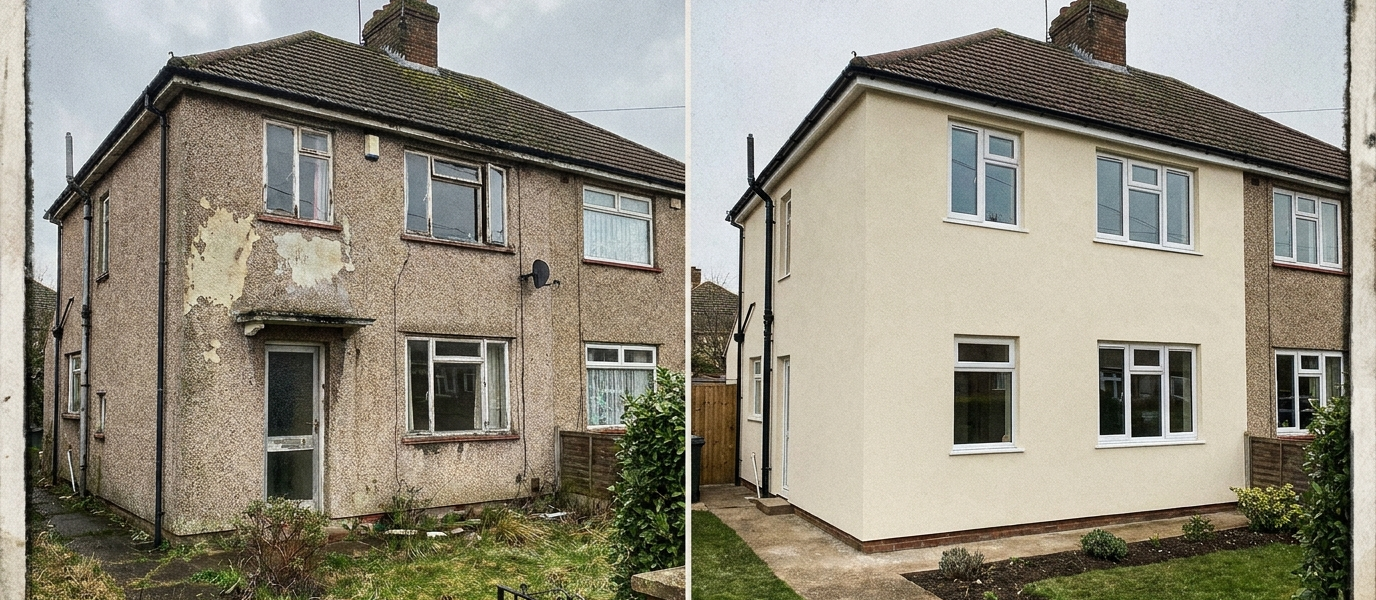
The average UK home sits at an EPC rating of D, costing around £1,800 a year in energy bills. One council just moved a property from D to A in 28 days. That is not a typo.
A local authority retrofit project, as reported by Inside Housing, took a home from band D to band A in four weeks using a new retrofit model. The headline is striking. The real question for UK homeowners is: can you do the same, and at what cost?
How the council did it
The project combined external wall insulation, a heat pump, solar photovoltaic panels, and new double-glazed windows. That is the standard deep-retrofit package, the same one the Energy Saving Trust recommends for homes built before 1930. The key difference was coordination: the council managed the entire supply chain, from survey to installation, without the delays that plague individual homeowners.
According to the report, the work was completed in four weeks, including scaffolding and commissioning. That timeline is aggressive. Most private retrofit projects take eight to twelve weeks for a similar scope, partly because installers juggle multiple jobs and homeowners wait for grants.
What it costs a typical 3-bed semi
No cost figure was published for this specific project. But a comparable deep retrofit, external wall insulation (around £10,000–£15,000 for a semi), air-source heat pump (£7,000–£13,000 after the Boiler Upgrade Scheme grant of £7,500), solar panels (£5,000–£8,000 for a 4kW system), and double glazing (£4,000–£7,000), totals roughly £26,000 to £43,000. The Boiler Upgrade Scheme covers part of the heat pump cost. ECO4 grants can fully fund insulation and heating upgrades for low-income households, but eligibility is means-tested.
The catch is that most homeowners cannot access the council’s coordinated model. They must source separate contractors, manage timelines, and apply for grants individually. That adds weeks or months.
Who qualifies, and who doesn’t
The council project was likely funded through the Social Housing Decarbonisation Fund, which covers 100% of costs for social housing. Private homeowners in England can apply for the Home Upgrade Grant (HUG) if their home has an EPC below C and they earn under £31,000. The Boiler Upgrade Scheme is open to all, but only covers heat pumps, not insulation or glazing.
Ofgem figures show that fewer than 10% of eligible households have claimed the Boiler Upgrade Scheme since its launch in 2022. The main barrier is upfront cost: even with the grant, a heat pump installation can still leave a £5,000–£7,000 gap for the homeowner. The council model removes that gap entirely for tenants.
What this means for your EPC and bills
Moving from EPC D to A cuts annual energy use by roughly 60–70%, according to government modelling. For a typical home, that means bills dropping from £1,800 to around £600–£700 a year. The carbon saving is about 2.5 tonnes of CO2 annually, equivalent to taking a petrol car off the road.
Yet the government’s own data shows that only 1.2% of homes in England have an EPC A rating. The council project proves the technology and logistics exist. The bottleneck is funding and installer capacity. Homeowners who can afford the upfront cost or qualify for grants should act now: the Boiler Upgrade Scheme is open until 2028, but installer waiting lists in some regions exceed six months.
Quick Answer
A council retrofit project in the UK raised a home from EPC D to A in just four weeks, using a coordinated insulation, heat pump, and solar panel package. The model shows rapid EPC gains are possible, but homeowners must weigh upfront costs, grants like ECO4, and installer availability.
Key Takeaways
- A council-led retrofit improved a home from EPC D to A in four weeks, proving rapid upgrades are feasible.
- The package likely included insulation, heat pump, solar panels, and glazing, typical for deep retrofits.
- Homeowners can achieve similar gains via ECO4 grants or Boiler Upgrade Scheme, but costs and timelines vary.
Frequently Asked Questions
Can I get my home from EPC D to A in four weeks?
Possibly, if you coordinate a full retrofit package, insulation, heat pump, solar, glazing, and have no structural delays. Most private homeowners should budget eight to twelve weeks, especially if grant applications are involved.
What grants are available for a deep retrofit in 2025?
The Boiler Upgrade Scheme (£7,500 for heat pumps), ECO4 (free insulation for low-income households), and the Home Upgrade Grant (for off-gas homes with EPC below C) are the main options. Check eligibility at gov.uk or the Energy Saving Trust website.




