The 2026 Heat Pump Grant Covers Edwardian Semis
Can you install a heat pump in an Edwardian semi in 2026 and still claim the full £7,500 government grant? The short answer is yes, but the eligibility rules are tighter for pre-1919 homes than for modern houses. The Boiler Upgrade Scheme (BUS) does not exclude Edwardian semis by age, but it imposes three conditions that many older properties struggle to satisfy.
The BUS provides a £7,500 grant toward an air source heat pump for any home in England and Wales, including Edwardian semis, as of December 2026 (DESNZ, Boiler Upgrade Scheme guidance, 2026).
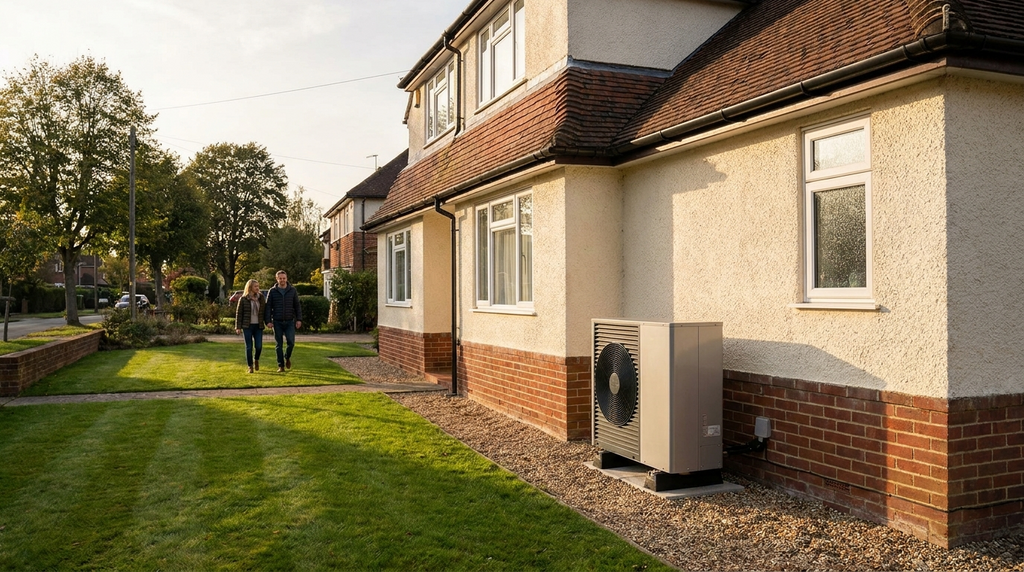
Grant eligibility depends on three conditions: a valid MCS-certified installer quote, a property with an Energy Performance Certificate (EPC) that does not require a new loft or cavity wall insulation recommendation, and a suitable outdoor location for the external unit. Edwardian semis built before 1919 face additional scrutiny because solid brick walls, single-glazed sash windows, and uninsulated floors reduce heat pump efficiency. The installer must prove the system can heat the whole house, not just supplement the boiler.
Quick Numbers, Grant Amounts, Heat Pump Costs, and Efficiency Benchmarks for Edwardian Semis
The table below summarises the key financial and technical figures for a heat pump installation in a typical Edwardian semi. All costs are 2026 estimates for an 8.5 kW air source heat pump installed in a three-bedroom semi with solid brick walls.
| Item | Value |
|---|---|
| BUS grant amount | £7,500 |
| Typical installed cost for 8.5 kW heat pump | £9,000–£13,000 |
| Average annual running cost (Edwardian semi, solid walls) | £1,100–£1,500 |
| Minimum Seasonal Coefficient of Performance (SCOP) for BUS eligibility | 2.8 |
Sources: DESNZ, BUS grant amount, 2026; Energy Saving Trust, heat pump cost guide, 2026; EST, running cost estimates for solid-wall homes, 2026; MCS 020 standard, SCOP requirements, 2026.
The Seasonal Coefficient of Performance (SCOP) measures how many units of heat the pump delivers for each unit of electricity it consumes. A SCOP of 2.8 means the pump produces 2.8 kWh of heat for every 1 kWh of electricity. Edwardian semis typically achieve a lower SCOP than modern homes because heat loss through solid walls and single glazing forces the pump to work harder.
Who Qualifies for the £7,500 Grant, The EPC Rule and the Solid-Wall Exception
The BUS grant does not require a minimum EPC rating, but it does require the property’s EPC to have no outstanding recommendations for loft or cavity wall insulation. Edwardian semis with solid brick walls cannot have cavity wall insulation, so the EPC check focuses on loft insulation adequacy and any recommendations for floor or wall insulation that the installer must address.
If your EPC recommends solid wall insulation (internal or external), you must either install it or provide evidence that it is impractical or structurally damaging before the heat pump can qualify. The installer must submit a written justification explaining why solid wall insulation cannot be fitted, for example, because it would reduce internal floor area below legal minimums or cause damp in a solid-wall structure. Ofgem reviews these justifications case by case (Ofgem, BUS eligibility, property requirements, 2026).
Most Edwardian semis will pass the EPC check if the loft has at least 270 mm of insulation and the EPC does not flag cavity wall insulation as a recommendation. If your EPC is more than 10 years old, you may need a new one before applying (GOV.UK, EPC recommendations for solid-wall properties, 2026).
Heat Pump Edwardian Semi UK, The One Eligibility Rule That Most Homeowners Miss
The single most overlooked rule: the heat pump must be sized and installed to meet the full space heating demand of the property, not just supplement the existing gas boiler. Edwardian semis often have high heat loss due to single glazing, draughty floorboards, and solid walls. The installer must calculate the heat loss using the MCS Heat Pump Design Standard (MIS 3005) and size the unit accordingly (MCS, MIS 3005 heat pump design standard, 2026).
If the heat pump is undersized, the system will fail to keep the home warm, and the grant may be rejected because the installation does not meet the “whole-house heating” requirement. Ofgem requires the installer to confirm in writing that the heat pump can maintain 21°C in the living room and 18°C in other habitable rooms during the coldest winter conditions (Ofgem, BUS installation requirements, whole-house heating, 2026).
This rule catches many homeowners who assume a smaller, cheaper unit will suffice. An Edwardian semi with a heat loss of 10 kW requires a heat pump rated for at least 10 kW, not a 7 kW model that would run constantly and still fail to reach the target temperature.
How to Verify Your Installer, MCS Certification
The heat pump must be installed by an MCS-certified installer. The grant application is submitted by the installer, not the homeowner, through Ofgem’s portal. TrustMark registration is also required for BUS eligibility. Check the TrustMark website for the installer’s current registration status before signing a contract (TrustMark, BUS scheme rules, 2026).
The installer must provide a written quote that includes the heat pump model, MCS certificate number, and a heat loss calculation. The homeowner does not pay the installer upfront, the grant is deducted from the quote. You pay only the difference between the total installation cost and the £7,500 grant (Ofgem, BUS installer requirements, 2026).
To find an MCS-certified installer near you, use the MCS certified installer search tool. Always ask for at least three quotes to compare prices and heat loss calculations (MCS, certified installer search, 2026).
how to compare heat pump quotes for an Edwardian semi
Why Edwardian Semis Need a Higher Heat Pump Capacity
An Edwardian semi with solid brick walls and single glazing typically requires a heat pump between 8 kW and 12 kW, compared to 5–7 kW for a modern semi. The higher capacity increases the upfront cost by £1,500–£3,000, but the £7,500 grant still covers most of the installation (EST, heat pump sizing for solid-wall homes, 2026).
The installer must confirm that the property’s electrical supply (typically 60–100 amp) can handle the heat pump’s peak demand. An electrical upgrade may be needed and is not covered by the BUS grant. Upgrading a consumer unit or installing a dedicated heat pump circuit typically costs £500–£1,500 (MCS, electrical supply requirements for heat pumps, 2026).
Because the grant amount is fixed at £7,500 regardless of heat pump size, the net cost to you increases with capacity. An 8.5 kW system costing £11,000 leaves you paying £3,500 after the grant. A 12 kW system costing £14,000 leaves you paying £6,500. The grant does not cover electrical upgrades, pipework modifications, or new radiators (Ofgem, BUS, excluded costs, 2026).
What to Do If Your Edwardian Semi Is Excluded
Homes that fail the EPC condition or lack outdoor space for the external unit may still qualify for the Home Upgrade Grant (HUG) if they are off the gas grid and have a household income below £31,000. Edwardian semis with oil or LPG heating can apply for the HUG, which covers heat pumps and insulation improvements with no upfront cost to the homeowner (DESNZ, Home Upgrade Grant guidance, 2026).
For properties on the gas grid that are excluded from the BUS, the only current alternative is local authority or devolved government schemes. The Welsh Government’s Nest scheme offers free heat pumps for low-income households in Wales, regardless of grid connection (Welsh Government, Nest scheme, 2026). In Scotland, Home Energy Scotland provides interest-free loans and grants for heat pumps. Check your local authority’s website for area-specific funding.
heat pump grants for off-gas-grid homes in 2026
If none of these routes apply, you can still install a heat pump without a grant, the £7,500 is a subsidy, not a requirement. The upfront cost is higher, but the running cost savings compared to oil or LPG can offset the investment over 10–15 years, depending on your current fuel price and heat pump efficiency.
Frequently Asked Questions
Yes, the Boiler Upgrade Scheme (BUS) does not exclude Edwardian semis by age. You can claim £7,500 if your home meets three conditions: a valid MCS-certified installer quote, an EPC without new loft or cavity wall insulation recommendations, and a suitable outdoor location for the external unit.
Typical installed cost for an 8.5 kW air source heat pump in an Edwardian semi is £9,000–£13,000 in 2026, according to the Energy Saving Trust. The £7,500 BUS grant reduces your outlay to £1,500–£5,500.
Average annual running cost for a heat pump in an Edwardian semi with solid walls is £1,100–£1,500, per Energy Saving Trust estimates. This is higher than for a modern insulated home due to lower thermal efficiency.
You may need to improve insulation, as the BUS requires your EPC to not recommend new loft or cavity wall insulation. Edwardian semis often have solid brick walls and single-glazed windows, which reduce heat pump efficiency; the installer must prove the system can heat the whole house.
The minimum Seasonal Coefficient of Performance (SCOP) for BUS eligibility is 2.8, as set by the MCS 020 standard. Your installer must certify the heat pump meets this benchmark to qualify for the £7,500 grant.