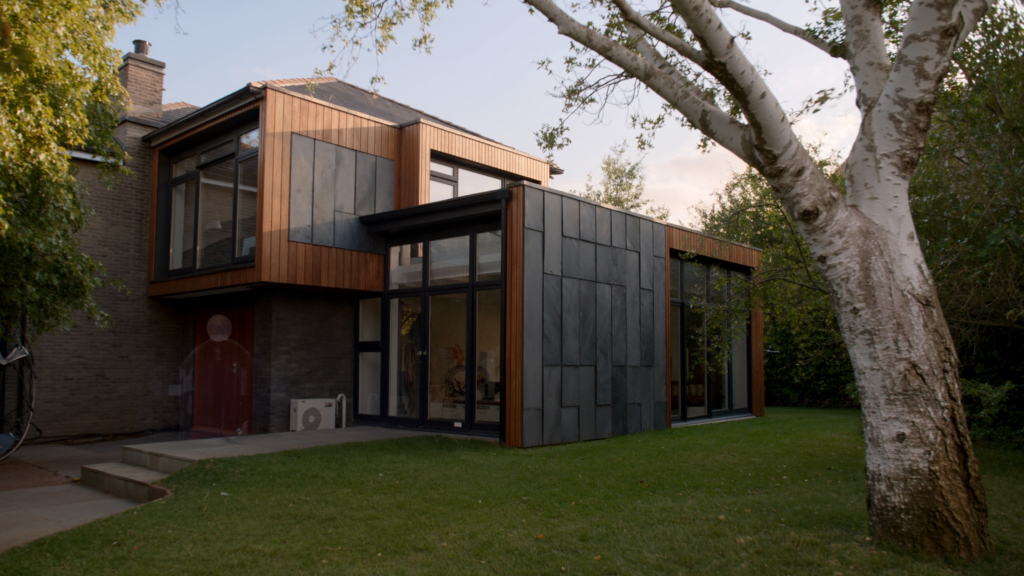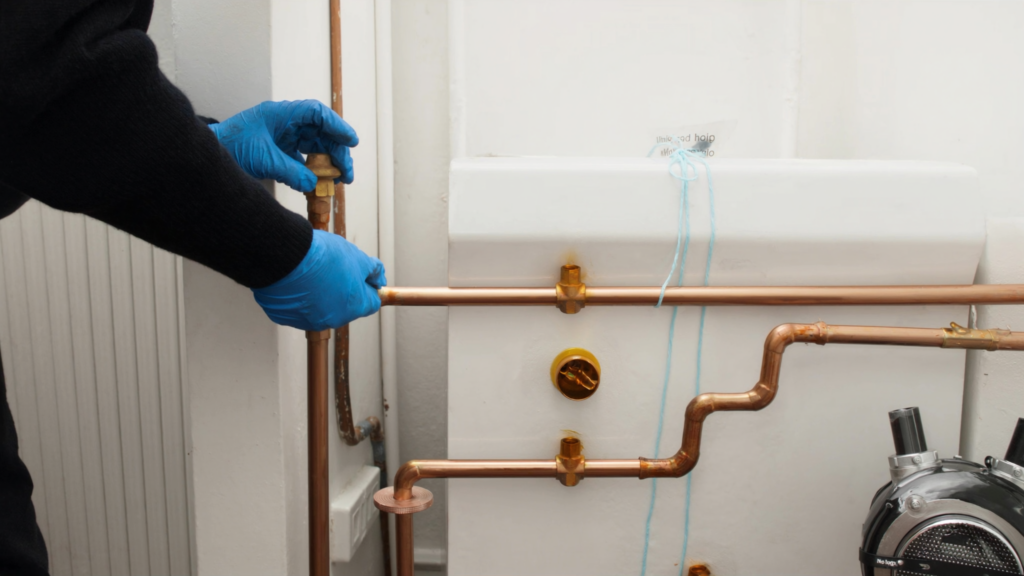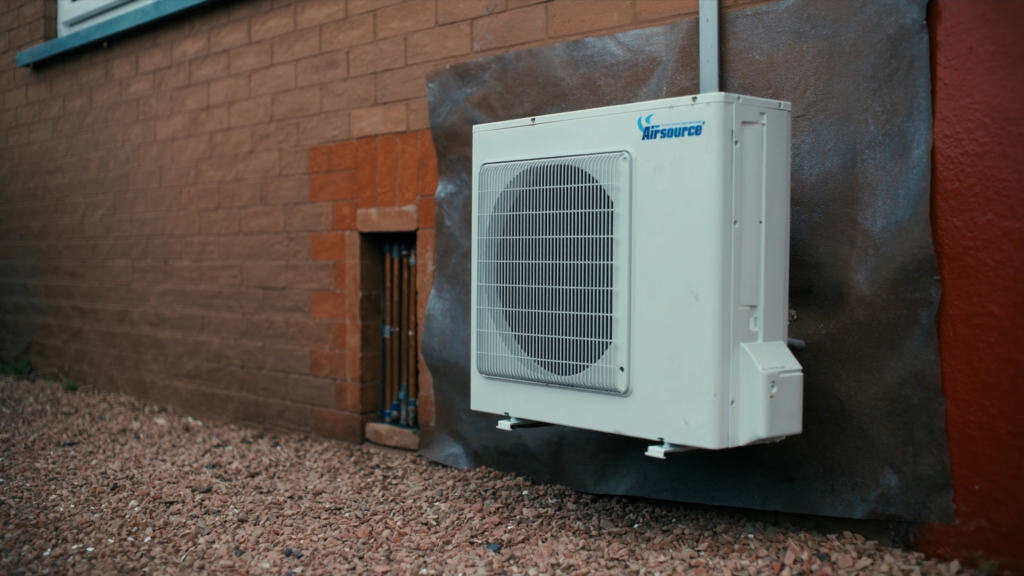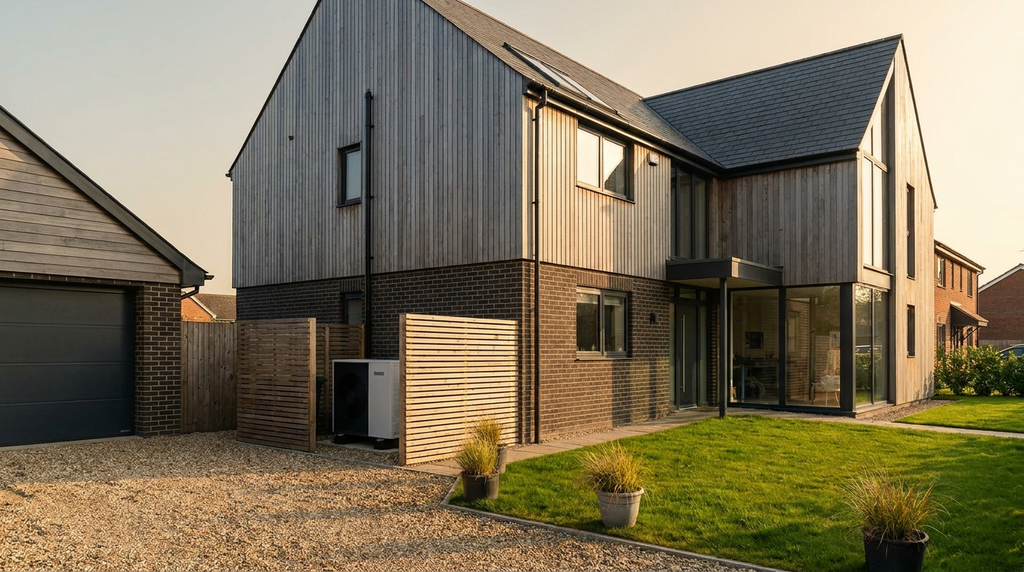
Installing a heat pump in a 2026 new build typically costs £3,500–£4,500 less upfront than retrofitting the same model into an existing home.
If you are building a new home or buying one off-plan, the heat pump is a design feature built in from the start. If you are upgrading an existing home, you face extra work and cost. MCS Installation Database data for 2026 shows that an 8–12 kW air-source heat pump costs £6,000–£8,000 installed in a new build, compared with £8,000–£12,000 for a retrofit into an existing home (MCS, 2026).
New-build homes are designed with lower flow temperatures (35–45°C) and larger heat emitters, avoiding the need for costly upgrades. A retrofit often requires radiator swaps, underfloor heating installation, or upgraded pipework, adding £2,000–£5,000 to the total bill. A 3–5% efficiency penalty is common in retrofit installations due to higher system temperatures and poorer insulation (DESNZ, 2026).
Quick numbers heat pump costs, running costs, and grants for retrofit vs new build
| Cost or metric | New build (2026) | Retrofit (pre-1990 home) | Retrofit (1990–2010 home) |
|---|---|---|---|
| Upfront installation cost (8–12 kW air-source) | £6,000–£8,000 | £10,000–£14,000 | £8,000–£12,000 |
| Typical annual running cost (Octopus Agile, 2026 average) | £200–£250 | £300–£400 | £250–£350 |
| Eligible government grant (Boiler Upgrade Scheme) | £0 (not eligible) | £7,500 | £7,500 |
| Estimated payback period (vs gas boiler) | 5–8 years | 7–12 years (after grant) | 6–10 years (after grant) |
| Average system efficiency (SCOP) | 3.5–4.0 | 2.8–3.2 | 3.0–3.5 |
Sources: MCS Installation Database (MCS, 2026), Ofgem Boiler Upgrade Scheme data (Ofgem, 2026), DESNZ heat pump performance report (DESNZ, 2026). Running costs are based on a typical 3-bed semi using 12,000 kWh of heat annually, at the 2026 average electricity tariff of 24p/kWh under Octopus Agile.
Heat pump efficiency is 10–20% higher in a new build than in a typical UK retrofit home.
A heat pump’s efficiency is measured as the Seasonal Coefficient of Performance (SCOP). This is the ratio of heat output to electricity input over a year. A SCOP of 3.5 means the heat pump delivers 3.5 kWh of heat for every 1 kWh of electricity it uses. DESNZ field trial data from 2026 shows new builds achieve a SCOP of 3.5–4.0 due to lower flow temperatures and better fabric efficiency (DESNZ, 2026).
Retrofits in pre-1990 homes average SCOP 2.8–3.2. Homes built 1990–2010 average SCOP 3.0–3.5. The gap narrows if the retrofit includes full cavity-wall insulation, triple glazing, and floor insulation. In that case, SCOP can reach 3.6–3.8, close to new-build levels. The Energy Saving Trust advises that fabric upgrades are the single most effective way to improve heat pump performance in an existing home (Energy Saving Trust, 2026).
Retrofitting a heat pump is eligible for a £7,500 grant; new builds are not.
The Boiler Upgrade Scheme (BUS) provides a £7,500 grant to homeowners in England and Wales who install an air-source heat pump in an existing home. New builds are explicitly excluded from the scheme (GOV.UK, 2026). The grant is deducted from the installation cost by the installer, so the homeowner pays the net amount.
Retrofit homeowners can also claim 0% VAT on installation under a separate scheme from HM Treasury (HM Treasury, 2026). New-build installers may recover costs via the Future Homes Standard (2025 building regulations), which mandates heat pumps or low-carbon alternatives. The builder passes the cost to the buyer in the purchase price, but no direct grant is available.
The key difference is that a new build is designed for a heat pump from the outset, while a retrofit requires a fabric-first upgrade to avoid high bills.
Energy Systems Catapult’s 2026 report on heat pump readiness confirms that new builds meet Part L 2021/2025 fabric standards with U-values of walls at 0.18 W/m²K and roofs at 0.11 W/m²K (Energy Systems Catapult, 2026). This minimises heat loss. This allows the heat pump to run at low flow temperatures and high efficiency.
Retrofits often need insulation upgrades first, costing £3,000–£8,000, to prevent the heat pump running at high flow temperatures. Without fabric upgrades, a retrofit heat pump can cost 30–50% more to run than a gas boiler, according to Energy Saving Trust field trial data (Energy Saving Trust, 2026). The fabric-first approach is essential: insulate the home, then install the heat pump.
How to verify a heat pump installer MCS certification is mandatory for grants and building regulations compliance.
For any heat pump installation (new build or retrofit), the installer must be MCS-certified to qualify for the Boiler Upgrade Scheme. TrustMark registration is also required for BUS eligibility. You can check both on the TrustMark website (TrustMark, 2026). For new builds, the installer must comply with Part L 2025 and submit a SAP calculation showing the heat pump meets the Target Emission Rate (GOV.UK, 2026).
Verify on the MCS installer database at mcscertified.com before hiring. An MCS certificate is also required for building regulations compliance under the Competent Person Scheme. If the installer is not MCS-certified, you cannot claim the BUS grant, and the installation may not meet building regulations.
A retrofit heat pump can match new-build running costs if the home is upgraded to an EPC band C or better.
Energy Saving Trust’s 2026 heat pump cost comparison report shows that homes with EPC band C or above (typically built post-2000 or with full insulation) achieve SCOP of 3.4–3.8, similar to a new build (Energy Saving Trust, 2026). Retrofits with EPC band D or lower see running costs 20–30% higher than a new build.
The cost of upgrading a band D home to band C averages £4,000–£7,000 for insulation, glazing, and draught-proofing, plus the heat pump installation. DESNZ EPC data for 2026 shows that 58% of UK homes are below band C (DESNZ, 2026). If your home is already band C or better, the retrofit running costs are close to new-build levels.
The total cost of ownership over 15 years favours new build by £2,000–£4,000, but grants narrow the gap.
DESNZ’s 2026 total cost of ownership model for heat pumps vs gas boilers calculates upfront cost plus 15 years of running costs plus maintenance, minus any grant. For a new build, the total is £9,000–£11,000 (installation £6,000–£8,000; running costs £200–£250/year). For a retrofit in a pre-1990 home including insulation upgrades, the total is £13,000–£16,000 (installation £8,000–£12,000; running costs £250–£350/year; grant -£7,500) (DESNZ, 2026).
After the BUS grant, a retrofit can cost £5,500–£8,500 total. That makes it cheaper than a new build in some cases. The payback period is longer for a retrofit, but the grant significantly reduces the upfront hit. Boiler Upgrade Scheme eligibility checklist Heat pump running costs vs gas boiler 2026
Frequently Asked Questions
An 8-12 kW air-source heat pump costs £6,000-£8,000 in a new build, compared with £8,000-£12,000 for a retrofit in a 1990-2010 home, according to MCS Installation Database data for 2026.
No, the Boiler Upgrade Scheme is not available for new build homes, as confirmed by Ofgem in 2026. Only existing homes are eligible for the £7,500 grant.
For a new build, payback versus a gas boiler is 5-8 years. For a retrofit in a pre-1990 home, it is 7-12 years after the £7,500 grant, per Ofgem and MCS data (2026).
New builds are designed for lower flow temperatures (35-45°C) with larger heat emitters, achieving a SCOP of 3.5-4.0. Retrofits often need radiator upgrades and suffer a 3-5% efficiency penalty, according to DESNZ (2026).
Retrofitting may require radiator swaps, underfloor heating, or pipework upgrades, adding £2,000-£5,000 to the total bill, as reported by MCS (2026).