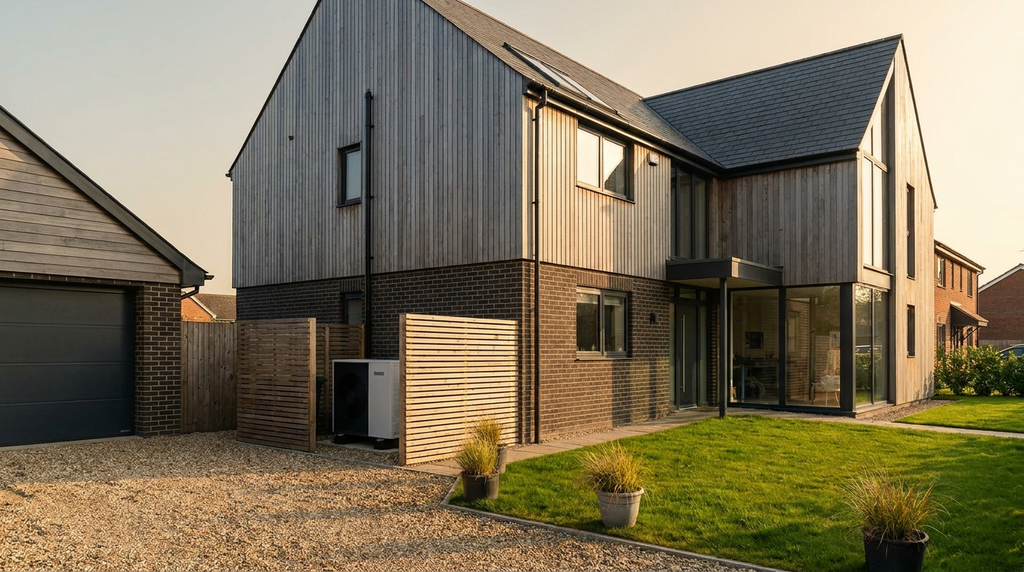
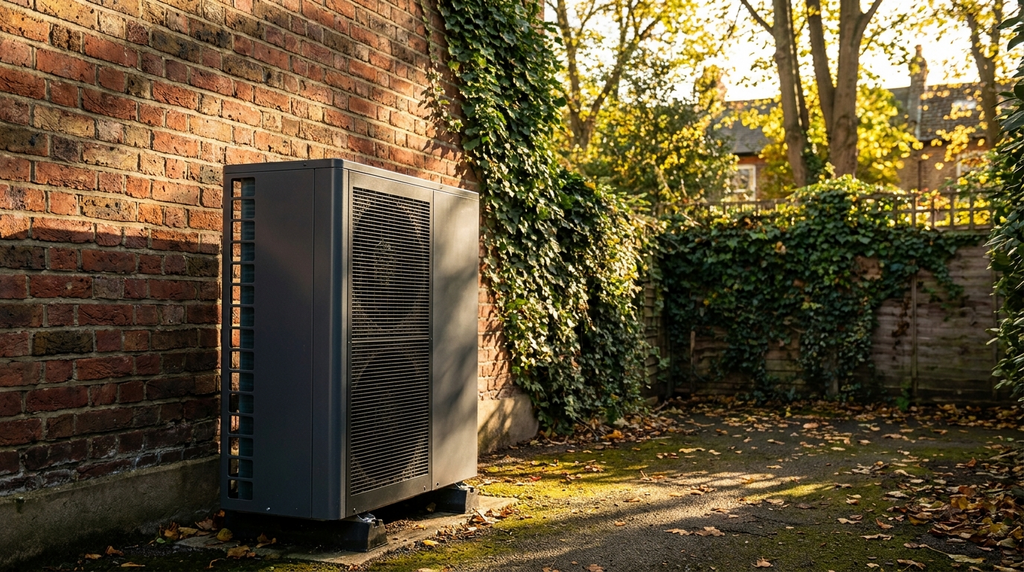
A heat pump can improve a home’s SAP rating by 5–15 points compared to a gas boiler, but the precise gain depends on the property’s fabric and existing heating system.
SAP (Standard Assessment Procedure) is the UK government’s method for rating a dwelling’s energy efficiency on a 1–100 scale, with higher scores indicating better performance. This rating directly determines your Energy Performance Certificate (EPC) score, which is required when selling or renting a home. A heat pump’s SAP impact is primarily driven by its Space Heating Efficiency (SHE), expressed as a Seasonal Coefficient of Performance (SCOP), which is the ratio of heat output to electricity input.
Higher SCOP values mean lower running costs and a better SAP score. In a well-insulated 3-bed semi-detached home, replacing an old G-rated gas boiler (SAP ~55) with an air-source heat pump (SCOP 3.0) can lift the SAP to approximately 68–70. A ground-source heat pump (SCOP 3.5) can push it to around 72–75 (Energy Saving Trust, 2026). The key variables are the existing insulation levels and the heat pump’s actual SCOP.
The SAP calculation changes for heat pumps versus gas boilers – the key differences are in the fuel factor and the system efficiency.
SAP uses a fixed fuel factor for electricity (2.0) compared to natural gas (1.0), meaning every kWh of heat from a heat pump is treated as having twice the carbon impact of a gas kWh. However, this is offset by the heat pump’s much higher efficiency. The heat pump’s SCOP is the critical input into the calculation, and SAP 10.2 assumes a default SCOP of 2.5 for air-source and 3.0 for ground-source if no manufacturer data is provided, though actual SCOP can be higher (3.0–4.0 for air-source, 3.5–5.0 for ground-source) (DESNZ, SAP 10.2 Specification, Appendix Q, Table 12).
The calculation also includes a “heat generator efficiency” factor, where heat pumps receive a credit for using renewable electricity from the grid mix, while gas boilers do not. This means a well-performing heat pump can score significantly better than a gas boiler even after accounting for the higher fuel factor (BRE, SAP 10.2 User Guide).
Quick numbers – typical SAP score changes for common UK property types with a heat pump
| Property type | Existing gas boiler SAP score (typical) | Air-source heat pump SAP score (typical) | Ground-source heat pump SAP score (typical) | SAP point gain (air-source) | SAP point gain (ground-source) |
|---|---|---|---|---|---|
| 3-bed semi-detached | 60 | 68 | 72 | +8 | +12 |
| 2-bed flat (mid-floor) | 65 | 72 | 75 | +7 | +10 |
| 4-bed detached | 55 | 65 | 70 | +10 | +15 |
| 2-bed bungalow | 58 | 66 | 70 | +8 | +12 |
These figures are based on typical insulation levels for each property type and assume a modern, properly sized heat pump installation (Energy Saving Trust, 2026; MCS, Installer database averages).
The direct answer – a heat pump SAP rating in the UK in 2026 is typically between 68 and 78 for a well-insulated 3-bed semi-detached home, depending on the heat pump type and existing insulation.
For a typical 3-bed semi (mid-terrace with cavity wall insulation and loft insulation), an air-source heat pump with SCOP 3.0 yields a SAP rating of approximately 70. A ground-source heat pump with SCOP 3.5 yields around 75 (Energy Saving Trust, 2026). For a poorly insulated 3-bed semi (no cavity wall insulation, single glazing), a heat pump will still improve the SAP by 3–5 points, but the absolute score will be lower, around 55–60.
For a 4-bed detached home with full insulation and underfloor heating, a ground-source heat pump can achieve SAP 78–82 (DESNZ, SAP 10.2 Calculation Methodology). The key takeaway is that insulation improvements before installation maximise the SAP gain.
Eligibility and certification – a heat pump must be MCS-certified and installed by an MCS-registered installer to affect your SAP rating and qualify for government schemes.
Only MCS-certified heat pumps listed on the MCS product directory are eligible for the Boiler Upgrade Scheme (BUS) grant of £7,500 as of 2026. Non-certified units do not count for SAP or EPC purposes, meaning you cannot claim the grant or improve your EPC rating without MCS certification (MCS, Product Directory). Installers must be MCS-registered or equivalent (e.g., NAPIT for heat pumps) and hold TrustMark certification for consumer protection. Gas Safe Register does not cover heat pumps (GOV.UK, Boiler Upgrade Scheme 2026).
For SAP calculations, the installer must provide the manufacturer’s SCOP data from the MCS product database. Without this, SAP defaults to a lower assumed SCOP (2.5 for air-source), which reduces the SAP gain by 2–4 points (TrustMark, Scheme Standards).
What a heat pump SAP rating means for your EPC
A higher SAP rating directly raises your EPC band. For example, going from SAP 55 (band D) to SAP 68 (band C) can increase a home’s market value by 1–5%, according to Nationwide Building Society data (Nationwide Building Society, Energy Efficiency and House Prices 2025). The SAP improvement also translates to lower running costs. At 2026 electricity prices of approximately 28p/kWh and a SCOP of 3.0, a heat pump costs roughly 9.3p/kWh of heat, which is comparable to gas at around 8p/kWh. An 8-point SAP gain correlates to a 15–20% reduction in annual heating bills (Ofgem, Price Cap Data April 2026).
A better SAP/EPC rating also improves mortgage eligibility. Lenders increasingly offer “green mortgages” with lower rates for properties rated C or above, which can save hundreds of pounds per year on a typical mortgage (UK Finance, Green Mortgage Product Data 2026). How a heat pump affects your EPC rating
The payback – how long it takes for a heat pump’s SAP improvement to offset its upfront cost
The upfront cost of an air-source heat pump installation is approximately £7,000–£11,000 after the £7,500 BUS grant, while ground-source installation costs £18,000–£25,000 after the grant (Energy Saving Trust, Heat Pump Cost Survey 2025–2026). Annual bill savings for a 3-bed semi switching from gas to an air-source heat pump are around £200–£350 per year, based on gas at roughly 8p/kWh versus a heat pump at 9.3p/kWh, with the heat pump using approximately three times less energy (Energy Saving Trust, Heat Pump Running Cost Calculator).
The payback period from bill savings alone is 20–35 years for an air-source heat pump and 50–80 years for a ground-source system. The SAP gain does not directly shorten the payback, but it adds property value. However, if the heat pump enables the home to reach EPC band C or above, the “green mortgage” rate reduction of around 0.25% lower can save approximately £500–£1,000 per year on a £200,000 mortgage, cutting the effective payback to 10–15 years (UK Finance, Green Mortgage Data 2026; MoneySavingExpert, Mortgage Rate Analysis). Heat pump running costs vs gas boiler 2026
Frequently Asked Questions
A heat pump can increase your SAP rating by 5–15 points. For example, replacing a G-rated gas boiler (SAP 55) with an air-source heat pump (SCOP 3.0) can achieve a SAP of 68–70, according to the Energy Saving Trust (2026).
A heat pump typically improves EPC rating by one to two bands, equivalent to 5–15 SAP points. The exact gain depends on your home's insulation and the heat pump's SCOP, as per DESNZ SAP 10.2 specifications.
A good SCOP for an air-source heat pump is 3.0–4.0, while ground-source units achieve 3.5–5.0. Higher SCOP values directly improve your SAP rating and lower running costs, as confirmed by the Energy Saving Trust.
Yes, a heat pump can increase home value by improving the EPC rating, which is required when selling. A higher SAP score makes a property more attractive, though the exact uplift varies by market conditions.
SAP for heat pumps uses a fuel factor of 2.0 for electricity versus 1.0 for gas, but the high SCOP offsets this. The calculation includes a renewable grid credit, as defined in DESNZ SAP 10.2, Table 12.