The old gloss on your window frames has that particular chalky tiredness you can feel before you see it. Run a finger along the edge and it meets a fine dust, a white powder that was once a confident sheen. The cracks are tiny at first, then they spider out; the light that used to bounce cleanly off the wood now lands dully, as if the frame itself has given up. Then one weekend you do something about it. You sand, you prime, you paint. And when you step back, the room feels different. Sharper. More intentional. The view through the glass seems brighter, as though the window has been cleaned twice over. This is what the right paint finish does: it doesn’t just protect the frame from the weather. It changes how you experience the light, the room, and the world outside.
The choice of finish is a quiet architectural decision, one you live with every morning when you open the curtains. It determines whether your windows recede into the wall or announce themselves with a clean line. And it matters more than most people realise.
Let the frame disappear, or make it a feature
There are two schools of thought when it comes to window frame finishes, and neither is wrong. The first wants the frame to disappear: a matte finish in a colour close to the wall, so the eye passes straight through to the garden or the street beyond. The second wants the frame to outline the view, to give the window a crisp edge that holds the room together. This is where gloss comes in, or its more restrained cousin satin, catching light and drawing the eye to the architecture of the opening.
The finish determines the visual weight. Gloss reflects light, which makes the frame feel prominent, almost sculptural. Matte absorbs light, softens the edge, lets the wall and window merge. Room orientation plays a part here. A north-facing window, with its cool, steady light, suits a softer finish that won’t feel stark. A south-facing sash can carry a sheen without it glaring; the light is warm enough to make gloss feel generous rather than hard.
The case for eggshell on timber
Eggshell is the quiet hero of wooden window frames, and it deserves more attention than it gets. It sits between matte and satin, offering a low reflection that doesn’t shout, but enough durability for the daily business of opening, closing, and occasional condensation. On timber, it has a warmth that gloss never quite manages. The frame still looks like wood, not plastic. It breathes with the grain rather than sealing it under a hard shell.
The practical advantages are real. Eggshell doesn’t show every imperfection the way gloss does, a slightly uneven sanding, a tiny bump in the undercoat, which makes it forgiving for anyone doing the work themselves. And when it needs touching up, you can blend a new coat into the old without the tell-tale patchiness that plagues high-gloss repairs. It feels warm to the touch, too, which matters on a cold morning when your hand rests on the sill.
Why satin works where gloss used to rule
For uPVC and metal frames, satin has become the natural replacement for the high-gloss that once dominated every new-build estate. It offers more durability than eggshell, better resistance to knocks, cleaning, and the constant friction of sliding sashes, without the glare that makes gloss feel like a surgical instrument. Satin catches light in a way that is present but polite. It is the finish that says: I am here, but I am not showing off.
On a metal Crittall-style frame, satin holds its own against condensation and the odd splash from a houseplant. It cleans up with a damp cloth and does not streak. On uPVC, it is the finish that makes the frame feel considered rather than cheap. A gloss white uPVC frame can look clinical, almost institutional. Satin softens it, gives it a warmth that belongs in a home.
When to choose a flat or matte finish
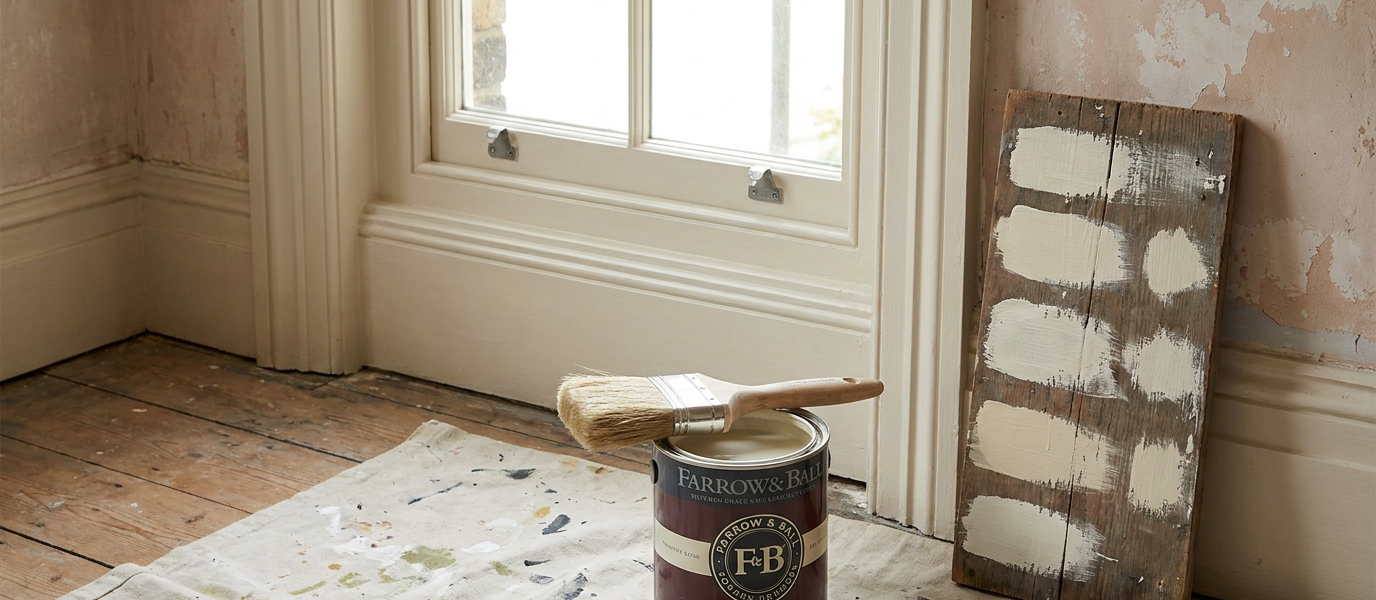
Matte finishes are for period homes with wide, deep-set frames, the kind of Victorian or Georgian sash where the wall meets the window in a generous reveal. Here, a matte or flat finish softens the transition between the plaster and the timber, so the window feels like part of the room’s fabric rather than a separate object inserted into a hole. The effect is atmospheric, especially in low light. A matte frame in a soft Farrow & Ball Drop Cloth or a muted grey simply dissolves into the wall, leaving the view undisturbed.
The trade-off is real: matte finishes are less scrubbable. Fingerprints and dust show more readily, and cleaning requires care. But for interior-facing frames in a bedroom or a study, where the mood matters more than wipe-clean convenience, the trade is worth making. A matte frame ages gracefully, too. Where gloss cracks and flakes, matte simply wears a little softer, a little duller, like a well-loved piece of furniture.
Pick a colour that softens with the seasons
The finish changes how a colour reads across the year. A gloss black frame can feel dramatic and sharp in summer, catching the high sun and throwing it back. Come January, under a grey sky, that same gloss black can feel harsh, almost aggressive. Matte finishes hold colour more consistently. A deep charcoal or a rich olive green stays steady through the changing light, because it absorbs rather than reflects.
Whites are particularly sensitive to finish. A soft eggshell white, something like Little Greene’s Slaked Lime Deep, stays creamy and warm, even on a dull afternoon. A gloss white, by contrast, can tip into clinical territory, especially in a north-facing room where the light is already cool. If you want a white frame that feels soft, choose a finish that softens it further.
Why texture matters more than colour
Colour gets all the attention, but texture is what you live with. The finish of your window frames shapes how the room sounds and feels in a way that colour alone cannot. Gloss bounces sound and light; a room with many gloss surfaces can feel bright but brittle, with a slight echo. Matte absorbs both, creating a quieter, more intimate space.
Then there is the tactile quality. Running a hand over a satin frame, smooth, clean, slightly cool, feels different from a rough, chalky old paint that has been neglected for years. That difference is not cosmetic; it is the difference between a home that is cared for and one that is just lived in. The right finish invites touch, and that matters more than we admit.
Eight ways to soften a tall sash window
Tall sash windows are a gift, but they can dominate a room if the finish is wrong. Here are eight ways to soften them:
- Use a matte or eggshell finish to reduce the dominance of that long vertical line.
- Pair with a colour one tone darker than the wall, not a stark contrast, a deep cream on a white wall, a soft grey on a pale stone.
- Paint the inner reveal in a lighter finish to bounce light deeper into the room.
- Consider a hand-painted effect rather than spray; the slight unevenness feels human, not factory-made.
- Use a low-sheen on the sash itself to avoid reflections that break the view.
- Keep the glazing bars in the same finish as the frame for a unified line.
- Add a faint wash of colour on the sill in the same finish, continuity matters.
- Let the finish age naturally. A matte frame looks better with a little wear than a gloss one does.
The one finish to avoid, and why
The old high-gloss on interior timber is the one to reconsider. It cracks because wood expands and contracts with the seasons, and gloss does not flex. It yellows because the resins in the paint oxidise over time, turning a once-bright white into a sickly butter. And it looks dated because it belongs to an era when every surface in the house was expected to shine like a car bonnet. That is not a rule for every home, a high-gloss frame in a modern, minimalist space can work as a deliberate statement. But for anyone repainting original timber frames, it is worth asking whether gloss is the right choice, or whether a hardwearing satin or a specialist oil-based eggshell might serve you better. They last without the glare. And they let the window be a window, not a mirror. window frame colour psychology