The difference between a window that disappears and a window that anchors a room
Stand in front of a bare sash window on a grey Tuesday morning and you’ll feel it, that unfinished edge, the room not quite settled. Hang a heavy curtain and suddenly the space feels theatrical, like you’re waiting for the velvet to part. A roman blind lands somewhere in between. It’s architectural but soft, tailored but not stiff. It gives a window a clean edge without swallowing the light. That quiet shift, from unfinished to intentional, is what makes this treatment worth considering in almost every room of your house.
This piece walks through the rooms where roman blinds genuinely shine, and the one or two where they might not. You’ll leave knowing exactly which window in your home wants one, and which fabric will make it feel like it was always meant to be there.
The kitchen window that doesn’t want to be noticed
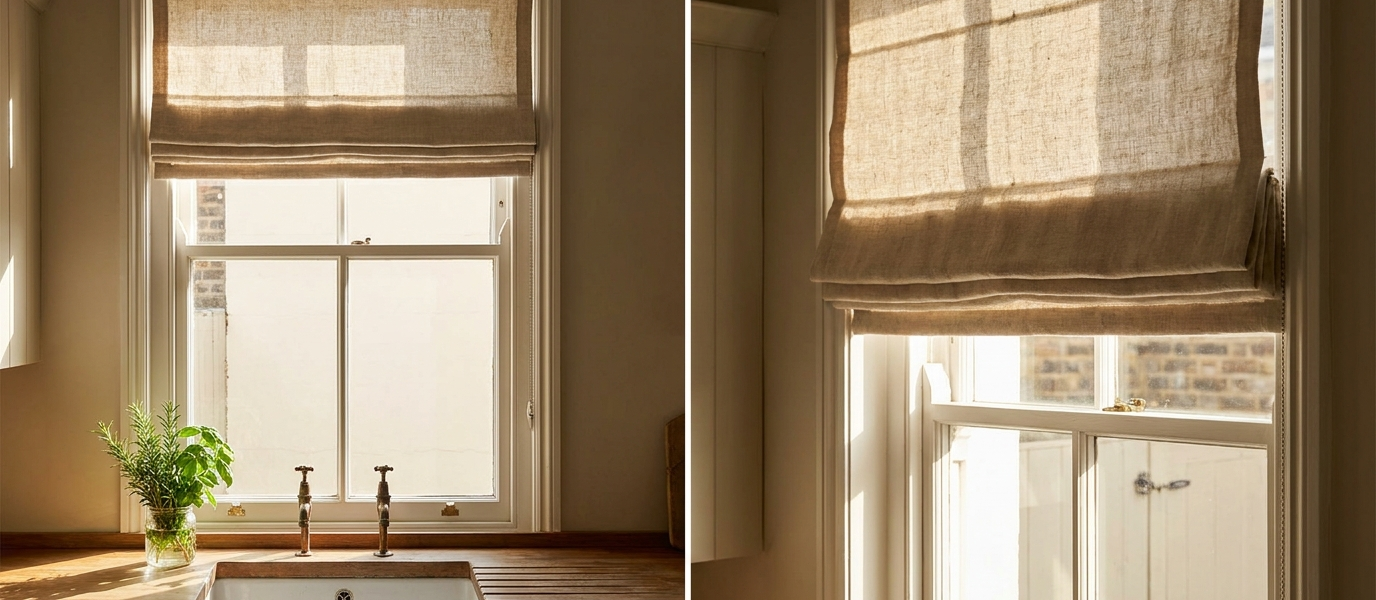
A kitchen window has a job to do, let in light, frame the garden, stay out of the way of steam and splashes. Roman blinds work here because they sit flush inside the recess, no fabric pooling near the hob or dripping into the sink. Choose a tight fold and a linen or cotton duck in a neutral that reads as a natural shadow, not a colour. A soft Farrow & Ball Drop Cloth or a warm off-white. The blind exists to soften the hard line of the frame, not to compete with the backsplash.
Roman blinds when to use in a kitchen means picking a fabric that can handle steam without wilting. A cotton-linen blend with a light lining will dry fast and stay crisp. Avoid silks and heavy velvets, the kitchen is no place for a fabric that sulks at a bit of moisture.
A tall sash window and the illusion of height
There’s something about a Victorian sash, tall, elegant, full of light, that a roman blind can either honour or fight. The trick is to stop the blind short of the sill by a hand’s breadth, letting the original proportions breathe instead of cutting them off at the knee. Mount the blind above the frame, not inside it, so the fabric extends the window’s vertical line. A single wide stripe or a subtle geometric pattern draws the eye upward, making a tall window feel even taller, and a short window feel less squat.
For a 1930s suntrap bay, this approach works especially well. The blind becomes a vertical accent, not a horizontal interruption.
The bay window that asks for something quieter than curtains
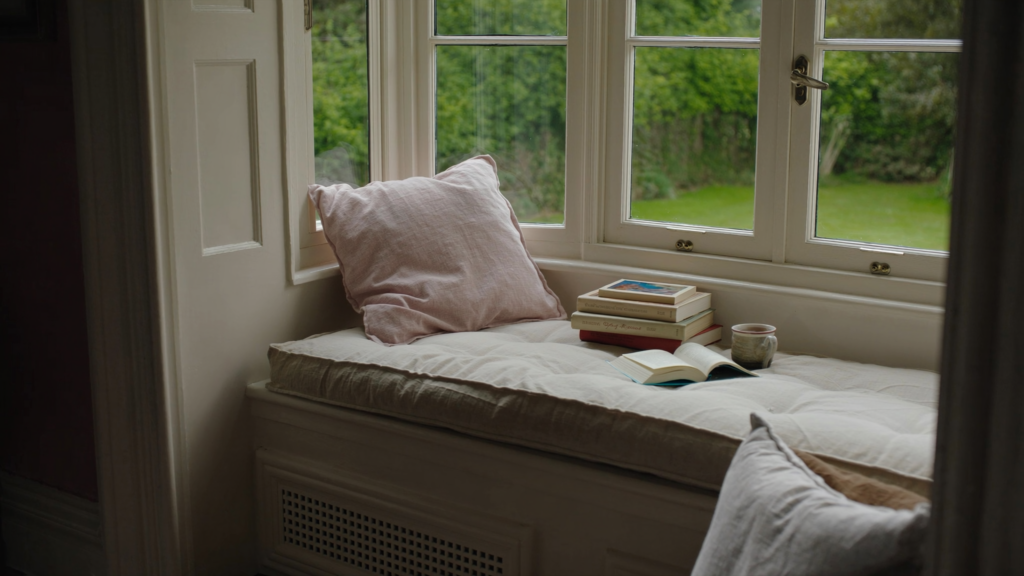
Curtains in a bay can feel like a tent, all that fabric, all those poles, all that fuss. Roman blinds sit flat, following the angles without drama. You have two choices: three separate blinds, one for each pane, or a single wide blind that spans the whole bay. The first option gives each window its own rhythm, ideal for a cosy reading nook. The second creates a single, clean plane that makes the bay feel larger and more unified.
Roman blinds when to use in a bay: when you want the architecture to lead and the fabric to follow. A pale linen in a soft oatmeal lets the window’s shape do the talking.
A bedroom where light matters more than privacy
Bedrooms need darkness, but they also need softness. A blackout-lined roman blind in a deep, dusty tone, think ochre, terracotta, or a greyed sage, reads as solid from outside but soft from inside. The blind drops to the sill, no gap, no light leak, no fussy tie-backs. That clean line means less visual clutter at the window, which means the bed and the headboard get to speak louder.
In a small bedroom, this matters even more. The roman blind’s simplicity lets the room breathe. Pair it with a warm wall colour, a deep Setting Plaster pink, say, and the window becomes a quiet backdrop rather than a focal point.
The small room that can’t afford heavy drapery
A roman blind takes up almost zero wall space. In a narrow hallway, a box room, or a tiny en-suite, that matters more than any fabric colour. A pale, textured weave, slub linen, a nubby cotton, a silk blend, catches the light without shouting. The blind gives the window back to the room instead of stealing square footage.
Roman blinds when to use in a small room: always. They’re the window treatment that doesn’t ask for space, it just fills the frame. For a hallway that feels more like a corridor, a single blind in a warm ivory can make the whole space feel wider.
Eight ways to soften a tall sash window without covering it up
Not every window wants a full drop. Sometimes the best treatment is a half measure. Here are eight ways to let a tall sash keep its character while adding a little softness:
- A roman blind in a sheer cotton that gathers into a soft, unstructured fold when raised, not a stiff concertina
- A blind that stops a third of the way down, leaving the top of the window bare, a half-dressed look that feels intentional
- A blind with a contrast binding that picks out the window frame colour, tying the two together
- A blind in a fabric that mirrors the wall colour, so the window reads as a continuous surface
- A blind with a deep hem that adds weight and a gentle curve at the bottom edge
- A blind made from a vintage textile, a faded linen, an old tablecloth, that brings a room’s history forward
- A blind that sits behind a pelmet, so the mechanism disappears and only the fabric shows
- A blind with a scalloped or shaped bottom edge that echoes the curve of an arched window
Each of these approaches lets the window stay the star while the blind plays a supporting role.
Why texture matters more than colour when the window faces north
North-facing rooms eat colour. A roman blind in a flat, pale fabric will look grey and lifeless by noon, no matter how cheerful it seemed in the shop. The solution isn’t a brighter shade, it’s texture. A slubby linen, a raw silk, or a cotton with a pronounced weave catches what light there is and holds it. The blind stays alive even in shadow, because the fabric itself is doing the work.
Roman blinds when to use in a north-facing room: when the fabric has enough texture to do the work that colour cannot. A nubby oatmeal linen will feel warm and rich where a smooth cream cotton would fall flat.
The window that frames a view, not the other way around
Some windows exist for the view, a treeline, a roofline, a slice of garden. A roman blind that rolls from the bottom up leaves the top of the window clear, so the scene stays visible from a seated position. A sheer or semi-sheer fabric softens the glare without blocking the view. The blind becomes a tool for editing what you see, not hiding it: you choose what to frame and what to screen.
For a ground-floor window that looks onto a busy street, this same approach works in reverse. A blind that drops from the top down screens the pavement while leaving the sky and treetops visible.
A front room that wants to feel formal without feeling stiff
A formal sitting room doesn’t have to mean heavy curtains and pelmets. A roman blind in a heavy velvet or a linen-cotton blend with a deep fold, paired with a slim curtain on each side for softness, strikes the right balance. The blind provides the structure; the curtain panels add the drape and the warmth. Together, they make the window feel dressed but not curtained, polished but not fussy.
Roman blinds when to use in a formal sitting room: when you want the window to feel intentional without overwhelming the space. A deep navy velvet with a slim cream curtain on each side, that’s a room that knows its own mind.