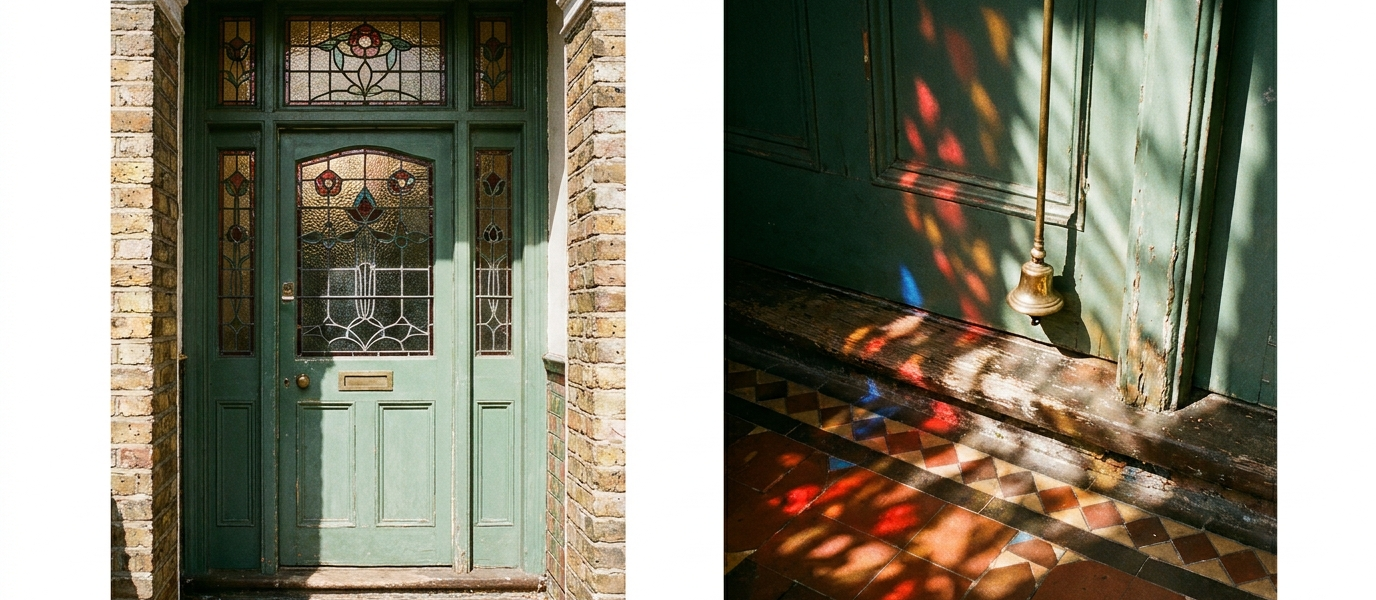
The front door forgot to be beautiful
Stand on any suburban street and count the front doors. Chances are, most of them are flat, blank, and forgettable, a slab of white uPVC or a dark grey composite rectangle that says nothing about the people who live behind it. It’s a missed opportunity, because your front door is the first thing you see every single day. You pass it more than any other window in the house, yet we’ve let it become purely functional: a lock, a letterbox, a place to hang a wreath at Christmas.
The original architectural jewellery that solved this problem was the fanlight, that half-moon or rectangular window perched above the door. In Victorian and Georgian homes, it told visitors something about the house before they stepped inside: that the owners cared about craftsmanship, that the home had a face, that light and shadow were taken seriously. That idea is quietly coming back, and it might be the single most impactful change you can make to your home’s exterior.
What a fanlight does that a standard window can’t
There’s a simple physics to it that modern frosted panels just can’t match. A fanlight sits above your door, catching daylight from above and throwing it down the hallway. Even on those grey February afternoons when everything feels flat, that angled light spills into your home in a way a side window never could. It’s borrowed light, and it’s free.
Now add colour. A stained glass fanlight doesn’t just let light in, it transforms it. That flat white glare you get from a standard frosted panel becomes something soft and jewel-like. A deep Setting Plaster pink from Farrow & Ball, cast through a pale peach pane, turns your hallway into a warm, welcoming space at 3pm. A sliver of amber catches the late afternoon sun and throws golden shapes across your wall. You can’t get that from a sheet of obscured glass.
There’s a practical gain too. Stained glass obscures while still welcoming light, which means you get privacy without a solid door. Your hallway stays bright, but nobody on the street can see your coat rack or your post piled on the mat. It’s the best kind of compromise.
Let your front door do the heavy lifting
A single fanlight changes the entire first impression of your house. From the street, your door stops being a flat rectangle and becomes something with depth and character. It signals that someone cares, that this house has been thought about.
The psychology of arrival matters more than you might think. A beautiful entrance makes coming home feel different, even before you turn the key. There’s a small pause, a moment of satisfaction, that a plain door simply doesn’t deliver. On a practical level, it also makes your house memorable to guests, delivery drivers, and anyone walking past. There’s a Victorian terrace in Manchester where a plain door with a reproduction fanlight became the most photographed house on the street. Not because it was flashy, but because it was quietly, unmistakably beautiful.
If you’re considering a new door, think about the fanlight first. door colour ideas can help you coordinate the frame, but the fanlight is what will make your house stand out in a sea of sameness.
Pick a colour that softens with the seasons
The traditional Victorian palette is bold, ruby reds, deep ambers, cobalt blues. They look magnificent in a period setting, especially when the sun hits them directly. But a more restrained modern approach might suit your home better. Think sea glass greens, warm greys, pale peaches, or a soft sage that echoes the garden.
The key is understanding how stained glass changes throughout the day. Morning light is cool and blue-toned, so a pale peach pane will read as a gentle blush. Afternoon light turns golden, and that same pane will warm into a soft apricot. Evening light is amber, and your fanlight will glow like a lantern. It’s a living thing, shifting hour by hour and season by season.
Choose colours that work with your interior hallway paint, not against it. A deep blue fanlight can clash with a yellow wall, while a warm grey or pale green will sit quietly beside almost anything. Your hallway sets the tone for the whole house, let the fanlight complement it, not compete.
Why texture matters more than colour
Here’s something that contradicts a common assumption: texture matters more than colour. Most people think of stained glass as bold, saturated panels, but the real magic often comes from the glass itself. Hand-rolled glass, rippled surfaces, and beveled edges catch light differently than flat coloured panes. They create depth and movement without shouting.
Textured glass can be the quieter, more sophisticated cousin to bold colour. Imagine hammered glass in warm white, with just a single ruby red roundel at the centre. Or a fanlight made entirely from seedy glass, that slightly bubbled, uneven surface that looks like old bottle glass, with a delicate leaded border. The effect is subtle but unforgettable. As the sun moves, the texture catches the light and throws tiny, shifting patterns across your hallway floor.
For homeowners who find traditional stained glass too ornate, textured glass offers a way in. It’s restrained, architectural, and deeply satisfying to watch throughout the day. leaded glass options can give you more ideas for this approach.
Eight ways to soften a tall sash window
- Leaded borders, A simple geometric border around the edge of your existing glass echoes the fanlight’s spirit without replacing the whole window.
- Single coloured roundel, One small circle of stained glass at the top of the window, catching the highest light.
- Etched geometric bands, Acid-etched lines in a horizontal band across the middle of the window, like a subtle belt.
- Small stained panel inset, A tiny panel of coloured glass set into the bottom corner, just visible from the street.
- Rippled glass in the lower half, Replace the bottom pane with textured glass for privacy while keeping the top clear for light.
- Beveled diamond pattern, A grid of beveled diamonds that catch light from every angle, like a discreet chandelier.
- Coloured leading in the fanlight itself, If you have a fanlight, add a single colour to the existing leadwork, like an amber stripe.
- Sandblasted motif, A subtle, sandblasted leaf or geometric shape in the centre of the window, barely there but unmistakably intentional.
Each of these is a way to test the concept without a full commitment. Small decorative touches can echo the fanlight’s spirit elsewhere in the house, tying your front entrance to your living spaces in a way that feels deliberate and cohesive.
The quiet return why it’s happening now
Homeowners are tired of grey minimalism and flat-fronted doors that look like everyone else’s. The revival of the stained glass fanlight isn’t about pastiche, it’s not about recreating a Victorian museum piece. It’s about reclaiming the idea that a house should have a face. That it should say something about the people who live there.
A stained glass fanlight doesn’t shout. It doesn’t compete with the neighbours or try to be the loudest thing on the street. It waits for you to notice it, and then it stays with you. You’ll find yourself looking at it every time you come home, watching the light shift, noticing how it changes with the weather. It’s a small thing, but it makes your house feel like yours in a way that a flat white door never could.
If you’re thinking about your front entrance, start with the fanlight. front door restoration tips can help you plan the rest. But the fanlight is where the magic lives.





