The single most important fact a retrofit heat pump can work in most older UK homes, but the heat loss must be below 8–10 kW for the standard models commonly installed today.
A properly designed retrofit heat pump system is viable for homes built pre-1900, including solid-wall properties, provided the heating system is upgraded and the building fabric is improved to a minimum standard. The key limiting factor is the building’s heat loss at the coldest expected outdoor temperature (-3°C to -5°C depending on region), not the age of the home. The Microgeneration Certification Scheme (MCS) standard requires the heat pump to meet the property’s heat load, meaning oversized units are inefficient and undersized units will fail to keep the home warm (MCS 020 Standard, 2026).
According to the Department for Energy Security and Net Zero (DESNZ) “Heat Pump Ready” programme, around 70% of UK homes have a heat loss below 10 kW at the design temperature, making them suitable for a standard 5–8 kW air-source heat pump (DESNZ, 2026). The Energy Saving Trust’s “Heat Pump Retrofit in Older Homes” report confirms that pre-1900 solid-wall homes can achieve this heat loss with targeted fabric upgrades (Energy Saving Trust, 2026).
Typical retrofit heat pump costs for an older UK home, and how they compare to a new gas boiler
A gas boiler replacement costs £1,500–£3,500 (including installation). A full retrofit air-source heat pump system (including new radiators, hot water cylinder, and pipework) costs £9,000–£15,000 for a typical 3-bedroom older home. The BUS (Boiler Upgrade Scheme) grant of £7,500 (England and Wales, 2026) reduces the net cost to £1,500–£7,500, making the upfront cost competitive with a boiler in some cases (GOV.UK Boiler Upgrade Scheme, 2026).
Running costs: at 2026 price cap rates (24.5p/kWh electricity), a heat pump with a typical SCOP of 3.5 costs roughly £700–£900/year to heat an average older home, versus £800–£1,100/year for a gas boiler (6.5p/kWh gas) (Ofgem Price Cap Q1 2026). The gap narrows with a higher SCOP or time-of-use tariffs such as Economy 7 or Octopus Agile. DESNZ estimates that a heat pump with SCOP 4.0 can undercut gas running costs by 10–15% at current rates (DESNZ Domestic Heat Pump Cost Estimates 2026).
Quick numbers key specs comparing a retrofit heat pump to a gas boiler for an older home
| Specification | Air-source heat pump (retrofit) | Gas boiler (replacement) |
|---|---|---|
| Upfront cost (after BUS grant) | £1,500–£7,500 | £1,500–£3,500 |
| Annual running cost (typical 3-bed semi) | £700–£900 | £800–£1,100 |
| System lifespan | 15–20 years | 10–15 years |
| Typical SCOP (heat pump) or efficiency (boiler) | SCOP 3.0–4.0 | 90–94% efficiency |
| Required space indoors (cylinder, unit) | Hot water cylinder (60–120L) + indoor unit | Minimal (no cylinder needed for combi) |
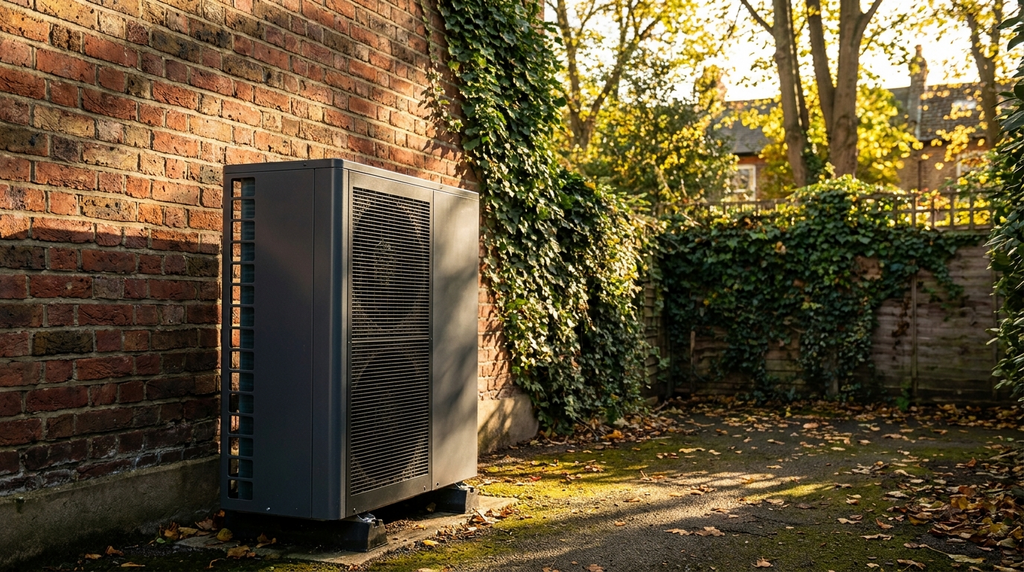
| Required space outdoors (unit) | ~1m x 1m footprint, 0.5m from walls | None (flue only) |
| Typical noise level (dB at 1m) | 40–55 dB | 45–55 dB (flue noise) |
All figures from MCS installer database averages, EST running cost models, and manufacturer datasheets (Vaillant, Daikin, Mitsubishi Electric) (MCS, 2026; Energy Saving Trust, 2026).
The answer to “Can I install a heat pump in my older home?” – eligibility in plain English
Eligibility is not based on the home’s age but on the building’s heat loss calculation (typically ≤10 kW for a standard 5–8 kW heat pump) and sufficient space for an outdoor unit, indoor cylinder, and new radiators. A heat loss survey by an MCS-certified installer will determine if the home is suitable. If heat loss is above 10 kW, a larger heat pump or a hybrid system (heat pump + boiler) may be needed (GOV.UK Boiler Upgrade Scheme guidance, 2026).
The BUS does not require EPC band D or above for heat pump applications (the EPC condition was removed in 2024). You only need a valid MCS installation certificate to claim the grant. The MCS standard MCS 020 mandates a full heat loss calculation using the EN 12831 methodology, which accounts for wall construction, window type, and local climate (MCS Heat Pump Installation Standards, 2026).
how to book a heat loss survey for your home
How to verify your installer has the right certification for a retrofit heat pump in an older home
Use an MCS-certified installer for the heat pump itself (required for BUS grant eligibility). Check the MCS Installer Database online at mcscertified.com. For electrical work (e.g., new circuit for the heat pump), the installer must be registered with NICEIC, NAPIT, or a Part P competent person scheme (NICEIC register, 2026).
For any new radiators or pipework, the installer should hold a relevant plumbing qualification (e.g., Gas Safe is not required for heat pump systems, but many installers hold both). TrustMark is a government-endorsed quality mark that covers all trades; look for an installer registered with both TrustMark and MCS (TrustMark website, 2026). Always request written confirmation of MCS certification before work begins.
The three essential building fabric upgrades that make a retrofit heat pump work in an older home
Insulation: Loft insulation to 270mm minimum and cavity-wall insulation (where possible) are the most cost-effective upgrades. Solid-wall insulation (internal or external) is often needed if heat loss is high. The Energy Saving Trust estimates that loft insulation alone can reduce heat loss by up to 25% in an uninsulated pre-1930 home (Energy Saving Trust Insulation Guide, 2026).
Draught-proofing: Sealing gaps around windows, doors, and floorboards can reduce heat loss by 10–15%. A professional air-tightness test is not mandatory but can identify problem areas. DESNZ’s “Heat Pump Retrofit Guidance for Older Properties” (2025 update) recommends draught-proofing as the second priority after insulation (DESNZ, 2026).
Radiator sizing: Heat pumps run at lower flow temperatures (35–45°C) than boilers (65–75°C), so radiators must be larger or replaced with oversized models. Underfloor heating is ideal but not essential. CIBSE guidance notes that radiator surface area typically needs to double to deliver the same heat output at 40°C flow temperature (CIBSE Heat Pump Design for Existing Buildings, 2026).
How the Energy Performance Certificate (EPC) rating changes after a heat pump retrofit in an older home
A typical uninsulated pre-1930 home with a gas boiler might have an EPC band E or F. After a heat pump retrofit with loft insulation, draught-proofing, and new radiators, the band can rise to D or C. The EPC calculation for heat pumps assumes a specific efficiency (SCOP) and fuel cost; a higher SCOP (e.g., 4.0 vs 3.0) improves the rating (GOV.UK Energy Performance of Buildings Regulations, 2026).
The actual rating depends on the whole home’s fabric, not just the heat source. Installing a heat pump alone without fabric upgrades will not significantly improve the EPC band and may even lower it if the heat pump is less efficient than assumed. The Energy Saving Trust notes that a heat pump in a poorly insulated home can have a realised SCOP of 2.5 or lower, which would reduce the EPC rating compared to a modern gas boiler (Energy Saving Trust EPC Briefing, 2026).
how to improve your EPC rating before a heat pump installation
Frequently Asked Questions
Yes, a retrofit heat pump can work in most older UK homes if the heat loss is below 8-10 kW at design temperature. The Energy Saving Trust confirms pre-1900 solid-wall homes can achieve this with fabric upgrades.
A full retrofit air-source heat pump system costs £9,000-£15,000 for a 3-bed older home. After the Boiler Upgrade Scheme grant of £7,500, net cost is £1,500-£7,500 according to GOV.UK.
At 2026 price cap rates, a heat pump with SCOP 3.5 costs £700-£900/year to heat an average older home, compared to £800-£1,100/year for a gas boiler, saving up to £200/year according to Ofgem.
The MCS 020 standard requires heat loss below 8-10 kW at -3°C to -5°C for standard models. Oversized or undersized units will be inefficient or fail to heat the home adequately.
Yes, older homes typically need larger radiators or underfloor heating to work efficiently with a heat pump's lower flow temperatures. The Energy Saving Trust recommends this as part of a full retrofit.