Loft insulation is the highest-return single home energy upgrade in the UK. A typical three-bedroom semi without insulation can save £270 a year by reaching the modern 270 mm standard. The work itself costs £400 to £700 fitted, or under £250 if you do it yourself in a weekend. The cheapest route depends on whether you qualify for free installation under ECO4.
What it costs by route
| Route | Cost | Time | Notes |
|---|---|---|---|
| ECO4 free install | £0 | 2-4 weeks from application | Eligible homes on means-tested benefits; EPC D-G only |
| DIY mineral wool roll | £150-£250 | One weekend | B&Q / Wickes / Screwfix; rolls cover ~5 m² each |
| Professional installer | £400-£700 | Half a day | Faster, cleaner, includes top-up to 270 mm |
| Sheep’s wool DIY | £700-£1,200 | One weekend | Eco-friendly, premium product, no breathing issues |
| Spray foam (do not use) | £2,000-£4,000 | One day | Mortgage lenders flag it as a defect; avoid |
The headline figure homeowners often miss: spray foam is being rejected by mortgage lenders. UK Finance reported in 2024 that 60% of major lenders have either restricted lending or required removal of spray foam before approving a mortgage. If you are considering insulation and you plan to sell within 20 years, do not use spray foam in your loft.
How much it saves
Energy Saving Trust figures for a typical gas-heated home going from uninsulated to 270 mm of mineral wool:
| Property | Annual saving | Annual CO₂ reduction |
|---|---|---|
| Detached house | £270 | 900 kg |
| Semi-detached | £170 | 560 kg |
| Mid-terrace | £120 | 400 kg |
| Bungalow | £260 | 880 kg |
| Flat (top floor) | £190 | 620 kg |
If you already have 100 mm and top up to 270 mm, the saving is around £35 to £45 a year for a detached. Topping up shallow insulation is still worth doing, but the headline savings are much smaller than the initial install.
The DIY route
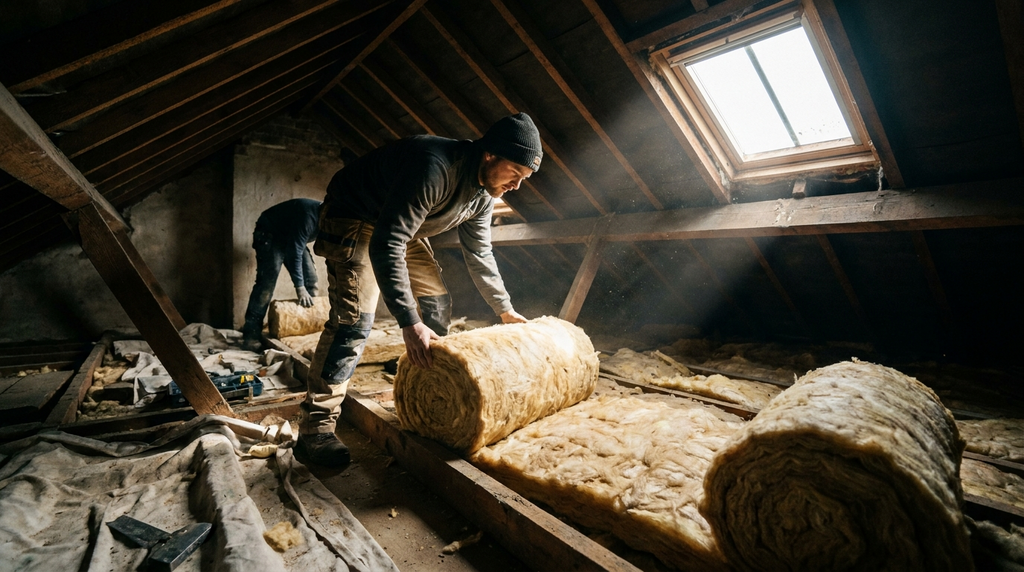
For most modern lofts with simple geometry and reasonable access, DIY is genuinely cheaper and fast. A 100 m² roll-blanket install in a typical three-bed semi takes one person a day.
Buy:
- 270 mm worth of mineral wool blanket, typically two layers of 170 mm laid perpendicular. Around 20 to 24 rolls for a 100 m² loft.
- A face mask (FFP2 minimum), gloves, long sleeves.
- Loft boards if you need storage access, boarded sections do not get full insulation depth, so build them above the insulation on raised loft legs.
- A loft ladder if you do not have one.
Steps:
- Clear the loft, brush dust, check for damp or wiring issues.
- Lay first layer of 170 mm blanket between the joists, tight to all edges.
- Lay second layer perpendicular across the joists. Do not crush the wool, that destroys its insulating value.
- Do not block eaves ventilation. Keep a 50 mm air gap at the eaves to prevent condensation.
- Insulate the loft hatch with a separate cut piece.
When an installer is worth the extra cost
- Awkward access, small or sloped hatch, no head clearance, lots of pipework or wiring.
- Mineral wool dust sensitivity, installers wear professional respirators and you avoid the irritation.
- Existing insulation contaminated, droppings, damp, mould. Professional removal and disposal is regulated and not a DIY job.
- Cold roof versus warm roof conversion, if you are insulating a loft conversion at rafter level, a professional is required for compliance.
ECO4, free installation route
If you receive Universal Credit, Pension Credit, Income Support, Working Tax Credit or several other means-tested benefits, your home may qualify for fully-funded loft insulation under the Energy Company Obligation (ECO4). The scheme closes 31 December 2026. The application route is via your local council or one of the certified installers, see the related article on ECO4 grants. Lead times are typically two to four weeks from application to install.
Properties must have an EPC rating of D to G. Homes already rated A, B or C are not eligible.
After ECO4 closes
The Warm Homes Plan is expected to launch its successor low-income grant route in 2026 or 2027 but no detail is published. Homeowners who do not qualify for means-tested support will be able to access low or zero interest loans under the same programme, including for insulation. Those terms are not yet published either.
The practical position: if you might qualify for ECO4, apply before December. If you do not qualify, DIY is the cheapest route at any time; commercial installer cost is unlikely to fall further.
Sources
- Roof and loft insulation, Energy Saving Trust
- Energy Company Obligation, Ofgem
- How to insulate your home, Which?
Frequently Asked Questions
The current UK recommendation is 270 mm. Older houses often have 100 mm or less. Going from 100 mm to 270 mm saves a typical detached home around £40 a year; going from nothing to 270 mm saves around £270 a year.
No. Most UK mortgage lenders now restrict lending on properties with spray foam loft insulation or require its removal. If you plan to sell or remortgage within 20 years, use mineral wool or sheep's wool instead.
Not directly, compressed insulation loses its R-value. Use raised loft legs to build a boarded platform above the 270 mm wool, leaving the insulation uncompressed underneath.
Only if you block ventilation. Modern guidance is to maintain a 50 mm gap at the eaves so air can move through the roof void. Tight-packed insulation against the eaves can trap moisture.