DIY loft insulation costs roughly £300 in materials but can save a semi-detached home up to £300 a year on heating bills
If your loft has little or no insulation, you are almost certainly losing heat through the roof. A typical three-bedroom semi-detached house can lose up to 25% of its heat through an uninsulated loft. The material cost for DIY loft insulation in a typical three-bedroom semi is about £250–£350, depending on roll thickness and type (mineral wool vs. sheep’s wool), according to the DESNZ “Energy efficiency cost guide” (DESNZ, 2026).
The direct answer: DIY loft insulation costs roughly £300 in materials but can save a semi-detached home up to £300 a year on heating bills, giving a payback period of 1–2 years. For an uninsulated loft, the Energy Saving Trust estimates savings of £250–£300 per year for a semi-detached house (Energy Saving Trust, 2026).
Annual savings vary by property size and current insulation level. The payback period for DIY installation is typically 1–2 years, compared to 3–5 years for professional installation due to labour costs. If you already have some insulation, the savings will be lower, so measure your existing depth first.
DIY loft insulation must meet the current building regulation minimum of 270mm of mineral wool or equivalent
The 2026 Building Regulations (Part L, Volume 1) require a U-value of 0.16 W/m²K for loft insulation. A U-value measures how well a material prevents heat from passing through it; the lower the number, the better the insulation. This is achieved by approximately 270mm of mineral wool or 200mm of rigid foam board (GOV.UK, “Approved Document L,” 2026).
Layering is critical. The first layer goes between the joists (100mm), and the second layer goes over the joists (170mm+), using a cross-lay technique to avoid gaps. If the existing insulation is less than 100mm, you must remove it and start fresh. Topping up over old, compressed insulation reduces effectiveness because compressed material has a higher U-value and traps less air.
If you are topping up existing insulation that is already 100mm or more, you only need to add enough to reach the 270mm total. Check the existing depth with a tape measure before buying materials.
Quick numbers cost, savings, depth, and payback for a typical three-bedroom semi
The table below compares the three most common insulation types for a 50m² loft area. Material costs are from the DESNZ “Energy efficiency cost guide” (DESNZ, 2026). Savings are based on the Energy Saving Trust loft insulation savings calculator (Energy Saving Trust, 2026).
| Insulation type | Material cost per m² | Total material cost for 50m² loft | Annual energy saving | Payback period |
|---|---|---|---|---|
| Mineral wool rolls (100mm + 170mm) | £5–£7/m² | £250–£350 | £250–£300 | 1–2 years |
| Sheep’s wool rolls | £12–£18/m² | £600–£900 | £250–£300 | 2–3 years |
| Rigid foam board | £15–£25/m² | £750–£1,250 | £250–£300 | 3–5 years |
Mineral wool offers the fastest payback but requires the most careful handling. Sheep’s wool costs more but is less irritating to handle and has better moisture management. Rigid foam board is best for lofts with limited headroom because it achieves the required U-value at a thinner depth.
The direct answer DIY loft insulation in the UK in 2026 is safe if you follow three rules, no electrical wiring buried, no blocked vents, and correct PPE
DIY loft insulation is safe if you follow three rules. Rule 1: Do not bury electrical cables in insulation. Cables must be run on top of the insulation or in conduit to avoid overheating, as per Electrical Safety First guidance (Electrical Safety First, 2026). Rule 2: Do not block soffit vents or the eaves gap. Leave a 50mm air gap at the eaves to prevent condensation and mould, as advised by the NHBC (NHBC, 2026). Rule 3: Wear a disposable FFP3 dust mask, goggles, gloves, and long sleeves when handling mineral wool. Sheep’s wool requires less dust protection but still needs a mask, according to the HSE (HSE, 2026).
These three rules prevent the most common DIY mistakes that lead to fire risk, damp, or respiratory irritation. If you cannot guarantee any of these conditions, hire a certified installer instead.
You must check MCS certification for any installer if you later use a grant
The Great British Insulation Scheme closed on 31 March 2026. It funded insulation measures only and never covered windows or glazing. Those require an MCS-certified installer, as per Ofgem guidance (Ofgem, 2026). If you plan to claim a grant, you must hire an MCS-certified installer from the start. The same applies if you later sell the property: an Energy Performance Certificate (EPC) assessor may note DIY insulation as “assumed” rather than “measured” unless you can provide photos or receipts.
For DIY work, the relevant safety certification is self-verification: check that the product is CE or UKCA marked (GOV.UK, “Construction products regulation,” 2026). The Great British Insulation Scheme closed on 31 March 2026. It funded insulation measures only and never covered windows or glazing.
guide to MCS-certified installers and grants
Loft insulation installation steps measure
Step 1: Measure the loft area (length x width of the ceiling) and buy enough rolls to cover at least 270mm depth. Add 10% for cutting waste, as recommended by the Energy Saving Trust DIY loft insulation guide (Energy Saving Trust, 2026).
Step 2: Clear the loft of stored items, check for damp or leaks, and ensure all electrical cables are not buried. Electrical Safety First provides a loft insulation checklist for this step (Electrical Safety First, 2026). Repair any roof leaks before insulating.
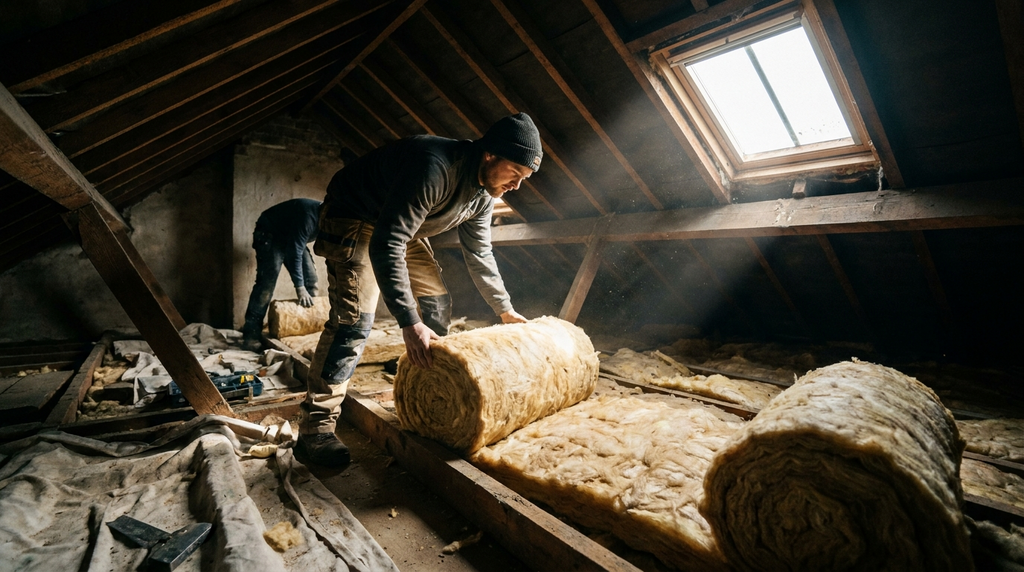
Step 3: Lay the first layer between joists, then the second layer over the joists at right angles. Do not compress the insulation. Compression reduces its thickness and therefore its U-value, as per NHBC standards (NHBC, 2026).
Step 4: Leave a 50mm gap at the eaves for ventilation. Do not block soffit vents or roof vents. The NHBC confirms this gap is mandatory to prevent condensation (NHBC, 2026).
Loft insulation safety hazards fire
Fire risk: recessed downlights must be covered with a fire-rated cap or left uncovered. Insulation must not touch them. Electrical Safety First provides specific guidance on downlights and insulation (Electrical Safety First, 2026). Building Regulations Part B (fire safety) requires that insulation does not create a fire hazard near heat sources.
Damp risk: blocked ventilation leads to condensation on the roof timbers, which can cause rot. A 50mm eaves gap is mandatory under Building Regulations Part F (ventilation). If you see damp patches or mould after insulating, you have likely blocked the airflow. Unblock the vents immediately.
Dust risk: mineral wool fibres can irritate the skin, eyes, and lungs. Wear an FFP3 mask, goggles, and gloves. The HSE lists mineral wool as a respiratory irritant requiring control measures (HSE, 2026). Sheep’s wool produces less dust but still releases particles during cutting.
guide to identifying and fixing loft condensation
Frequently Asked Questions
Around £250 to £350 for materials in a typical 3-bed semi, according to the DESNZ 'Energy efficiency cost guide' (2026). Mineral wool is cheapest; sheep's wool costs more.
Up to £300 a year for an uninsulated semi-detached house, per the Energy Saving Trust (2026). Savings depend on property size and existing insulation depth.
270mm of mineral wool or equivalent, achieving a U-value of 0.16 W/m²K, as per Part L of the 2026 Building Regulations (GOV.UK). Use a cross-lay technique.
Yes, with precautions: wear a dust mask, gloves and long sleeves when handling mineral wool. Ensure adequate lighting and never cover electrical cables or recessed lights.
Yes, if existing insulation is less than 100mm. Compressed or damp insulation loses effectiveness; remove it and start fresh with new rolls.