DIY underfloor insulation can cut your heating bill by £80–£200 per year
If you have draughty rooms and high heating bills, the floor beneath your feet could be the culprit. Insulating under suspended timber floorboards is a job many homeowners can tackle themselves, and the savings are significant.
According to the Energy Saving Trust, insulating under suspended timber floorboards can save a typical semi-detached house around £80 per year on heating costs, while larger or draughtier homes can save up to £200 (Energy Saving Trust, 2026). Published data from DESNZ (2026) shows uninsulated suspended floors account for roughly 10–15% of heat loss in an average UK home (DESNZ, 2026).
The payback period depends on material cost and your DIY labour, but typically falls between 2 and 5 years for a standard ground-floor area. With mineral wool at the cheaper end, you can recoup your material costs in as little as one winter.
What materials you need and what they cost per square metre
Three main insulation materials work under floorboards, each with different costs and performance characteristics.
Mineral wool (rock or glass fibre) costs roughly £5–£10 per m² from major builders’ merchants (Travis Perkins retail pricing, 2026). It must be supported between joists with netting or battens to stop it sagging. This is the cheapest option and easiest to cut with a sharp knife.
Rigid foam boards (PIR or XPS) cost £10–£20 per m² and offer a higher R-value per thickness, meaning you need less depth for the same thermal performance (Wickes retail pricing, 2026). They require careful cutting with a fine-tooth saw and must fit tightly between joists with no gaps.
Foil-faced bubble wrap or multifoil insulation costs £8–£15 per m² but is less effective than mineral wool or foam for floor applications (MCS certified product listings, 2026). The Energy Saving Trust recommends mineral wool or rigid foam as the primary choices for underfloor insulation (EST insulation materials guide, 2026).
How to assess whether your floorboards are suitable for DIY insulation
Before buying materials, check three things to confirm your floor is suitable for DIY insulation.
Floor type. Exposed suspended timber floorboards with a ventilated sub-floor (airbricks in the wall) are the ideal candidate. Concrete or solid floors require different methods such as rigid insulation laid on top. If you have concrete floors, this guide does not apply.
Damp and rot. Check for damp, rot, or woodworm before starting. The National House-Building Council (NHBC) standards state insulation must not trap moisture against timber (NHBC technical guidance on floor insulation, 2026). If you see signs of damp, address the cause first or call a surveyor.
Headroom. Measure the depth between the top of the floorboard and the ground level below. You need at least 150 mm of clear space for mineral wool or 75 mm for foam boards (BRE report on thermal insulation of suspended timber floors, 2026). If the gap is smaller, rigid foam is your only option.
The step-by-step DIY method for installing insulation under floorboards
Follow these steps for a safe and effective installation.
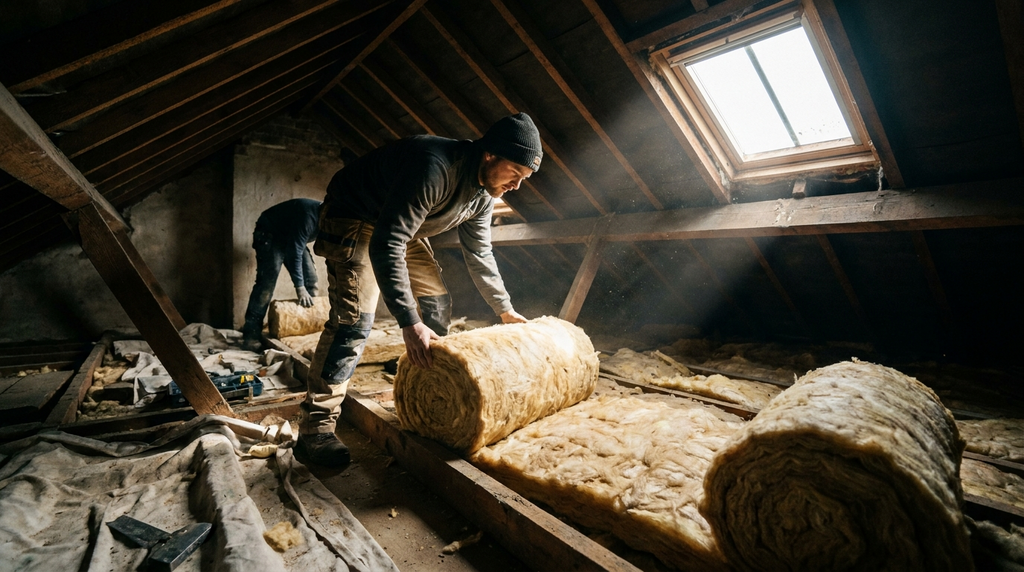
- Lift the boards. Lift a single row of floorboards along the room’s longest wall using a floorboard saw or a multi-tool. Pry up carefully to avoid splitting the boards.
- Support the insulation. Lay netting or plastic mesh between joists to support the insulation. Staple it to the joist sides every 300 mm using a staple gun.
- Cut and fit. Cut insulation to fit snugly between joists with no gaps larger than 5 mm. Use a sharp knife for mineral wool or a fine-tooth saw for foam boards. Push the insulation fully into the gap but do not compress it.
- Replace the boards. Secure the floorboards with screws (not nails) at 400 mm centres using 50 mm decking screws (Energy Saving Trust DIY floor insulation guide, 2026). Screws make future access easier if you need to inspect pipes or wiring.
Do not block airbricks or cover the sub-floor ventilation. The British Standards Institute BS 5250:2026 requires that ventilation paths remain clear to prevent condensation and rot (BS 5250:2026, ventilation requirements).
Quick numbers, cost, savings, and payback for a 20 m² ground floor
| Item | Figure | Source |
|---|---|---|
| Typical ground-floor area (semi-detached) | 20 m² | DESNZ English Housing Survey, 2026 |
| Material cost (mineral wool) | £100–£200 | Travis Perkins retail pricing, 2026 |
| Material cost (rigid foam) | £200–£400 | Wickes retail pricing, 2026 |
| Annual heating bill saving | £80–£200 | Energy Saving Trust, 2026 |
| Payback period (mineral wool) | 1–2.5 years | Calculated from above figures |
| Payback period (rigid foam) | 2–5 years | Calculated from above figures |
| CO₂ saving per year | 150–400 kg | EST home insulation carbon savings, 2026 |
What the payback looks like for different house types
The savings vary by home size and heat loss. Here is what the Energy Saving Trust data shows for common house types (EST floor insulation savings by house type, 2026).
- Semi-detached with 20 m² of uninsulated floor saves £80–£120 per year. Payback is 1–3 years with mineral wool.
- Detached with 30 m² of floor area saves £120–£200 per year. Payback is 1–2.5 years with DIY labour.
- Mid-terrace with 15 m² saves £60–£90 per year. Payback is still under 3 years for most homes.
These figures assume the floor is the only uninsulated element. If walls and loft are already insulated, the floor savings are at the higher end of the range. DESNZ data confirms average floor areas by dwelling type match these estimates (DESNZ average floor areas, 2026).
How to verify your installer (if you decide not to DIY) and the key certification you need
If you choose to hire a contractor instead of doing the job yourself, check their credentials carefully.
For DIY, no certification is required. The Great British Insulation Scheme closed on 31 March 2026. It funded insulation measures only and never covered windows or glazing.
TrustMark registration is the minimum standard for any insulation installer under the government’s TrustMark scheme (TrustMark approved insulation installers directory, 2026). Always check the register before paying a deposit.
If the work involves sealing airbricks or altering ventilation, a Gas Safe registered engineer may be needed for gas appliances in the room above, as per BS 5440:2026 (Gas Safe Register, 2026). Never block airbricks without professional advice.
The direct answer to ‘Can I insulate under my floorboards myself?’
Yes, you can insulate under suspended timber floorboards yourself using mineral wool or rigid foam boards between joists, provided you have adequate headroom (at least 150 mm for mineral wool) and no damp issues (Energy Saving Trust DIY floor insulation guide, 2026).
The job for a 20 m² ground floor typically takes 1–2 days for a competent DIYer and costs £100–£400 in materials, saving £80–£200 per year on heating. You do not need any formal certification to do it yourself, but you must maintain ventilation (airbricks must stay clear) and avoid trapping moisture against timber (NHBC technical guidance floor insulation for timber floors, 2026).
Check our guide on how to insulate a suspended timber floor for a full checklist.