Why Dunbar Homeowners Are Turning to Double Glazing Right Now
If you’ve spent a winter in Dunbar, you already know what the wind off the Firth of Forth feels like rattling through single-glazed sash windows. This is not a gentle coastal town, it’s a place where the North Sea weather makes itself known, and where heating bills have been climbing steadily enough to make even the most patient homeowner think seriously about upgrading their windows.
Dunbar sits in a genuinely exposed position on the East Lothian coast. The town’s Victorian and Edwardian terraces along the High Street and around the harbour were built with solid stone walls but minimal thought for thermal efficiency. Combine that with an average EPC rating of Band D across the town, and you’ve got a lot of homes quietly haemorrhaging heat from October through to April.
Right now, there’s a real push from East Lothian Council encouraging residents to improve their home energy performance as part of the Scottish Government’s Heat in Buildings Strategy, which targets fully decarbonised heating across Scotland by 2045. Double glazing is often the first step, and a prerequisite for making other upgrades like heat pumps work properly. If your walls are insulated but your windows are letting cold air flood in, nothing else you do will hit its potential.
There’s also a practical financial driver. Energy bills for a typical Band D Dunbar home running 13,200 kWh of gas per year are noticeably higher than the Scottish average. Double glazing won’t solve everything, but it absolutely moves the needle, and in a town where many homes were built over a century ago, there’s enormous room for improvement.
What Double Glazing Actually Involves for a Typical Dunbar Home
Most of Dunbar’s housing stock falls into two main eras. You’ve got the Victorian and Edwardian stone terraces, many found on and around the High Street, Victoria Street and Westgate, and then a wave of mid-20th century semi-detached council and private builds, particularly in areas like Summerfield and Brodie Road. Each era comes with its own quirks for fitting double glazing.
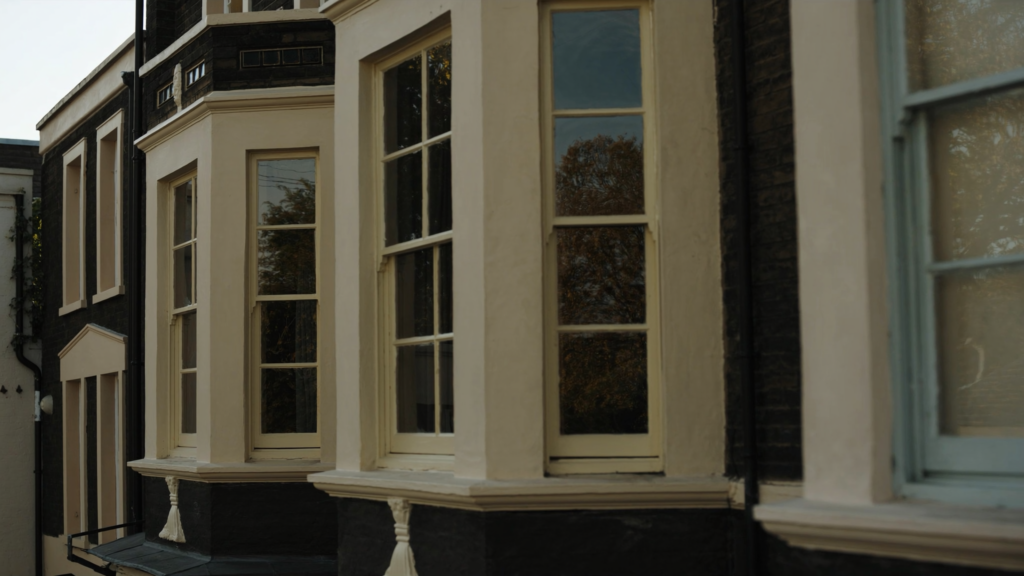
For the older stone terraces, the challenge is almost always the original timber sash-and-case windows. These are deep-set into thick rubble stone walls, and replacing them is more involved than swapping out a standard uPVC frame in a 1970s semi. You’ll need a glazing company comfortable working with masonry reveals, and in many cases specialist staff rather than a general fitting team.
For the semi-detached homes from the 1950s through 1980s, the job is typically more straightforward, standard casement or tilt-and-turn replacements that slot into existing openings. The walls are more predictable, parking access is usually easier, and most frames are already in the standard sizes that manufacturers hold in stock.
What makes Dunbar slightly trickier than a larger town is the logistics. There are no major double glazing showrooms in town itself. Most installers covering Dunbar are based in Haddington (17km away), Musselburgh (34km), or Edinburgh, meaning travel costs and minimum job values can push prices up slightly compared with what you’d pay in a larger urban centre. Scheduling can also take longer, particularly in peak autumn and winter months when demand surges across East Lothian.
One thing in Dunbar’s favour is that most of the town’s residential streets have reasonable vehicle access. Unlike some parts of Edinburgh’s Old Town, there’s usually somewhere for a fitter’s van to park without a special permit, though narrow closes and lanes near the harbour area are the exception.
How Much Double Glazing Costs in Dunbar and the Scotland Area in 2026
Costs vary depending on window style, frame material, glass specification, and how complex the installation is. The table below gives you realistic 2026 figures for a typical Dunbar property. These are installed costs, supply and fit, not materials alone.
| Property Type | Number of Windows | uPVC Casement (standard) | uPVC Sash-Style | Timber or Aluminium |
|---|---|---|---|---|
| Mid-terrace (2-bed) | 5–7 | £3,200 – £4,500 | £4,800 – £6,200 | £6,500 – £9,000 |
| End-terrace (3-bed) | 7–10 | £4,400 – £6,000 | £6,500 – £8,500 | £8,500 – £12,000 |
| Semi-detached (3-bed) | 8–11 | £4,800 – £6,500 | £7,000 – £9,500 | £9,000 – £13,500 |
| Semi-detached (4-bed) | 10–14 | £5,800 – £8,000 | £8,500 – £12,000 | £11,000 – £16,000 |
As a rough comparison, the Scotland-wide average for a 3-bed semi with standard uPVC double glazing sits around £5,200 installed. Dunbar properties tend to come in at the mid-to-upper end of that range, typically 8–12% above central Scotland averages, largely because of the installer travel distance and the prevalence of older, non-standard window openings in the town’s Victorian housing stock.
If your home is in or near a conservation area (which covers parts of Dunbar’s historic core), expect to add £500–£1,500 to the bill for heritage-appropriate frames and any additional planning consultation costs.
Tip: Always get three quotes. Prices across East Lothian can vary by 20–30% for the same job, and a company based in Haddington might quote differently from one coming out of Edinburgh or Berwick-upon-Tweed.
How Dunbar’s Weather and Location Affect Your Double Glazing Choices
This is where Dunbar is genuinely different from many Scottish towns, and it matters more than most people realise when choosing glazing specifications.
The town sits directly exposed to North Sea airflows, particularly from the northeast and east. The Firth of Forth doesn’t offer the same shelter as the deeper sea lochs on the west coast, and easterly winds in winter can be fierce. Dunbar regularly logs more heating degree days annually than towns at equivalent latitudes on the west side of Scotland, the figure runs to over 2,200 heating degree days per year, which is roughly 20–30% above the national average. That means windows are working hard for a long season.
What does this mean practically? You want double glazing with a low U-value, ideally 1.2 W/m²K or below for the whole window unit, not just the glass. Standard budget uPVC units often only hit 1.6, which is still a vast improvement on single glazing, but in a town with Dunbar’s exposure, the extra investment in high-performance glazing pays back faster.
The coastal air also brings accelerated corrosion risk for any metal components. If you’re going for aluminium frames (which look excellent on some of Dunbar’s older properties), insist on powder-coated finishes with a minimum 25-year warranty, and check that any hardware, hinges, handles, locking mechanisms, is specified for coastal environments.
Rainfall in Dunbar averages 700–900mm per year, and with prevailing westerlies and easterly squalls, you’ll want to ensure any new frames come with proper weather sealing rated for wind-driven rain. Ask your installer specifically about the weather performance classification of the units they’re proposing, BS EN 12208 Class 9A or above is what you’re aiming for.
The Products and Options That Actually Perform Well in Dunbar
Given everything above, here’s an honest breakdown of what tends to work well for Dunbar homes specifically, not just what’s popular nationally.
- uPVC with triple glazing, For homes on the coastal and northeastern edges of town, triple glazing (U-value around 0.8 W/m²K) is worth considering despite the higher upfront cost. The extra pane makes a real difference in a house that faces North Sea winds for five or six months of the year. Budget an extra 20–30% over standard double glazing costs.
- Argon-filled double glazing as a minimum, Any double glazing you install should be argon-filled as standard, not just air-filled. The thermal performance difference is meaningful, and reputable installers covering East Lothian will offer this as default.
- Warm-edge spacer bars, These replace the old aluminium spacers that cause cold edges and condensation. In Dunbar’s climate, they reduce heat loss at the perimeter of the glass unit by around 10% compared to standard spacers. Ask specifically for warm-edge or “super spacer” technology.
- Sash-style uPVC for Victorian terraces, If your home is one of the Victorian stone terraces and you want to preserve the character without the maintenance headache of timber, modern uPVC sash windows have improved enormously. They’re not identical to the originals, but the best versions are a good compromise, and far easier to justify under planning where conservation rules apply.
- Timber double glazing for conservation areas, Where East Lothian Council requires like-for-like replacement in conservation areas, engineered timber double-glazed units are often the correct answer. They’re more expensive but they’re durable, authentic-looking, and can be specified with the same high-performance glass as any other unit.
One product to avoid, secondary glazing marketed as equivalent to full replacement. It’s cheaper, yes, but in a town with Dunbar’s wind exposure, the draught performance is significantly worse. It suits listed buildings where you can’t replace the original windows, but for standard properties it’s a compromise that doesn’t fully deliver.
How to Find a Trustworthy Double Glazing Installer Near Dunbar
There are no large double glazing firms with a permanent showroom in Dunbar itself. In practice, your installer will almost certainly be travelling from Haddington, Musselburgh, Edinburgh, or occasionally from the direction of Berwick-upon-Tweed for the larger national firms. That’s completely normal and not a problem, but it means you need to be a bit more selective about who you invite to quote.
Here’s what to look for and ask about before signing anything.
- FENSA registration, In Scotland, installers replacing windows and doors must either be FENSA-registered or notify the local authority (East Lothian Council) and arrange a building warrant. FENSA-registered installers self-certify compliance with building regulations (Scottish Section 6), which is simpler and cheaper. Always ask for the FENSA registration number and verify it at fensa.org.uk.
- TrustMark accreditation, This government-endorsed quality scheme is worth checking independently alongside FENSA. Not every good installer has it, but it adds a layer of consumer protection.
- Manufacturer guarantees in writing, A 10-year guarantee on frames and a 5-year guarantee on sealed units is a reasonable minimum. Some premium manufacturers offer 20 years. Make sure it’s from the manufacturer, not just the installer, so it survives if the company changes hands.
- Experience with stone-built properties, Specifically ask whether they’ve worked on Victorian rubble-stone houses in East Lothian. It’s a different installation context from a cavity-wall semi, and you want someone who knows the difference.
Lead times in East Lothian currently run 4–8 weeks for standard units from quote to installation. Bespoke sizes, common in older Dunbar properties, can push this to 10–12 weeks. Book early if you want installation complete before the worst of the winter.
Red flags to watch for, a quote that’s dramatically lower than others (often means inferior glass units or no frame guarantee), pressure to sign on the day, and any installer who can’t name the glass manufacturer they use.
Grants and Funding That Could Reduce Your Costs in 2026
Dunbar residents have access to a genuinely useful set of funding options in 2026, and the Scottish-specific schemes are often better than what’s available south of the border.
Home Energy Scotland Loan
Home Energy Scotland offers interest-free loans of up to £15,000 for energy efficiency improvements including double glazing. You apply through Energy Saving Trust Scotland, and the process is straightforward. There’s no income threshold, it’s available to all homeowners. Repayment terms are flexible up to 12 years. This is the single most useful funding route for most Dunbar homeowners who don’t qualify for free measures.
Warmer Homes Scotland
If you’re on qualifying benefits (including Pension Credit, Universal Credit, or certain disability benefits) and your home is EPC Band D or below, which applies to the majority of Dunbar properties, you may qualify for free energy efficiency measures through Warmer Homes Scotland. Double glazing can be included as part of a package of improvements. The scheme is administered by Home Energy Scotland; call 0808 808 2282 to check eligibility.
ECO4 (Energy Company Obligation)
ECO4 applies across Scotland alongside the Scottish-specific schemes. It targets low-income and fuel-poor households and is delivered through energy suppliers. Eligibility depends on household income and property EPC rating, Band D or below is the key threshold that many Dunbar homes will meet. Your energy supplier is the first port of call, or you can check through the government’s ECO4 eligibility checker.
Great British Insulation Scheme
The Great British Insulation Scheme closed on 31 March 2026. It funded insulation measures only and never covered windows or glazing. It’s less direct than ECO4 but worth checking if you’re planning multiple improvements at once.
Important note, always apply for funding before signing a contract with an installer. Some schemes require pre-approval, and work started before assessment may not qualify.
Planning Permission and Regulations in Dunbar, What You Actually Need to Know
For most Dunbar homeowners, replacing like-for-like windows does not require planning permission under permitted development rights. However, there are important exceptions you need to check before going ahead.
Dunbar has a designated Conservation Area covering much of its historic core, particularly around the High Street, Castle area, and parts of the harbour. If your property sits within this area, you’re subject to additional controls. Specifically, East Lothian Council’s planning policy requires that replacement windows respect the character of the original building. In practice this usually means timber frames, or very high-quality uPVC sash-style windows that replicate the original profile closely, rather than standard casement units.
You can check whether your property falls within the conservation area using East Lothian Council’s online planning map at eastlothian.gov.uk/planning, it takes about two minutes and could save you a costly mistake.
For listed buildings (and there are several in Dunbar, particularly around the Old Town and harbour area), Listed Building Consent is required for any window alterations. This is a separate process from planning permission and is always required regardless of what changes you’re making. Do not start any work on a listed building without this