Heat pump compared to combi boiler 2026
If you are replacing your home heating system in 2026, the choice between a heat pump and a gas combi boiler is one of the biggest financial decisions you will make. The direct answer is that a heat pump costs roughly three times more to install than a new combi boiler, but its annual running costs can be up to 50% lower.
A heat pump costs £12,000–£16,000 to install, roughly three times more than a £2,500–£4,000 combi boiler, but running costs are 50% lower at £800–£1,000 per year vs £1,600–£2,000. The £7,500 Boiler Upgrade Scheme grant narrows the upfront gap.
- Install a heat pump for £12,000–£16,000 or a combi boiler for £2,500–£4,000.
- Save up to 50% on annual heating bills with a heat pump (Ofgem data).
- Heat pumps last 15–20 years; combi boilers last 10–15 years.
- Boiler Upgrade Scheme offers a £7,500 grant for heat pumps only.
- Check your EPC for insulation recommendations before applying for BUS.
- Heat pump compared to combi boiler 2026
- The Boiler Upgrade Scheme (BUS) offers a £7,500 grant for a heat pump, but not for a combi boiler
- To qualify for a heat pump grant, your home must meet minimum insulation standards first
- Quick numbers, heat pump versus combi boiler side-by-side
- The direct answer to "heat pump vs combi boiler" is that it depends on your home's insulation, your budget for upfront cost, and whether you want lower long-term running costs and carbon emissions
- You must use an MCS-certified installer to qualify for the £7,500 heat pump grant, and TrustMark registration is required for all government-backed schemes
- The grant only applies if you are replacing a fossil-fuel heating system, not an existing heat pump
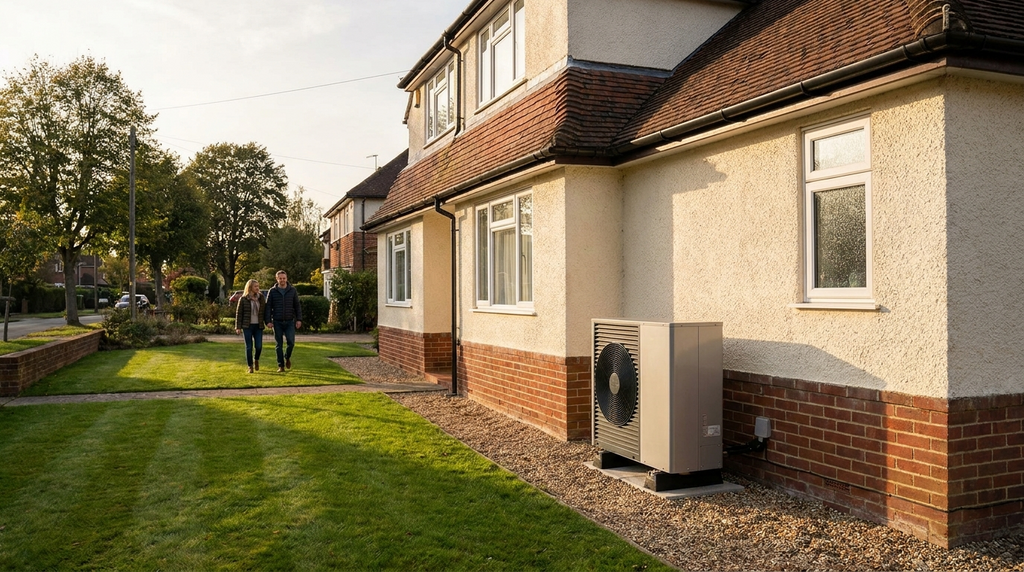
The typical installed price for an air-source heat pump in 2026 is £12,000–£16,000, compared with £2,500–£4,000 for a new combi boiler (Energy Saving Trust, 2026). Annual heating bills for a heat pump in a typical semi-detached home are roughly £800–£1,000, versus £1,600–£2,000 for a gas combi boiler, based on Ofgem price cap rates continuing into 2026 (Ofgem, 2026). The gap in running costs narrows if the heat pump is inefficiently sized or the property lacks adequate insulation (Energy Saving Trust field trial reports, 2026). A heat pump typically lasts 15–20 years, while a combi boiler lasts 10–15 years (Energy Saving Trust product lifespan data, 2026).
The Boiler Upgrade Scheme (BUS) offers a £7,500 grant for a heat pump, but not for a combi boiler
The Boiler Upgrade Scheme provides a flat £7,500 grant for air-source heat pumps installed by an MCS-certified installer from April 2026 (GOV.UK Boiler Upgrade Scheme guidance, 2026). The grant is deducted from the installation cost by the installer, not paid to the homeowner (DESNZ BUS fact sheet, 2026). To qualify, you must own the property and have a valid Energy Performance Certificate (EPC) with no outstanding recommendations for loft or cavity wall insulation (GOV.UK BUS eligibility criteria, 2026). The BUS does not cover the cost of upgrading radiators, pipework, or hot water cylinders, which may be required for a heat pump installation (Energy Saving Trust guidance on heat pump installation, 2026). There is no equivalent grant for replacing a working gas combi boiler (DESNZ domestic heating policy, 2026).
To qualify for a heat pump grant, your home must meet minimum insulation standards first
The BUS requires that your property’s EPC has no outstanding recommendations for loft insulation to at least 270mm or cavity wall insulation (GOV.UK BUS eligibility criteria, 2026). If the EPC shows these insulation measures are missing, you must install them before the BUS application can be completed (DESNZ BUS administrative guidance, 2026). For homes with solid walls, there is no BUS requirement for external wall insulation, but poor thermal performance will reduce heat pump efficiency (Energy Saving Trust technical brief, 2026). The property must also have a floor area of less than 450 square metres to be eligible for the BUS (GOV.UK BUS eligibility criteria, 2026).
Quick numbers, heat pump versus combi boiler side-by-side
| Measure | Air-source heat pump (2026) | Gas combi boiler (2026) |
|---|---|---|
| Installation cost (after BUS grant) | £4,500–£8,500 | £2,500–£4,000 |
| Annual running cost (typical semi-detached) | £800–£1,000 | £1,600–£2,000 |
| Lifespan | 15–20 years | 10–15 years |
| Carbon emissions per year (kgCO2) | 500–800 | 2,500–3,500 |
| Required insulation standard | EPC with no outstanding loft/cavity wall insulation | None |
Source data: Energy Saving Trust, 2026; Ofgem, 2026; GOV.UK, 2026; MCS, 2026.
The direct answer to “heat pump vs combi boiler” is that it depends on your home’s insulation, your budget for upfront cost, and whether you want lower long-term running costs and carbon emissions
A heat pump is better for well-insulated homes where you can afford the higher upfront cost (even after the £7,500 grant) and want lower annual bills and near-zero carbon emissions (DESNZ heat pump strategy, 2026). A combi boiler is the cheaper upfront option and works well in poorly insulated homes, but has higher annual running costs and higher carbon emissions (Energy Saving Trust, 2026). The average heat pump in 2026 has a Seasonal Coefficient of Performance (SCOP) of 3.0–3.5, meaning it produces 3–3.5 kWh of heat per 1 kWh of electricity (MCS database averages, 2026). A modern gas combi boiler has an efficiency of around 90–94%, meaning it wastes 6–10% of the gas it burns (Energy Saving Trust boiler efficiency data, 2026). How to improve home insulation before installing a heat pump
You must use an MCS-certified installer to qualify for the £7,500 heat pump grant, and TrustMark registration is required for all government-backed schemes
The BUS requires the heat pump installer to be registered with the Microgeneration Certification Scheme (MCS) (GOV.UK BUS eligibility criteria, 2026). TrustMark registration is also mandatory for all installers under the BUS, as it is a government-endorsed quality mark (DESNZ BUS installer requirements, 2026). To check an installer, use the MCS online installer database at mcs.org.uk and the TrustMark website at trustmark.org.uk (MCS official registry, 2026; TrustMark official registry, 2026). For a gas combi boiler, the installer must be Gas Safe Registered, which you can check via the Gas Safe Register website at gassaferegister.co.uk (Gas Safe Register official site, 2026). For a heat pump, there is no requirement for the installer to be Gas Safe registered, but electrical work must comply with Part P of the Building Regulations and be certified by a NICEIC- or NAPIT-registered electrician if needed (GOV.UK Building Regulations Part P guidance, 2026). What to ask a heat pump installer before signing a contract
The grant only applies if you are replacing a fossil-fuel heating system, not an existing heat pump
The BUS is available for replacing an existing gas, oil, LPG, or electric heating system (including storage heaters or electric boilers) with a heat pump (GOV.UK BUS eligibility criteria, 2026). It does not cover replacing one heat pump with another (DESNZ BUS guidance, 2026). The system being replaced must be a whole-house heating system; individual room heaters (for example, plug-in storage heaters) are not eligible (DESNZ BUS eligibility FAQ, 2026). You must not have previously received a BUS grant for the same property (GOV.UK BUS application process, 2026).
Frequently Asked Questions
Yes, a heat pump typically costs £800–£1,000 annually to run, compared to £1,600–£2,000 for a gas combi boiler, based on Ofgem price cap rates in 2026. Savings are up to 50% but depend on your home's insulation and heat pump sizing.
An air-source heat pump installation costs £12,000–£16,000, while a new combi boiler costs £2,500–£4,000, according to the Energy Saving Trust (2026). The Boiler Upgrade Scheme reduces the heat pump cost by £7,500.
Yes, the Boiler Upgrade Scheme offers a £7,500 grant for air-source heat pumps installed by an MCS-certified installer from April 2026 (GOV.UK). No equivalent grant exists for replacing a working gas combi boiler.
A heat pump typically lasts 15–20 years, while a combi boiler lasts 10–15 years, based on Energy Saving Trust product lifespan data (2026). Heat pumps require less frequent replacement.
Yes, you may need to upgrade radiators, pipework, or install a hot water cylinder for a heat pump, according to Energy Saving Trust guidance (2026). The Boiler Upgrade Scheme does not cover these costs.