Why Aberdeen Homeowners Are Turning to Solar Right Now, and It’s Not the Reason You’d Expect
Here’s something that surprises a lot of people: Aberdeen actually has a strong case for solar panels, despite sitting further north than Moscow. Yes, you read that right. While the Granite City’s reputation for grey skies and bitter North Sea winds might make solar seem like a stretch, the reality is more nuanced, and more promising, than the weather forecast suggests.
The real driver right now is energy cost anxiety. Aberdeen households are paying significantly more to heat their homes than the UK average, with gas usage running around 14,000 kWh per year and heating demand running 20–30% above the national norm. Combine that with Scotland’s ambitious 2045 decarbonisation targets under the Heat in Buildings Strategy, and you’ve got a city full of homeowners who genuinely need to act, not just for the planet, but for their bank accounts.
Aberdeen City Council has also been quietly building momentum on retrofit programmes, and the availability of interest-free loans through Home Energy Scotland makes 2026 a particularly smart time to move. Solar panels are increasingly being installed alongside heat pumps as part of whole-home upgrades, something we’re seeing a lot of in areas like Cults, Bieldside, and the newer estates around Bridge of Don.
What Installing Solar Panels Actually Looks Like on a Typical Aberdeen Home
Aberdeen’s housing stock is fascinatingly varied. You’ve got solid granite terraces in areas like Torry and Rosemount, beautiful, but with roofs that have their own quirks. Then there are the 1930s and 1950s semi-detached houses that dominate large chunks of Mastrick, Kincorth, and Northfield. And increasingly, modern new-builds on the fringes of the city around Westhill and Portlethen.
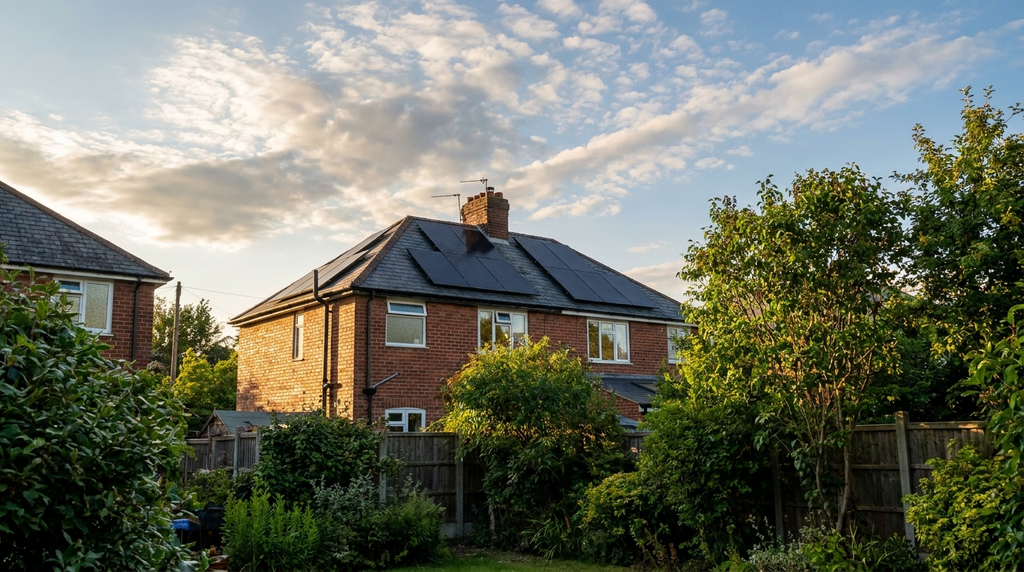
For the semi-detached homes that make up much of Aberdeen’s suburban housing, the good news is that roof orientation is often workable. South or southwest-facing rear roofs are common on many of these estates, which is exactly what you want. The challenge is roof pitch, older Aberdeen homes sometimes have steeper pitches built to shed the considerable snow load this city sees in winter, and that actually works well for solar panels angled toward lower winter sun.
Flats are trickier. If you’re in a tenement conversion in areas like the West End or Ferryhill, you’ll need agreement from all co-owners in the title to install on a shared roof. This is a legal requirement under Scots property law, not just a courtesy, and it can slow things down considerably. Top-floor flat owners have the most obvious route forward, but even then, the process is more involved than for a detached house.
Granite construction itself isn’t a problem for solar, panels are mounted on roof tiles or battens rather than the walls, but older granite-built homes sometimes have heavier, more complex roof structures that take slightly longer to survey and install on.
How Much Solar Panels Cost in Aberdeen in 2026, Honest Numbers, Not Ballpark Guesses
Labour costs in Aberdeen run higher than the Scotland average, partly because of the city’s historically oil-industry-driven wages, and partly because scaffolding hire here is more expensive than in smaller towns. Expect to pay around 10–15% more than you’d pay in Inverurie or Stonehaven for the same system.
| System Size | Property Type | Aberdeen Cost | Scotland Average | Estimated Annual Output |
|---|---|---|---|---|
| 3 kWp (6 panels) | Small flat or terrace | £6,200 – £7,400 | £5,500 – £6,500 | 2,100 – 2,400 kWh |
| 4 kWp (8 panels) | Semi-detached | £7,800 – £9,200 | £7,000 – £8,200 | 2,800 – 3,200 kWh |
| 6 kWp (12 panels) | Larger semi or detached | £10,500 – £12,500 | £9,200 – £11,000 | 4,200 – 4,800 kWh |
| 4 kWp + battery (9.5 kWh) | Semi-detached | £12,500 – £15,000 | £11,000 – £13,500 | 2,800 – 3,200 kWh + storage |
| 6 kWp + battery (9.5 kWh) | Larger home | £15,500 – £18,500 | £14,000 – £16,500 | 4,200 – 4,800 kWh + storage |
These figures include installation, inverter, mounting hardware, and connection to your consumer unit. They do not include DNO (Distribution Network Operator) application fees if required, which typically add £100–£300. Battery storage costs have come down considerably, a 9.5 kWh battery now adds roughly £4,500–£5,500 to a system, compared to nearly double that a few years ago.
If you’re in Peterhead or Inverurie and comparing quotes, you’ll likely find local installers based in those towns charge slightly less for labour, but Aberdeen-based companies frequently cover those areas too, and often without travel surcharges if they’re already scheduling runs that direction.
Aberdeen’s Climate and What It Really Means for Solar Panel Performance
Let’s be completely straight with you. Aberdeen gets between 700 and 900 hours of sunshine per year. That compares to around 1,400–1,600 hours in the south of England. So yes, your system will generate less than one in Surrey would. But that’s already baked into the output figures in the table above, and it doesn’t mean solar is a bad investment here.
The key insight is long summer days. Aberdeen is at roughly 57° north latitude, which means summer evenings stay light until 10pm and beyond. In June and July, your panels will be generating usable electricity for 16–17 hours a day. This dramatically compensates for the darker winters, and it means battery storage becomes especially valuable here, catching that surplus evening generation and using it overnight.
Winter is the honest weak point. October through February, you’ll see relatively modest generation, and some weeks in January you’ll barely notice your panels are running. Planning your finances around this seasonal variation is important, don’t assume consistent monthly savings throughout the year.
Snow loading is a real consideration that most national guides ignore. Aberdeen roofs can carry significant snow weight in a hard winter, and your installer should confirm that your roof structure can handle both the panel weight (roughly 12–15 kg per panel) and potential snow accumulation on top. Most modern roofs can handle this without reinforcement, but granite homes built before 1920 should always have a structural survey as part of the installation process.
Wind is less of a concern than people assume. While Aberdeen can be windy, especially in coastal areas like Footdee or on exposed hillside estates, modern solar mounting systems are engineered for far higher wind speeds than we typically see here. A properly installed system from a certified installer will be rated for the conditions.
The Specific Products and Setups That Perform Best on Aberdeen Homes
Given Aberdeen’s lower irradiance levels, choosing the right panel technology genuinely matters more here than it would in southern England. Here’s what we’d actually recommend for this specific climate.
- Monocrystalline PERC or TOPCon panels, These outperform standard polycrystalline panels in low-light and diffuse light conditions, which is exactly what Aberdeen’s cloudy days deliver. Brands like Longi Hi-MO, Jinko Tiger Neo, and SunPower Maxeon are worth asking about. Efficiency ratings above 20% are the benchmark to aim for.
- Microinverters or power optimisers, Aberdeen homes, particularly in areas with trees nearby (think Mannofield, Cults, Bieldside) or chimney shading, benefit enormously from panel-level power optimisation. If one panel is shaded, it won’t drag down the whole system. SolarEdge and Enphase systems are particularly popular with experienced local installers for this reason.
- Battery storage, Given Aberdeen’s long summer evenings and the fact that your electricity usage of around 3,400 kWh per year means you can’t self-consume all summer generation in real-time, a battery is strongly worth considering. A 9.5 kWh unit (such as a Tesla Powerwall 3, GivEnergy, or SolarEdge Energy Hub) will capture evening surplus and reduce your grid dependency significantly.
- Diverters for hot water, An immersion diverter (like a myenergi Eddi) costs around £400–£600 fitted and redirects surplus solar electricity to your hot water tank. For Aberdeen homes still on gas hot water, this is a brilliant low-cost add-on that makes a real dent in bills without needing a full battery system.
One system to be cautious about for Aberdeen specifically, avoid older string inverter setups without any shading mitigation if your roof has any partial shading at all. Aberdeen’s lower sun angle in winter means shading from neighbouring rooflines or chimneys affects more of the roof than it would further south.
How to Find a Reliable Solar Installer in Aberdeen Without Getting Burned
Aberdeen has multiple solar installers based in the city, plus a number of national companies that send teams up from central Scotland. Both can be fine, but there are specific things to check that matter more here than elsewhere.
MCS certification is non-negotiable. The Microgeneration Certification Scheme is what makes you eligible for the Smart Export Guarantee (SEG) payments and any applicable grants. An uncertified installer might be cheaper, but you’ll lose access to export income and funding. Check the MCS installer database at mcscertified.com before committing to anyone.
Ask these questions before signing anything:
- Have you installed on granite-built or pre-1920 properties in Aberdeen before, and what’s your process for assessing the roof structure?
- Are you familiar with Aberdeen City Council’s planning requirements for conservation areas?
- Do you use microinverters or power optimisers, and what’s your reasoning for the system design you’re proposing?
- Who handles the DNO application, and is that included in your quote?
- What warranty do you offer on workmanship, and who would I contact if there’s a problem in five years’ time?
Lead times in Aberdeen are currently running at around 6–10 weeks from survey to installation for a standard residential job. Companies that cover Aberdeen also frequently serve Inverurie, Peterhead, Ellon, and Banchory, so if a local firm has a good reputation in those towns, that’s a positive sign for their reliability in the city too.
Red flags to watch for: pressure to sign on the day, no physical address in Scotland, quotes that seem substantially cheaper than the table above with no explanation, and anyone who can’t provide recent local references.
Grants and Funding Available to Aberdeen Homeowners in 2026
Scotland has arguably the best residential energy grant landscape in the UK right now, and Aberdeen residents should be taking full advantage. Here’s what’s available.
Home Energy Scotland Loan
This is the big one for most Aberdeen homeowners. Home Energy Scotland offers interest-free loans of up to £15,000 for renewable energy and energy efficiency measures, including solar panels and battery storage. There’s no income threshold, this is available to all homeowner-occupiers in Scotland. You apply through Home Energy Scotland (0808 808 2282), get a free home assessment, and can often have a decision within a few weeks.
Warmer Homes Scotland
If your household income is below a qualifying threshold or you receive certain benefits, Warmer Homes Scotland can provide free measures. Solar panels aren’t always the headline measure here, it’s more focused on insulation and heating, but if solar forms part of a whole-home package, it can sometimes be included. Worth a call to find out if you qualify.
Energy Company Obligation (ECO4)
ECO4 applies across Scotland as well as England and Wales. Larger energy companies are obligated to fund energy efficiency improvements in lower-income households. If you’re on certain benefits or your home is in a lower Council Tax band with a poor EPC rating, you may qualify for free or heavily subsidised solar as part of an ECO4 package. Your energy supplier’s website will have a checker tool.
Smart Export Guarantee (SEG)
This isn’t a grant but it’s money in your pocket, and it’s ongoing. Once your MCS-certified system is installed, you register with an SEG-licensed energy supplier and get paid for every unit of excess electricity you export to the grid. Rates currently range from around 4p to 15p per kWh depending on the tariff. Octopus Energy’s Flux tariff and similar time-of-use export tariffs can substantially improve your return if you also have battery storage.
Aberdeen City Council Schemes
Aberdeen City Council has been running area-based schemes targeting specific postcodes for energy improvements. These change periodically, so it’s worth checking the Council’s website directly or calling their energy advice line. Areas with higher concentrations of fuel-poor households, including parts of Torry and some areas north of the city, have historically received priority funding.
Planning Permission for Solar Panels in Aberdeen, What the Rules Actually Say
For most Aberdeen homeowners, solar panels fall under permitted development rights in Scotland, which means you don’t need planning permission. However, there are important exceptions that are particularly relevant in a city like Aberdeen.
You’ll need planning permission if:
- Your property is a listed building, Aberdeen has a significant number of these, particularly granite-built Victorian and Edwardian properties in the West End, Crown Street area, and around the city centre. Contact Aberdeen City Council’s planning department before doing anything.
- Your home is in a Conservation Area, Aberdeen has several, including parts of Rubislaw, Ferryhill, and the Cathedral Quarter. In these areas, panels visible from a public road typically require consent.
- The panels would protrude more than 200mm from the roof surface, standard flush-mounted systems won’t hit this limit, but some older-style installations might.
- You live in a flat with shared ownership of the roof, you’ll need agreement from co-owners and potentially a factoring company before installation, regardless of planning.
Even where permitted development applies, you should notify your local planning authority and get written confirmation. Aberdeen City Council’s planning portal allows you to submit a prior approval notification online. A good installer will handle this paperwork as part of their service, if they don’t mention it at all, that’s a minor yellow flag worth raising.
Building standards approval under Scottish Section 6 energy regulations may also be required for the electrical installation, your installer’s MCS certification covers much of this, but confirm with them explicitly.