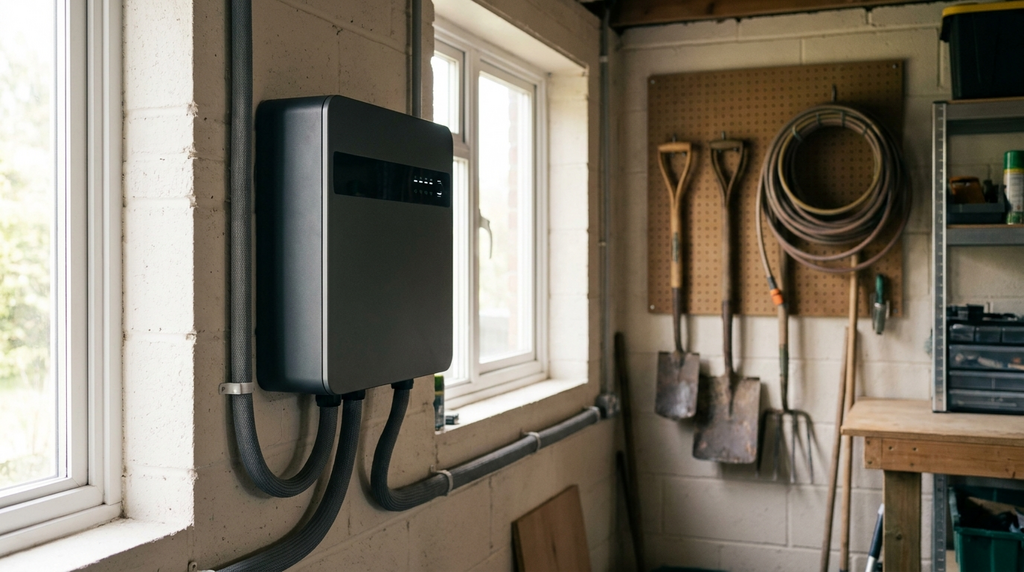
Home battery sizing is the place where solar buyers most often overpay. A 13 kWh battery costs around twice what a 5 kWh battery costs, but only adds 30 to 50% more annual benefit for most households. Honest sizing means buying for your actual daily evening load, not the marketing spec.
How much electricity you actually use overnight
The battery’s job is to store cheap or self-generated electricity during the day and release it during evening peak hours when grid prices and household demand are highest. The right size is determined by how much you use between sunset and sunrise, not by panel count.
| Household profile | Annual usage | Daily total | Evening-to-morning (60% of daily) |
|---|---|---|---|
| Couple, no kids, 2-bed flat | 2,200 kWh | 6 kWh | 3.6 kWh |
| 3-bed semi, gas heating, no EV | 3,500 kWh | 9.6 kWh | 5.8 kWh |
| 4-bed detached, gas heating, one EV | 5,500 kWh | 15 kWh | 9 kWh |
| 4-bed detached, heat pump, one EV | 8,500 kWh | 23 kWh | 14 kWh |
For the first row, a 5 kWh battery is sufficient. For the third row, 10 kWh starts to make sense. For the last row, the heat pump load skews the picture, battery is less effective for heat pump operation than for EV charging because heat demand is continuous.
Sizing for solar self-consumption
The other anchor for sizing is how much surplus your solar panels produce. A 4 kW solar system in southern England generates around 3,800 kWh a year. Roughly 60% of that is surplus to immediate consumption (around 2,280 kWh). On a summer day the surplus might be 12 to 15 kWh; on a winter day, 1 to 2 kWh.
A 5 kWh battery captures around 80% of the financial value of available solar surplus across the year. Doubling to 10 kWh captures around 92%. Doubling again to 20 kWh only captures around 97%. The diminishing returns are real, you are paying more for less incremental benefit.
Smart-tariff arbitrage changes the maths
On a flat tariff, a battery only saves you money by storing solar. On a time-of-use tariff like Cosy Octopus, it does double duty: charge from cheap-window grid electricity (around 7p per kWh) and discharge during evening peak (around 35p per kWh). That arbitrage adds £200 to £400 a year on top of solar savings.
Battery payback for a household on Cosy Octopus:
| Battery | Cost | Annual benefit | Payback |
|---|---|---|---|
| 5 kWh GivEnergy AC | £4,500 | £550 | 8 years |
| 9.5 kWh GivEnergy AC | £5,800 | £720 | 8 years |
| 13.5 kWh Tesla Powerwall 3 | £8,500 | £830 | 10 years |
| 20 kWh stack | £11,500 | £910 | 13 years |
The 5 kWh and 9.5 kWh tiers offer the best payback per pound spent. The 13.5 kWh and beyond are about resilience and EV charging convenience, not pure economics.
Warranties and lifetime
Mainstream UK home batteries carry 10-year warranties at 70-80% retained capacity. Daily cycling at 80% depth-of-discharge sees roughly 4,000 cycles before significant degradation, over ten years that is one cycle per day, broadly matching usage. Three brand notes:
- Tesla Powerwall 3, 13.5 kWh, integrated inverter, ten-year warranty. Premium price but tight integration with Tesla EVs.
- GivEnergy, modular AC-coupled, 5 kWh and 9.5 kWh units. UK-designed, strong Octopus compatibility. Best value.
- Sigenergy / SolarEdge / Sunsynk, newer entrants, competitive on price, less long-term field data.
Installation cost notes
Battery installation cost should be £400 to £800 on top of the battery hardware price, including labour, electrical work and certification. Anything above £1,000 in installation alone is excessive unless your situation is genuinely complex (long cable runs, three-phase supply, multiple-battery stack).
0% VAT applies to battery installs until 31 March 2027, whether or not solar is being installed alongside.
Sources
- Solar batteries buying advice, Which?
- Solar batteries, Energy Saving Trust
- Smart Export Guarantee, Ofgem
Frequently Asked Questions
For a typical three-bedroom home with gas heating, 5 kWh is the standard pairing for a 4 kW solar system. If you also have an EV, 9.5 kWh delivers a better balance.
No. Outgoing Octopus is an export-only tariff for any solar household, with or without a battery. A battery boosts the maths by letting you discharge during peak hours.
You can add a battery later. AC-coupled batteries retrofit easily without changing the solar inverter. 0% VAT applies to retrofit batteries until March 2027.
Only if it has Emergency Power Supply or islanding capability and is installed with the right protection equipment. Many mainstream batteries do not have this by default.