Yes, you can claim tax relief on solar panels through the Property Income Allowance or as a capital allowance, but it depends on whether the panels are for your own home or a rental property (GOV.UK, 2026). For homeowners, there is no direct income tax deduction for installation costs.
The key variable is property type. If you install solar panels on your own home, the costs are not deductible against your personal income tax. However, if you are a landlord and the panels are on a rental property, you may claim the cost as a capital allowance or a repair expense. The distinction hinges on whether the installation is a capital improvement (new asset) or a repair (replacing an existing system).
Homeowners cannot deduct installation costs
If you live in the property, solar panel installation costs are not a tax-deductible expense. HMRC treats the panels as a capital improvement to your home, not a repair or maintenance cost. This means you cannot offset the £5,000 to £8,000 typical cost of a 4kWp system against your income tax (Energy Saving Trust, 2026). The only tax relief for homeowners comes from the Smart Export Guarantee (SEG) payments, which are taxable as income if you earn above the £1,000 trading allowance.
Landlords can claim capital allowances
Landlords who install solar panels on a rental property can claim the cost as a capital allowance under the Annual Investment Allowance (AIA). The AIA allows 100% relief on qualifying plant and machinery costs up to £1 million in 2026 (GOV.UK, 2026). Solar panels qualify as plant and machinery because they generate energy for the property. You must reduce the claim by any private use if the panels also serve your own home. Claim the allowance in your self-assessment tax return for the year of installation.
SEG payments are taxable income
Any income you receive from exporting surplus solar electricity to the grid under the Smart Export Guarantee (SEG) is taxable. HMRC treats SEG payments as miscellaneous income. If your total SEG income exceeds £1,000 in a tax year, you must declare it on a self-assessment tax return (GOV.UK, 2026). Below £1,000, the trading allowance lets you ignore it. For landlords, SEG income is part of the property business profits and is taxed at your marginal rate. No VAT is due on SEG payments as they are exempt from VAT.
A worked example
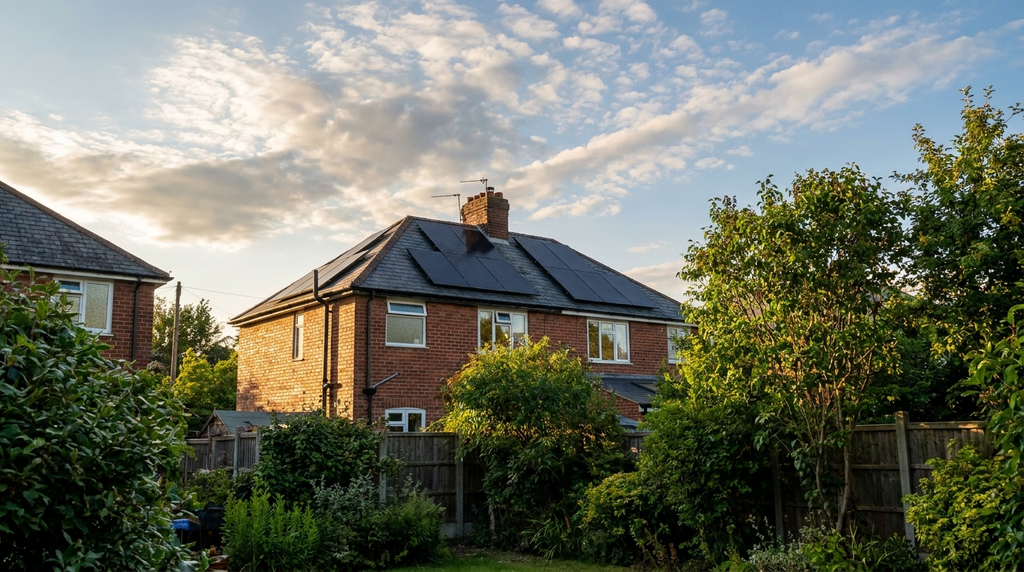
A semi-detached 1930s home in Manchester installing a 4kWp solar panel system would typically pay around £7,000 after the 0% VAT saving, with a payback period of roughly 12 years based on Energy Saving Trust estimates. The homeowner receives Smart Export Guarantee payments of roughly £120 per year for selling surplus electricity back to the grid, plus saves approximately £350 annually on their electricity bill by using the generated power directly. Over 25 years, the total benefit from bill savings and SEG income reaches roughly £11,750, meaning the system pays for itself and then generates clear profit for over a decade. The 0% VAT on solar installations applies until March 2027. That makes this an attractive time to install, though no income tax deduction is available for the homeowner. The Energy Saving Trust confirms these figures vary by location and roof orientation, but the principle of long-term savings remains consistent across most UK homes.
| Item | Figure |
|---|---|
| Upfront cost after grants | £7,000 |
| Yearly savings | £470 |
| Payback period | 12 years |
| 25-year lifetime savings | £11,750 |
What homeowners often get wrong
The most common mistake homeowners make is assuming they can claim the installation cost against their income tax, which HMRC does not allow. Here are three frequent errors that lead to wasted time or missed opportunities.
- Believing solar panels are a repair expense Many homeowners think installation counts as a repair or maintenance cost, which is deductible. HMRC classifies it as a capital improvement, meaning no tax relief is available for your own home, potentially costing you a rejected claim and wasted effort.
- Forgetting SEG payments are taxable over £1,000 Homeowners often overlook that Smart Export Guarantee income above the £1,000 trading allowance must be declared to HMRC. Failing to report it can lead to a fine from HMRC of up to 30% of the unpaid tax, plus interest.
- Assuming grants and tax relief are the same thing Some homeowners confuse the £7,500 BUS grant with a tax deduction. The grant reduces upfront costs directly, while tax relief is a separate benefit that does not apply to owner-occupied homes, so mixing them up can cause confusion about your true net cost.
Quick reference
- Homeowners cannot claim solar panel installation costs against income tax under any circumstances.
- Landlords can claim 100% capital allowances on solar panels for rental properties under the Annual Investment Allowance.
- Smart Export Guarantee payments exceeding £1,000 per year are taxable as income and must be declared to HMRC.
- The typical 4kWp system costs £5,000 to £8,000 after 0% VAT, with payback in 10 to 15 years.
- Applying for the wrong tax relief can result in a rejected claim and potential HMRC penalties for incorrect returns.
Frequently Asked Questions
No, homeowners cannot claim solar panel installation costs on their tax return. HMRC treats the installation as a capital improvement, not a deductible expense (GOV.UK, 2026).
Yes, landlords can claim tax relief on solar panels as a capital allowance under the Annual Investment Allowance. The AIA offers 100% relief on qualifying costs up to £1 million (GOV.UK, 2026).
Yes, SEG payments are taxable as income if you earn over £1,000 per year. You can use the £1,000 trading allowance to offset this (Energy Saving Trust, 2026).