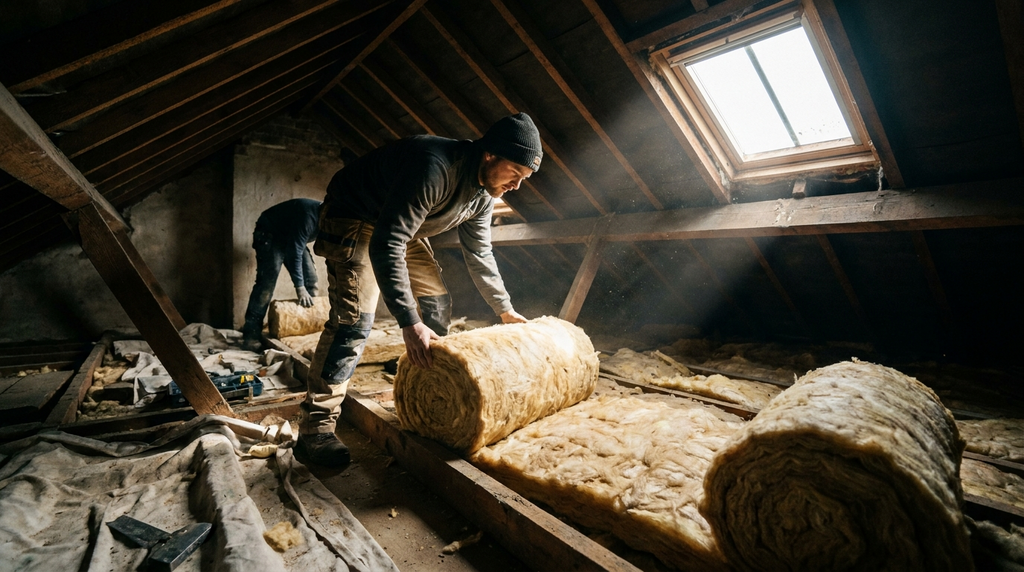
On a suspended timber floor, thick underlay alone can save roughly 10–15% of heat loss, but it is not a substitute for 100mm mineral wool between the joists
If you are considering upgrading your floor covering, you may wonder whether a thicker underlay will meaningfully reduce your heating bills. The short answer is that it helps, but only to a limited degree.
The Energy Saving Trust (EST) estimates that upgrading from a standard 8mm carpet underlay to a 12mm or thicker foam or rubber version can cut heat loss through a suspended timber floor by roughly 10–15% (Energy Saving Trust, 2026). To put that in context, heat loss through a suspended timber floor typically accounts for 15–20% of a home’s total heat loss (DESNZ, “Floor insulation in UK homes: a review of retrofit standards”, 2026). So a 10–15% reduction on that fraction translates to a modest overall saving of roughly 1.5–3% of your total heating energy.
The reason thick underlay alone is limited is that it only addresses the surface layer. The majority of heat escapes through the air gap and floorboards above. The EST states that for a significant reduction in U-value, from roughly 0.5 W/m²K to 0.2 W/m²K, you need insulation between the joists (Energy Saving Trust, 2026). Thick underlay on its own cannot bridge that gap.
Quick numbers U-values, cost, and heat-loss reduction for underlay vs. full floor insulation
The table below compares four common floor insulation scenarios. Figures are based on DESNZ and EST data for a typical UK home.
| Scenario | U-value achieved (W/m²K) | Typical cost per m² (materials) | Heat-loss reduction vs. uninsulated floor | Typical payback period (years) |
|---|---|---|---|---|
| Standard 8mm underlay on concrete slab | 0.85–1.0 | £3–£5 | 5–10% | Not applicable (negligible saving) |
| 12mm thick foam/rubber underlay on suspended floor | 0.45–0.55 | £5–£10 | 10–15% | 15–25 years |
| 100mm mineral wool between joists plus 8mm underlay | 0.20–0.25 | £15–£25 | 60–70% | 5–10 years |
| 150mm PIR board on concrete slab plus 8mm underlay | 0.15–0.20 | £20–£35 | 70–80% | 4–8 years |
Sources: Energy Saving Trust, 2026; DESNZ, “Floor insulation in UK homes”, 2026; MCS register, typical installation costs, 2026.
Thick underlay can reduce draughts and improve comfort, but it does not meet Building Regulations for a new floor
Building Regulations Approved Document L (2026 edition) requires a U-value of 0.25 W/m²K or lower for a new or replacement floor (GOV.UK, “Approved Document L”, 2026). A 12mm foam underlay on a suspended timber floor typically achieves a U-value of around 0.45–0.55 W/m²K (DESNZ, “Floor insulation performance data”, 2026). That is roughly double the permitted maximum.
The EST confirms that underlay alone cannot meet this standard, even on a concrete slab (Energy Saving Trust, 2026). For retrofit (existing floor), there is no legal minimum U-value, but the EST recommends aiming for 0.25 W/m²K to qualify for any future grant.
The direct answer underlay is floor insulation only in the loosest sense, it is a thermal layer, not a primary insulator
Thick underlay adds a small amount of thermal resistance to a floor, reducing heat loss by roughly 10–15%, but it is not a substitute for 100mm–150mm of dedicated floor insulation. For a significant improvement, you need insulation between the joists (suspended floors) or on top of the concrete slab (solid floors).
The EST defines “floor insulation” as material with a thermal conductivity of 0.04 W/mK or lower installed to a thickness that achieves a U-value of 0.25 W/m²K or better (Energy Saving Trust, 2026). Thick underlay (e.g., 12mm foam) has a thermal conductivity of around 0.045 W/mK, but its thinness means it provides only about 0.27 m²K/W of thermal resistance, far below the 2.5 m²K/W needed for a 0.25 U-value (DESNZ, “Floor insulation performance data”, 2026).
For a suspended timber floor, the best approach is to combine thick underlay with 100mm mineral wool between joists
The EST recommends 100mm of mineral wool (conductivity 0.04 W/mK) between joists, plus a vapour-control layer, before laying floorboards and underlay (Energy Saving Trust, 2026). This combination achieves a U-value of approximately 0.2–0.25 W/m²K, which meets Building Regulations for a new floor. Thick underlay on top adds a small extra thermal resistance (about 0.27 m²K/W) and improves acoustic performance.
Cost: mineral wool between joists costs roughly £15–£25 per m² (materials), plus labour; thick underlay costs £5–£10 per m² (MCS register, typical costs, 2026).
For a solid concrete floor, thick underlay is a minor upgrade, the main insulation must be PIR board on top of the slab
On a solid concrete floor, the standard retrofit is 150mm of PIR (polyisocyanurate) board on top of the slab, covered with a screed or chipboard, then underlay and flooring. Thick underlay (12mm foam) on its own adds negligible thermal resistance compared to the PIR board.
The EST states that for a solid floor, the insulation layer must be at least 100mm of PIR or 150mm of mineral wool to achieve the 0.25 U-value target (Energy Saving Trust, 2026). Cost: PIR board costs £20–£35 per m²; thick underlay adds £5–£10 per m² but does not replace the PIR.
The Great British Insulation Scheme closed on 31 March 2026. It funded insulation measures only and never covered windows or glazing.
The Great British Insulation Scheme closed on 31 March 2026. It funded insulation measures only and never covered windows or glazing. Thick underlay alone fails this threshold, so it cannot be funded under the scheme.
The scheme covers mineral wool between joists (suspended floors) or PIR board on solid floors, but only when installed by an MCS-certified or TrustMark-registered installer (MCS register, 2026).
How to verify an installer for floor insulation MCS, TrustMark, and Gas Safe are the relevant certifications
For floor insulation (mineral wool or PIR), the installer must be MCS-certified for insulation (MCS 023 standard) or registered with TrustMark for the relevant work type (MCS register, 2026; TrustMark website, 2026). For gas-fired underfloor heating (if combined with insulation), the installer must be Gas Safe registered (Gas Safe Register, 2026).
The EST advises homeowners to ask for a written quote that specifies the U-value target and the insulation thickness (Energy Saving Trust, 2026). Check the MCS register or TrustMark before hiring.