Why Hammersmith Homeowners Are Looking at Double Glazing Right Now
If you live in Hammersmith, you already know the noise. The A4 thundering through towards the M4, the District and Piccadilly lines rattling beneath your feet, and the constant hum of one of London’s busiest riverside communities. For thousands of residents here, double glazing provides warmth and makes it possible to hear yourself think.
But there’s a bigger picture too. With the average Hammersmith home sitting on EPC Band D, there’s real room to improve energy performance and cut bills. Energy prices have stabilised somewhat in 2026, but they’re nowhere near the comfortable lows of a decade ago, and households with draughty Victorian sashes or single-glazed 1960s windows are still haemorrhaging heat every winter.
There’s also the London-specific push around sustainability. The Greater London Authority has been actively encouraging borough-level retrofit through its published retrofit guides, and the London Borough of Hammersmith and Fulham has its own sustainability commitments baked into local planning policy. That means more residents are getting proactive, and installers in this area are genuinely busy.
What Double Glazing Actually Involves for a Typical Hammersmith Home
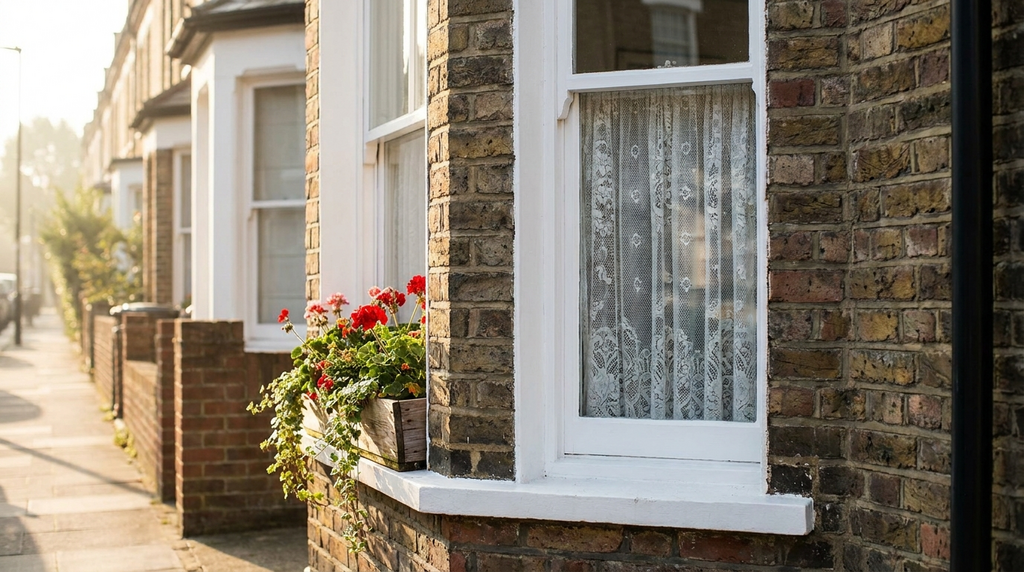
The vast majority of properties in Hammersmith are flats or terraced houses, and a huge proportion of those were built between 1870 and 1930. That Victorian and Edwardian housing stock is beautiful, but it comes with some very specific double glazing challenges.
Those chunky timber sash windows, the tall, elegant ones you see across Brackenbury Village, Ravenscourt Park, and the streets around Brook Green, are not straightforward to replace. The original frames can be warped, the reveals are often non-standard, and in conservation areas (more on that below), you may be restricted in what you can install. Slim-profile uPVC or timber-effect double glazed sashes exist specifically for this market, but they cost more and take longer to manufacture.
For purpose-built flats, the red-brick mansion blocks around King Street and the post-war estates closer to White City border, the challenge is often the opposite. Leasehold complications mean you’ll likely need freeholder or management company permission before any glazing work starts. Get that in writing before you book an installer.
- Victorian terraces, expect non-standard window sizes, timber frames, possible conservation area constraints, and higher installation complexity
- Edwardian semis and terraces, similar issues but often slightly larger windows; bay windows add cost
- 1930s-1960s homes, often have standard metal or early uPVC frames that are straightforward to replace
- Mansion block flats, leasehold permissions essential; communal areas may have shared glazing decisions
- Post-war council and housing association stock, may already have double glazing; focus on upgrading to modern A-rated units
Access is another Hammersmith-specific issue. Many streets here are narrow, parking is controlled, and getting a van, let alone a scaffold tower, to the front of a terraced house on a road like Weltje Road or Hammersmith Grove can be genuinely complicated. That adds time and sometimes cost to installations that would be simple in a town with a driveway.
How Much Double Glazing Costs in Hammersmith and the London Area in 2026
Let’s be straight with you, double glazing in Hammersmith costs more than the national average. Labour in London runs 15–25% above the rest of England, and that feeds directly into your quote. Add in parking permits for installers, congestion zone charges on some routes, and the complexity of older properties, and you’re looking at a meaningful premium over what the same job might cost in, say, Swindon or Sheffield.
Even so, you’re not paying London prices for everything. Many installers serving Hammersmith are also covering Chiswick, Kensington, Wandsworth, and Ealing in the same week, which creates genuine competition and keeps quotes honest. Get at least three.
| Window Type | Number of Windows | Hammersmith Estimated Cost | UK National Average |
|---|---|---|---|
| Standard uPVC casement (white) | 4–5 (typical flat) | £2,800 – £3,800 | £2,200 – £3,000 |
| Standard uPVC casement (white) | 8–10 (terraced house) | £4,800 – £6,500 | £3,800 – £5,200 |
| Timber sash double glazed (Victorian-style) | 6–8 | £7,500 – £12,000 | £6,000 – £9,500 |
| uPVC sash (slim-profile) | 6–8 | £5,500 – £8,000 | £4,500 – £6,500 |
| Aluminium double glazed (contemporary) | 8–10 | £8,000 – £13,000 | £6,500 – £10,500 |
| Full house replacement (inc. front door) | Full terrace | £7,000 – £14,000 | £5,500 – £11,000 |
Insider tip, if you live on a controlled parking zone street, check whether your installer can get a temporary dispensation permit from the London Borough of Hammersmith and Fulham. Good local installers know this process; the ones who don’t might quote you a job and then hit you with unexpected delay charges.
How Hammersmith’s Weather and Location Affect Your Double Glazing Choices
Hammersmith sits in the Thames Valley, which creates its own microclimate. Winters here are genuinely mild by UK standards, you’re looking at 1,200–1,500 heating degree days annually, which is at the lower end even for southern England. But don’t let that lull you into thinking thermal performance doesn’t matter. The easterly winds that sweep across London in January and February are cutting, and they hit the front elevations of terraced streets particularly hard.
The Thames itself adds another dimension. Properties within a few streets of the river, think Chiswick Eyot side, the Hammersmith Embankment, or Fulham reach, experience noticeably higher wind-driven rain exposure than streets further inland. For those homes, the quality of the frame seal and the drainage channels on your new windows matters more than average. Specify windows with a minimum weathering class of 9A under BS EN 12208, and don’t let an installer talk you into skimping on seals to save a few quid.
On the positive side, Hammersmith enjoys excellent solar irradiance, around 1,100–1,200 kWh per square metre per year, the best in the UK. South and southwest-facing rooms can benefit from solar gain through well-chosen glass, reducing your heating load naturally through winter. Opt for glass with a solar factor (g-value) of around 0.4–0.5 for south-facing windows rather than going all-out on low-emissivity coatings that block everything out.
The Products and Options That Work Best Here
For most Hammersmith terraced houses outside conservation areas, a high-quality uPVC casement or tilt-and-turn window with A++ rated glazing is genuinely the best value choice. The frames are thermally broken, low maintenance, and hold up well against the intermittent wind-driven rain from river-adjacent streets. Look for a U-value of 1.2 W/m²K or better for the whole window unit, not just the glass.
If you’re in a conservation area or a locally listed building (common in Brackenbury Village, parts of Brook Green, and the Ravenscourt Park Conservation Area), you’ll want to look at either engineered timber double glazed sashes or slim-profile uPVC with authentic sash detailing. The latter is considerably cheaper and performs just as well thermally, though some conservation officers still prefer timber for listed buildings.
For flats with noise as a primary concern, and given the traffic and transport infrastructure here, that’s a lot of you, acoustic glazing is worth the upgrade. Asymmetric glass panes (e.g. 6mm and 4mm rather than matched panes) with a wider air gap (16mm or 20mm argon-filled) can reduce external noise by up to 40 decibels. If you’re within 200 metres of the A4, King Street, or Hammersmith Broadway, this specification pays for itself in quality of life terms.
- Best for Victorian terraces, timber sash or slim uPVC sash, U-value 1.2 W/m²K, A+ rated
- Best for 1960s–80s flats, uPVC casement, tilt-and-turn for easy cleaning on upper floors, argon-filled
- Best for noise reduction, asymmetric acoustic glazing, 20mm gap, laminated inner pane
- Best for south-facing rooms, low-e glass with g-value 0.4–0.5 to balance heat gain and loss
- Best for riverside or exposed locations, weather class 9A rating, reinforced drainage channels
How to Find a Trustworthy Double Glazing Installer Near Hammersmith
Hammersmith has solid installer coverage, partly because it sits in a cluster with Chiswick, Kensington, Wandsworth, and Ealing, most reputable west London glazing companies serve all of these areas from the same base. That means you’ve got genuine choice, which is your best protection against being overcharged.
The key certification to look for is FENSA registration. In England, any installer replacing windows in your home must either be FENSA-registered or arrange for the work to be signed off by a building control officer. FENSA registration means the installer self-certifies compliance with building regulations, it’s legally required, not just a nice badge. Check at fensa.org.uk before you sign anything.
TrustMark registration is the government-endorsed quality mark for home improvement work, and it’s increasingly required as a condition for grant funding. Again, verify it independently online, don’t just take a business card at face value.
Questions worth asking any installer before you commit
- Are you FENSA registered, and will you provide the FENSA certificate on completion
- Do you have experience with Victorian sash windows specifically (if relevant to your property)
- How do you handle parking and access on controlled parking zone streets
- What’s your lead time currently, and do you have local references I can contact
- Is the quoted U-value for the whole window unit or just the centre pane
Red flags to watch for include very short quote validity windows built to pressure you, quotes that don’t specify the glass specification in writing, and anyone who can start “tomorrow” when other reputable firms are booking 4–8 weeks out. Good installers in this area are busy, a suspiciously short wait can mean something.
Grants and Funding That Could Reduce Your Costs in 2026
The honest picture on grants for double glazing is that they’re more limited than for insulation or heat pumps, but they do exist, and Hammersmith residents have access to several routes worth exploring.
ECO4 (Energy Company Obligation), This government-mandated scheme requires energy suppliers to fund energy efficiency improvements for low-income and vulnerable households. Double glazing can be included where it forms part of a whole-house retrofit package. You’ll need to be receiving qualifying benefits (Universal Credit, Pension Credit, etc.) and have a low EPC rating. Contact the London Borough of Hammersmith and Fulham’s housing team for a referral, as local councils act as a gateway to ECO4 funding.
Great British Insulation Scheme (GBIS), Primarily aimed at insulation, but some approved measures can include glazing improvements where single glazing is being replaced. Worth checking eligibility via gov.uk or through a TrustMark-registered installer.
Hammersmith and Fulham Council Schemes, The council has been active in supporting residents through its own sustainability fund and through Mayor of London initiatives. The GLA’s Warmer Homes programme has provided grants of up to £10,000 for eligible owner-occupiers and private renters in fuel poverty. Check the council’s housing and energy pages directly, as funding rounds open and close throughout the year.
Glazing is standard-rated for VAT at 20%. The zero rate for energy-saving materials covers insulation, heat pumps and solar panels; HMRC names secondary and double glazing as excluded (VAT Notice 708/6). This is a meaningful saving, roughly £400–£700 on a typical terraced house full replacement job. Glazing is standard-rated for VAT at 20%, so a quote showing 20% VAT is correct and should not be challenged. HMRC names secondary and double glazing as excluded from the energy-saving materials zero rate (VAT Notice 708/6).
Planning Permission and Regulations in Hammersmith
Most double glazing replacements in Hammersmith fall under permitted development rights, meaning you don’t need to apply for planning permission. But there are important exceptions that catch out more Hammersmith homeowners than you might expect.
The London Borough of Hammersmith and Fulham contains numerous conservation areas, including the Brackenbury Village Conservation Area, the Brook Green Conservation Area, the Ravenscourt Park Conservation Area, and parts of the Hammersmith Riverside. If your property is within one of these designations, permitted development rights for window replacements are restricted or removed entirely.
In a conservation area, your new windows generally need to match the character of the existing windows, which in practice means timber sash styles for Victorian properties, not white uPVC. The council’s planning team can advise before you commit to a product. This doesn’t automatically mean you need full planning permission, in many cases a Certificate of Lawfulness will suffice, but you do need to check before installation, not after.
Listed buildings require Listed Building Consent for any window changes, full stop. Check the National Heritage List for England if you’re unsure of your property’s status.
For leasehold flats, which is a significant proportion of Hammersmith’s housing stock, freeholder or management company consent is separate from planning entirely. Most leases require it. Get written approval before ordering, because bespoke windows cannot be returned once manufactured.
What You Will Actually Save
With Hammersmith’s average gas usage of 10,300 kWh per year, you’re slightly below the national median. This reflects the relatively mild winters here. That’s actually useful context: your heating demand isn’t enormous, which means the savings from double glazing are real but shouldn’t be wildly overstated.
Moving from single glazing to modern A-rated double glazing in a mid-terrace house typically saves around 10–15% on heating costs. At current gas prices, for a home using 10,300 kWh annually, that translates to roughly £180–£270 per year in reduced gas bills. Add in reduced draught discomfort and the heating system running less hard, and the real-world